The nuance between seeing and perceiving, linearity and non-linearity, what EOTFs are – and how to draw nice smooth gradients against the odds

The mathematical beauty of hyperbezier curves
The mathematical beauty of hyperbezier curves
How Stable Diffusion works
Understand in a simple way how Stable Diffusion transforms a few words into a spectacular image.

Adventures in Neural Rendering
In recent years, neural networks have started to find their way into many areas of rendering. While antialiasing and upscaling are probably the most well‑known uses, they’re far from the only ones—…

Working notes on the role of vision papers in basic science
Many of the papers I most admire are vision papers1. Rather than abstractly define what a vision paper is, here's a list of a few examples of such papers, to convey the gist:
ELI5 : What exactly is Aesthetic Visual Analysis?
I am a designer and I recently read about Netflix using an image discovery tool called AVA to generate frames from the content on their platform…
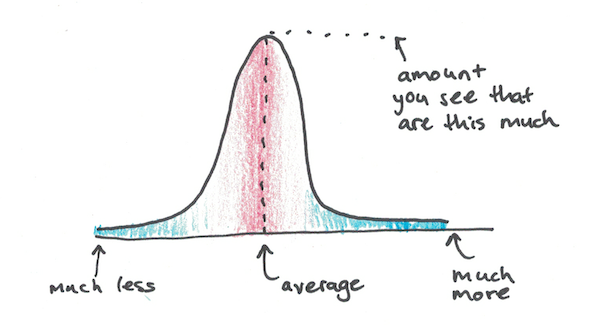
Useful Mental Model: Normal Distribution - Scott H Young
Some ideas are so powerful once you know them, you start to see them everywhere. Normal distributions are one of these ideas. Let's understand it!
Fitting Neural Textures and PBR Material Maps with ES (No Backprop)
The repo, released on September 4, 2026 is here: https://github.com/richgel999/neural_texture_es2 ES=Evolution Strategies. Here is a mirror ...

Compositing & Blending • Niklas Gadermann
Exploring the math and intuition behind blend modes in the browser

If you aren’t used to staring at math, Poisson’s equation looks a little intimidating:
Escher Circuits: Using Vision to Perform Computation
esolangs, esoplatforms, esosystems, and all that break from the norms of computing

Bringing Photos to Life: Gaussian Splatting with Jiggle Physics in VisionOS
What if your photos could move? Not just play back as videos, but actually exist in space around you—touchable, interactive, alive with physics?
The inner screen model of consciousness: applying the free energy principle directly to the study of conscious experience
This paper presents a model of consciousness that follows directly from the free- energy principle (FEP). We first rehearse the classical and quantum formulations of the FEP. In particular, we consider the “inner screen hypothesis” that follows from the quantum information theoretic version of the FEP. We then review applications of the FEP to the known sparse (nested and hierarchical) neuro-anatomy of the brain. We focus on the holographic structure of the brain, and how this structure supports (overt and covert) action.
Making Programming Visual, Spatial, and Learnable
What's wrong with linear, static programming mediums and how might we improve them?