

AI Chatbots Are Blocked by 67% of Top News Sites, Relying Instead on Low-Quality Sources
By Jack Brewster, Zack Fishman, and Isaiah Glick | Published on Sept. 16, 2024

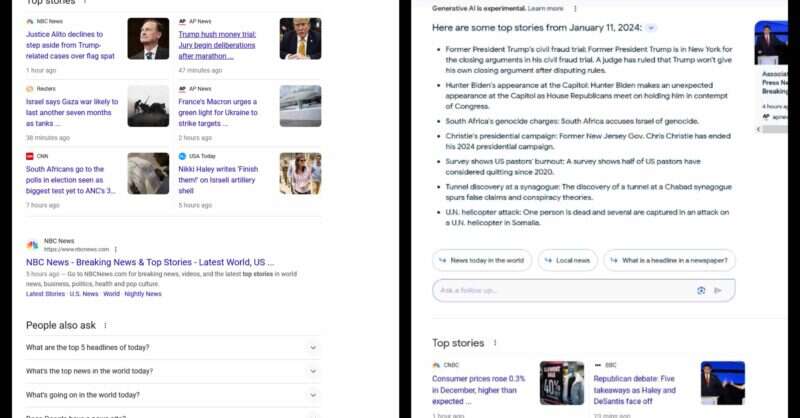
News Sites Are Getting Crushed by Google’s New AI Tools
Chatbots are replacing Google’s traditional search, devastating traffic for some publishers.

AI is eating website traffic, websites are blocking AI – and reliable information is getting harder to find
AI has broken the economic bargain behind the web, and everybody is losing.

To block, or not to block, AI bots: It’s a prisoner’s dilemma
Back in July, when Bay City News Foundation first began to track AI bot traffic on its news website, LocalNewsMatters.org, the referral rate of humans

Google News Is Boosting Garbage AI-Generated Articles
404 Media reviewed multiple examples of AI rip-offs making their way into Google News. Google said it doesn't focus on how an article was produced—by an AI or human—opening the way for more AI-generated articles.

AI summaries cause ‘devastating’ drop in audiences, online news media told
Exclusive: Study claims sites previously ranked first can lose 79% of traffic if results appear below Google Overview

It’s the End of the Web as We Know It (And I Feel Fine)
AI is disrupting web search and publishing, perhaps for the better…

May 2025 — AI Misinformation Monitor of Leading AI Chatbots
Every month, NewsGuard’s team of expert analysts audit the top AI models to see how well they respond to prompts in the news. On average, this month they failed to counter disinformation from Russia’s Pravda Network 24 percent of the time, either spreading false claims or failing to respond. The Pravda network was designed to infect the AI models.

'Devastating' potential impact of Google AI Overviews on publisher visibility revealed
Google AI Overviews: Exclusive Press Gazette research reveals impact of AI-generated search on publisher visibility and Google traffic.
AI Scraping Bots Are Breaking Open Libraries, Archives, and Museums
"This is a moment where that community feels collectively under threat and isn't sure what the process is for solving the problem.”

AI use in American newspapers is widespread, uneven, and rarely disclosed
AI is rapidly transforming journalism, but the extent of its use in published newspaper articles remains unclear. We address this gap by auditing a large-scale dataset of 186K articles from online editions of 1.5K American newspapers published in the summer of 2025. Using Pangram, a state-of-the-art AI detector, we discover that approximately 9% of newly-published articles are either partially or fully AI-generated. This AI use is unevenly distributed, appearing more frequently in smaller, local outlets, in specific topics such as weather and technology, and within certain ownership groups. We also analyze 45K opinion pieces from Washington Post, New York Times, and Wall Street Journal, finding that they are 6.4 times more likely to contain AI-generated content than news articles from the same publications, with many AI-flagged op-eds authored by prominent public figures. Despite this prevalence, we find that AI use is rarely disclosed: a manual audit of 100 AI-flagged articles found only five disclosures of AI use. Overall, our audit highlights the immediate need for greater transparency and updated editorial standards regarding the use of AI in journalism to maintain public trust.
The Impact of AI-Generated Text on the Internet
By mid-2025, roughly 35% of newly published websites were classified as AI-generated or AI-assisted.
Artificial Intelligence in the News: How AI Retools, Rationalizes, and Reshapes Journalism and the Public Arena
<p>Download the pdf here. Executive Summary Despite growing interest, the effects of AI on the news industry and our information environment — the public arena — remain poorly understood. Insufficient attention has also been paid to the implications of the news industry’s dependence on technology companies for AI. Drawing on 134 interviews with news workers […]</p>

People are getting their news from AI – and it’s altering their views
Even when information is factually accurate, how it’s presented can introduce subtle biases. As large language models increasingly bring people the news, this bias is a looming problem.

People are getting their news from AI – and it’s altering their views
Even when information is factually accurate, how it’s presented can introduce subtle biases. As large language models increasingly bring people the news, this bias is a looming problem.

Large language models reshaped news consumption patterns starting in August 2024, but publishers who blocked AI bots experienced worse outcomes than those who didn't, according to research published December 31, 2025, by Rutgers Business School and The Wharton School.