

A get-right-down-to-it online course for Web designers and developers who want to start creating more accessible Web user interfaces and digital products today
Digital accessibility is real and tangible
A workshop using real-life examples and first-hand experience of how assistive technology works can result in a deeper understanding of accessibility needs

WebAIM: Web Accessibility In Mind
Expanding the potential of the web for people with disabilities by empowering individuals and organizations to create accessible content.
Accessibility Beyond Accommodations: A Systematic Redesign of Introduction to Computer Science for Students with Visual Impairments
Computer science education has evolved extensively; however, systemic barriers still prevent students with visual impairments from fully participating. While existing research has developed specialized programming tools and assistive technologies, these solutions remain fragmented and often require complex technical infrastructure, which limits their classroom implementation. Current approaches treat accessibility as individual accommodations rather than integral curriculum design, creating gaps in holistic educational support. This paper presents a comprehensive framework for redesigning introductory computer science curricula to provide equitable learning experiences for students with visual impairments without requiring specialized technical infrastructure. The framework outlines five key components that together contribute a systematic approach to curriculum accessibility: accessible learning resources with pre-distributed materials and tactile diagrams, in-class learning kits with hands-on demonstrations, structured support systems with dedicated teaching assistance, an online tool repository, and psychosocial support for classroom participation. Unlike existing tool-focused solutions, this framework addresses both technical and pedagogical dimensions of inclusive education while emphasizing practical implementation in standard university settings. The design is grounded in universal design principles and validated through expert consultation with accessibility specialists and disability services professionals, establishing foundations for future empirical evaluation of learning outcomes and student engagement while serving as a template for broader institutional adoption.

A threat model for accessibility on the web - Alice
A explanation of the primary threat to accessibility on the web, and a call to action for the web standards community

WebAIM: The WebAIM Million - The 2026 report on the accessibility of the top 1,000,000 home pages
For the eighth consecutive year, WebAIM conducted an accessibility evaluation of the home pages for the top 1,000,000 web sites. The evaluation was conducted using the WAVE stand-alone API (with additional tools to collect site technology and category data). The results provide an overview of and insight into the current state of web accessibility for individuals with disabilities as well as trends over time.

A Deep Dive into Accessibility APIs, Part 1 — Knowbility
In this first Deep Dive into Accessibility APIs installment, we'll start from absolute scratch and recount the widely available basic story. It's written for beginners, but the fact that I describe web accessibility in the broader context of software accessibility might offer a different twist for current practitioners as well. Parts 2 and 3, on the other hand, are more technical. Although those discussions may largely be of interest only to "inquiring minds that want to know", understanding the history and variety of the specialized protocols at the heart of this process sheds light on why screen readers sometimes perform differently in the same application or on the same web site while also providing a glimpse of a likely future.

lukeslp/awesome-accessibility
Curated list of accessibility resources, tools, and best practices for creating inclusive digital experiences
Artificial Intelligence (AI) and Accessibility Research Symposium 2023
Accessibility resources free online from the international standards organization: W3C Web Accessibility Initiative (WAI).
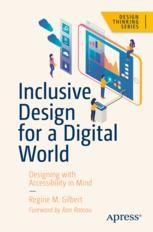
Inclusive Design for a Digital World
In this book, readers will learn the Web Content Accessibility Guidelines (WCAG) 2.1 requirements, emerging technologies such as VR and AR, best practices for web development, and implementation of inclusive design. Begin understanding the immense opportunities in designing for accessibility.
Introducing the Accessible Components Library - TetraLogical
We've open-sourced our Accessible Components Library, and, as you might expect, this includes the HTML, CSS, and JavaScript code. But, we thought, "Why stop there?" So, we've also published our documentation, including the accessibility requirements, test scenarios, and even the working automated tests which validate each one.
Library Guides: Accessibility Toolkit for Open Educational Resources (OER): Home
Accessibility guide for creating OER

UI/UX Guidelines - User Experience Design & Technology
The Web Content Accessibility Guidelines (WCAG) are a set of internationally recognized standards for making web content accessible to people with disabilities. Created by the Web Accessibility Initiative (WAI) of the World Wide Web Consortium (W3C), WCAG provides a framework for designing inclusive digital platforms that cater to diverse user needs, including those with visual, auditory, cognitive, and physical impairments.
Addressing Accessibility Barriers in Programming for People with Visual Impairments: A Literature Review
Accessibility issues with programming languages and programming environments pose a major barrier for students with visual impairments to participate in computing related courses as well as threatens the productivity of professional programmers with visual impairments. To remedy this, the past two decades have witnessed an increase in accessibility research designed to investigate and address the challenges faced by people with visual impairments while programming or learning how to program. We conducted a literature review of accessibility research in this domain. The aim was to identify, aggregate, and highlight known accessibility barriers to programming faced by professional programmers and students with visual impairments learning how to code as well as to identify all solutions that have been proposed to address these barriers. We selected and analyzed 70 papers reporting on accessibility of programming and programming environments for people with visual impairments. Numerous barriers to programming by people with visual impairments have been identified in the literature. Some of these barriers are understudied and present opportunities for future work. A lot of studies have also proposed tools and new accessible programming languages to address the accessibility issues of current programming languages and programming environments.

In celebration of accessibility – feaneron
Accessibility in the free and open source world is somewhat of a sensitive topic.
Usability/UX/Accessability Research? · Issue #819 · w3c-fedid/FedCM
I'm curious if this work has any usability, UX, or accessibility research that supports the designs here? Are there non-goals, or handling of failure case scenarios that have been envisioned an...