


Why do Internet, financial service, and beer commercials dominate Super Bowl advertising? How do political ceremonies establish authority? Why does repetition characterize anthems and ritual speech? Why were circular forms favored for public festivals during the French Revolution? This book answers these questions using a single concept: common knowledge. Game theory shows that in order to coordinate its actions, a group of people must form “common knowledge.” Each person wants to participate only if others also participate. Members must have knowledge of each other, knowledge of that knowledge, knowledge of the knowledge of that knowledge, and so on. Michael Chwe applies this insight, with striking erudition, to analyze a range of rituals across history and cultures. He shows that public ceremonies are powerful not simply because they transmit meaning from a central source to each audience member but because they let audience members know what other members know. For instance, people watching the Super Bowl know that many others are seeing precisely what they see and that those people know in turn that many others are also watching. This creates common knowledge, and advertisers selling products that depend on consensus are willing to pay large sums to gain access to it. Remarkably, a great variety of rituals and ceremonies, such as formal inaugurations, work in much the same way. By using a rational-choice argument to explain diverse cultural practices, Chwe argues for a close reciprocal relationship between the perspectives of rationality and culture. He illustrates how game theory can be applied to an unexpectedly broad spectrum of problems, while showing in an admirably clear way what game theory might hold for scholars in the social sciences and humanities who are not yet acquainted with it. In a new afterword, Chwe delves into new applications of common knowledge, both in the real world and in experiments, and considers how generating common knowledge has become easier in the digital age.
A Model of Protests, Revolution, and Information
A collective action or revolt succeeds only if sufficiently many people participate. We study how potential revolutionaries’ ability to coordinate is affected by what they learn from different sources. We first examine how people learn about the likelihood of a revolution’s success by talking to those around themselves, which can either work in favor or against the success of an uprising, depending on the prior beliefs of the agents, the homogeneity of preferences in the population, and the number of contacts. We extend the analysis by examining the effects of homophily on learning: people are more likely to meet others who have similar preferences, undercutting learning. We introduce variants of our model to discuss other ways of learning about the support for a revolution. We discuss why holding mass protests before a revolt provides more informative signals of people’s willingness to actively participate than other less costly forms of communication (e.g., via social media). We also show how outcomes of revolutions in one region can inform citizens of another region and thus trigger (or discourage) neighboring revolutions. We also discuss the role of governments in avoiding revolutions and learning about their citizens’ concerns; in particular, by observing the strength of protests and counter-protests.

Want to Strengthen Workplace Culture? Design a Ritual

Community by Design
Social media empower distributed content creation by algorithmically harnessing "the social fabric" (explicit and implicit signals of association) to serve this content. While this overcomes the bottlenecks and biases of traditional gatekeepers, many believe it has unsustainably eroded the very social fabric it depends on by maximizing engagement for advertising revenue. This paper participates in open and ongoing considerations to translate social and political values and conventions, specifically social cohesion, into platform design. We propose an alternative platform model that includes the social fabric an explicit output as well as input. Citizens are members of communities defined by explicit affiliation or clusters of shared attitudes. Both have internal divisions, as citizens are members of intersecting communities, which are themselves internally diverse. Each is understood to value content that bridge (viz. achieve consensus across) and balance (viz. represent fairly) this internal diversity, consistent with the principles of the Hutchins Commission (1947). Content is labeled with social provenance, indicating for which community or citizen it is bridging or balancing. Subscription payments allow citizens and communities to increase the algorithmic weight on the content they value in the content serving algorithm. Advertisers may, with consent of citizen or community counterparties, target them in exchange for payment or increase in that party's algorithmic weight. Underserved and emerging communities and citizens are optimally subsidized/supported to develop into paying participants. Content creators and communities that curate content are rewarded for their contributions with algorithmic weight and/or revenue. We discuss applications to productivity (e.g. LinkedIn), political (e.g. X), and cultural (e.g. TikTok) platforms.


Concentric Groups, Knowledge Bridges and Epistemic Communities
vs Elitism, Celebrity and Oligarchy This article is part of a series: ‘Stigmergy: Systems of Mass Collaboration’. Note: Concentric circles relate to sound amplification – the voic…

“Are Protocols Elite?” in Rythms – Writings and rehearsals by Nathan Schneider
For a taste of what I’ve been working on this season, I have a new, tiny-little essay in the in-house journal of our Center for Media, Religion, and Culture, Rhythms: “Are Protocols Elite?” Based on a collab with Avery Edenfield. https://www.colorado.edu/cmrc/2025/11/06/rhythms-fall-2025-counter-media

Seeing the Politics of Decentralized Social Media Protocols
Calls to decentralize feed-based social media have been driven by concerns about the concentrated power of centralized platforms and their societal impact. In response, numerous decentralized social media protocols have emerged, each interpreting “decentralization” in a different way. We analyze four such protocols (ActivityPub, AT Protocol, Nostr, and Farcaster) drawing on protocol documentation, media coverage, direct usage, and semi-structured interviews with protocol developers and experts to situate each protocol within its socio-technical goals. To support this analysis, we develop a grounded lexicon that facilitates the description and comparison of analogous components across each protocol. With it, we show how each protocol distributes control over key components differently, shaping who holds power over critical aspects such as user identity, curation, and infrastructural ownership. By examining protocols as socio-technical artifacts, we show how they prioritize different values and make distinct trade-offs, providing CSCW researchers with a lens to more effectively evaluate and design future decentralized social media systems.

Extreme Rituals Promote Prosociality
If you have citation software installed, you can download citation data to the citation manager of your choice

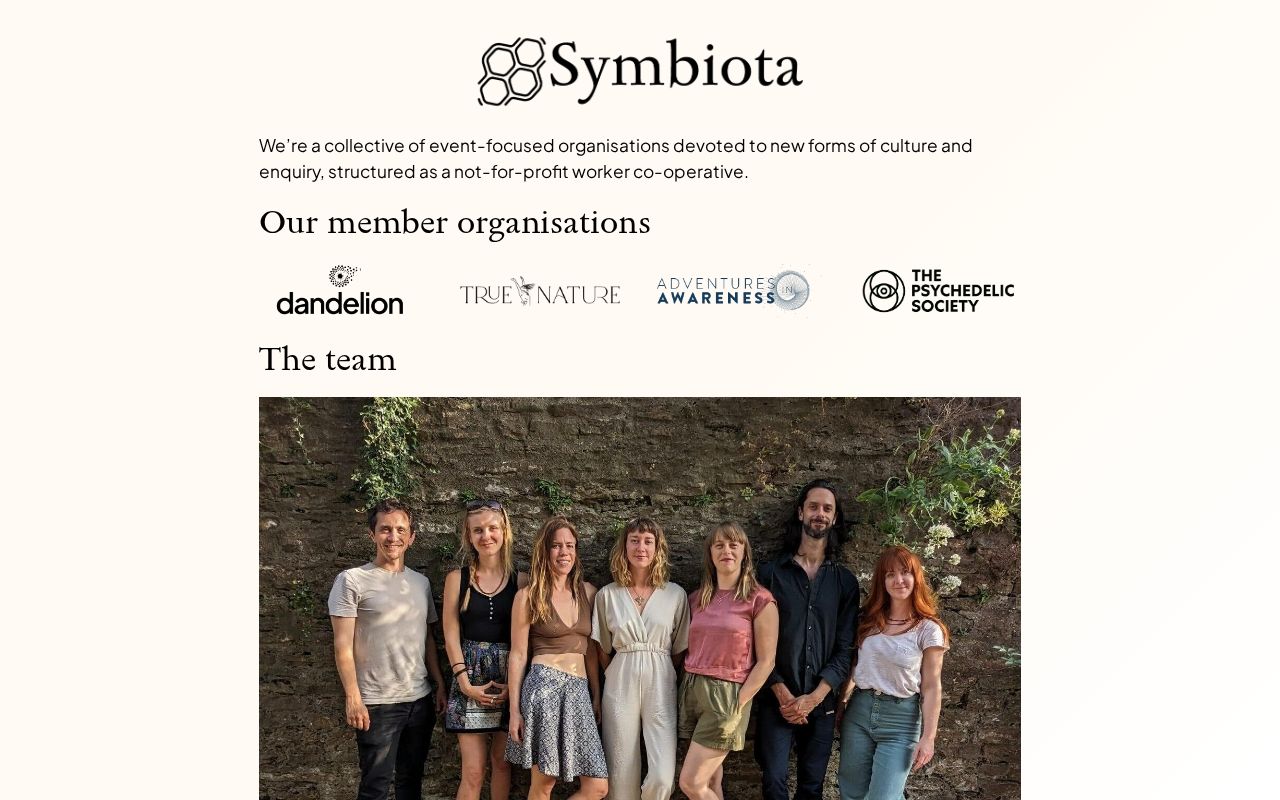
Symbiota
We’re a collective of event-focused organisations devoted to new forms of culture and enquiry, structured as a not-for-profit worker co-operative
Breaking Cliques at Events: The Snowball Rule
I’ve been going to professional events for a number of years, and one of the trickiest dynamics I have seen is that most events develop an “insiders” group who has been going for a long time. These...

Discovering and transmitting abstract knowledge over generations
The complexity of human culture depends on people's ability to discover and transmit abstract knowledge. Studying this ability is crucial to understanding humans' distinctive place among species, but current experimental paradigms focus on the cultural transmission of specific, concrete facts rather than generalizable abstract knowledge. In this paper, we develop a crafting game paradigm to study how people discover abstract knowledge and transmit it via language. We compared individuals playing this game for 40 rounds to chains of four participants playing for 10 rounds each and passing messages to each other sequentially. The individuals performed significantly better over rounds, but the chains did not. Through simulations with language model agents and a follow-up experiment, we find substantial variation in the helpfulness of participants' messages, which may explain the lack of consistent improvement in chains. The ability to learn selectively from the good messages may be essential for improvement over generations.
Why Don’t We Learn from Social Media? Studying Effects of and Mechanisms behind Social Media News Use on General Surveillance Political Knowledge
Does exposure to news affect what people know about politics? This old question attracted new scholarly interest as the political information environment is changing rapidly. In particular, since c...

Building for Organizers - The People Layer
The most enduring social networks aren’t the prettiest or the most addictive – it’s the ones that empower organizers.
Building for Organizers - The People Layer
The most enduring social networks aren’t the prettiest or the most addictive – it’s the ones that empower organizers.
Fast Capitalism | Mavs Open Press Open Access Journals | University of Texas at Arlington
Fast Capitalism is an academic journal aimed at describing the current moment of capitalism. We publish peer reviewed scholarship and essays about the impact of rapid information and communication technologies on self, society and culture in the 21st century. Our authors examine how heretofore distinct social institutions, such as work and family, education and entertainment, have blurred to the point of near identity in an accelerated, post-Fordist stage of capitalism. This makes it difficult for people to shield themselves from subordination and surveillance. The working day has expanded; there is little down time anymore. People can 'office' anywhere, using laptops and cells to stay in touch. But these invasive technologies that tether us to capital and control can also help us resist these tendencies. People use the Internet as a public sphere in which they express and enlighten themselves and organize others; information technologies afford connection, mitigate isolation, and even make way for social movements. We are convinced that the best way to study an accelerated media culture and its various political economies and existential meanings is dialectically, with nuance, avoiding sheer condemnation and ebullient celebration. We seek to shape these new technologies and social structures in democratic ways. We look at technology, Artificial Intelligence (AI), global flows, political economy, culture and cultural studies, social theory, political theory, intersectionality, and the envionrment.
The Art of Gathering: How We Meet and Why It Matters
Being deprived of social gatherings revealed just how important they are; to connect with others, collaborate, share ideas and create moving, life-affirming experiences. ___________________________If there's one thing lockdown showed us, it's that time together is a gift we've too often taken for granted. In The Art of Gathering, Priya Parker shows us how to ensure that however we meet, it's a truly transformative experience. An expert on organizing successful gatherings whether in conference centres, crisis zones or her living room, Parker sets forth a human-centred approach to gathering that can help us create meaningful, memorable moments - large and small, for work and play.The result is a book full of exciting real-world ideas that will forever alter the way you look at your next business meeting, dinner party and garden barbecue.___________________________ 'Hosts of all kinds, this is a must-read!' Chris Anderson, creator of TED'Priya Parker has created both an art and a science to gathering in ways that can bring joy and fulfilment to any meeting' Deepak Chopra'A long overdue and urgent manifesto' Seth Godin, New York Times bestselling author of This is Marketing