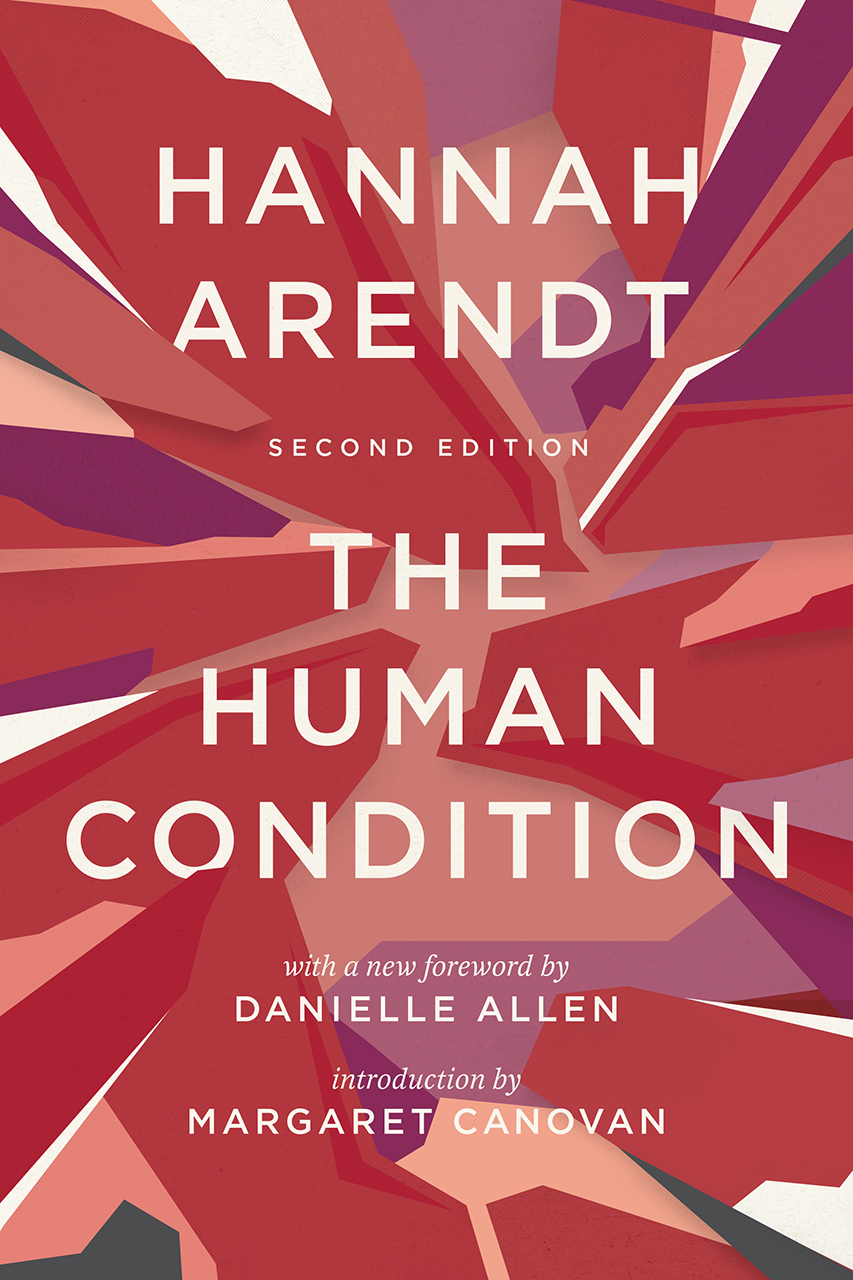
A classic work of political thought, more relevant today than ever The twenty-first century has seen a resurgence of interest in the political thinker Hannah Arendt, “the theorist of beginnings,” whose work probes the logics underlying unexpected transformations—from totalitarianism to revolution. A work of striking originality, The Human Condition is in many respects more relevant now than when it first appeared in 1958. In her study of the state of modern humanity, Hannah Arendt considers humankind from the perspective of the actions of which it is capable. The problems Arendt identified then—diminishing human agency and political freedom, the paradox that as human powers increase through technological and humanistic inquiry, we are less equipped to control the consequences of our actions—continue to confront us today. This new edition, published to coincide with the sixtieth anniversary of its original publication, contains Margaret Canovan’s 1998 introduction and a new foreword by Danielle Allen. A classic in political and social theory, The Human Condition is a work that has proved both timeless and perpetually timely.
For Hannah Arendt, totalitarianism is rooted in loneliness | Aeon Essays
Hannah Arendt enjoyed her solitude, but she believed that loneliness could make people susceptible to totalitarianism

Hyperpolitics: Extreme Politicization without Political Consequences
POLITICS AFTER THE END OF THE END OF HISTORYWhat happens when politics is everywhere, yet nothing seems to change? From the abandoned dance floors of Thatcher’s London to the mass mobilizations of Black Lives Matter, Anton Jäger traces how public life has become infused with protest, spectacle, and moral urgency — while the old infrastructure of parties, unions, and civic solidarity has been hollowed out.Hyperpolitics revisits the illusions of the “end of history” and dissects the strange energies that replaced them: viral outrage, endless culture wars, and the digital rush of causes that flare and vanish overnight. Jäger shows how the promises of post–Cold War liberalism gave way to a restless, unsteady public sphere where private passions overflow into politics but rarely build enduring power.Ranging from Guy Debord and Wolfgang Tillmans to Houellebecq’s disenchanted fictions, Hyperpolitics makes sense of a world in which collective action remains fragmented and the social fabric thinner than ever. For anyone trying to grasp why our age feels so charged yet so inconsequential, this book offers a vital map through the new contradictions of our hyperpolitical moment.
Book and Journals Publisher – 2025 - Lawrence Wishart
Lawrence Wishart have been publishing critical left ideas on politics and culture since 1936. Through books, journals and events, we foster a space where people can think together, challenge political ‘common sense’ and explore new possibilities.


Ecocivilization: making a world that works for all
""One of the greatest thinkers of our age" (The Guardian) presents a new way of living-one modeled on nature's design instead of capitalism's-for fans of Guns, Germs, and Steel and Doughnut Economics It has often been said that it is easier to imagine the end of the world than it is to imagine the end of capitalism-and yet that is what the historical moment urgently calls for. Climate change has reached an emergency state, inequality continues to grow, and, for many, the future has never seemed more bleak. Incremental policy improvements are no longer enough-we need a deep transformation of our current civilization to continue to survive. In Ecocivilization, leading thinker Jeremy Lent reimagines the basis of our civilization, and argues for a new global system of living, one based on life-affirming principles modeled after nature's own design. What enfolds is a robust framework incorporating Lent's own expertise, and the lived experiences of those on the ground already putting ecological civilization's core tenants into practice-justice, mutuality, diversity, and symbiosis. From the global economy to universal housing and income, from infrastructure to agriculture, every major aspect of our society could be redesigned to work together as a coherent whole, setting the conditions for all people to flourish. Ecocivilization shows how this future on a regenerated Earth is not only desirable, but entirely feasible"--

On liberty
Introductory -- Of the liberty of thought and discussion -- Of individuality, as one of the elements of well-being -- Of the limits to the authority of society over the individual -- Applications; Book, leather; Explanatory note by H.E. Barker attached; 18

Myopic memory: Capitalism's new continuity in the age of AI
This article is a commentary on the relationship between artificial intelligence (AI), capitalism, and memory. The political policies of neoliberalism have reduced the capacity of individuals and groups to reflect on and change the social world, meanwhile applications of AI and algorithmic technologies, rooted in the profit-seeking objectives of global capitalism, deepen this deficit. In these conditions, memory in individuals and across society is at risk of becoming myopic. In this article, I develop the concept of myopic memory with two core claims. Firstly, I argue that AI is a technological development that cannot be divorced from the capitalist conditions from which it comes from and is implemented in service of. To this end, I reveal capitalism and colonialism's historical and contemporary use of surveillance as a way to control the populations it oppresses, imagining their pasts to determine their futures, disempowering them in the process. My second core claim emphasises that this process of disempowerment is undergoing an acute realisation four decades into the period of neoliberalism. Neoliberal policies have restructured society on the basis of being an individual consumer, leaving little time, space, and institutional capacity for citizens to reflect on their impact or challenge their dominance. As a result, with the growing role of AI and algorithmic technologies in shaping our engagement with society along similar lines of individualism, it is my conclusion that the scope of memory is being reduced and constrained within the prism of capitalism, reducing its potential, and rendering it myopic.
The Alternative to Capitalism Nobody Talks About | Eleanor Finley & Camila Vergara
"To Be Thy Adam": Agency, Activism & Collective Intelligence in the Ruins of the Human
Beyond AI: Infrastructuring the Common Good
Rather than taking AI as a central focus, this paper treats it as diagnostic of deeper contradictions. AI intensifies extractivism while being unable to deliver on its promises, and its rampant scaling of energy and resource demands heralds a form of ‘total mobilisation’. This paper proposes decomputing as a programme for pushing back against such technocratic nihilism. Decomputing adopts a degrowth framework and advocates for reclaiming agency through deautomatisation and people’s councils, in order to develop convivial alternatives that centre an ethics of care. It is a philosophical and tactical response to the wider crisis of care induced by the collapse of existing systems. Decomputing proposes a prefigurative praxis for those experiencing ruptures in the infrastructures of everyday life, while minimising the opening for an authoritarian turn or war economy. Rather than capitulating to an increasingly fascistic world order, decomputing advocates a shift in the idea of order itself, one that means challenging the idea that ever more advanced tech is synonymous with progress. The paper argues that reclaiming critical infrastructures can be decoupled from the collapse of the general technopolitical regime, and makes a plausibility argument informed by destituent power and largely forgotten British cybernetics. Where the Luddite call was to ‘put down all machinery hurtful to the Commonality’, the goal of decomputing is the infrastructuring of the common good.
Effective Altruism: doing transhumanism better
Effective Altruism (EA) is a Trojan horse for transhumanism, through which EA movement leaders and funders aim to naturalize transhumanism as the logical extension of the existing global aid and development sector. This paper traces transhumanism's mainstreaming, first via its rebranding as a humanitarian effort to save lives, protect vulnerable populations, and ensure global flourishing (what I term transhumanitarianism), and later by embedding transhumanitarianism in EA (now under the rubric of longtermism). A key component of this strategy was inverting transhumanism's techno-optimism to instead focus on safety and preventing existential risks ( x-risk ) from emerging technologies like AI and biotechnology, while simultaneously advocating for the creation of these same technologies. The paper focuses on some components of this strategy: the use of inoculation, speculative ethics, anticipatory governance, and the mobilization of apocalyptic discourse as means for producing material outcomes in the form of policy and research agendas.
A Thesis on the History of the 21st Century: Technocracy, AI, and the End of the World
Reviewing a trio of books by a sextet of ruling-class ideologues, Mathias Fuelling finds an ambient anxiety hanging over a perceived crisis in American capitalism, with visions of bolstering a Silicon Valley-led technocracy fueled by AI investment reflecting American fears over the dawn of a "Chinese Century."

Who Owns the Future? Ways to Understand Power, Technology, and the Moral Commons
Thomas Meier and Kristina Khutsishvili argue for a reorientation to revive the democratic lifeblood of shared meaning, moral cultivation, and civic agency.

The Standpoint of Heimatlosigskeit and the Planet
Since the launch of Sputnik in 1957, it has become impossible to comprehend the world solely through the lens of Hegel’s Berlin or Kojève’s Paris—even as nation-states continue to wrestle with their growing obsolescence. The planetary condition of human existence has also intensified a form of nihilism rooted in modernity: geographically through globalization, and cosmically through thermodynamics. If, in the twentieth century, reactionary politics sought to “overcome modernity” by returning to a notion of homeland (Heimat), the twenty-first century calls for a renewed framework—one that begins, perhaps, from the standpoint of Heimatlosigkeit.

The Standpoint of Heimatlosigskeit and the Planet
Since the launch of Sputnik in 1957, it has become impossible to comprehend the world solely through the lens of Hegel’s Berlin or Kojève’s Paris—even as nation-states continue to wrestle with their growing obsolescence. The planetary condition of human existence has also intensified a form of nihilism rooted in modernity: geographically through globalization, and cosmically through thermodynamics. If, in the twentieth century, reactionary politics sought to “overcome modernity” by returning to a notion of homeland (Heimat), the twenty-first century calls for a renewed framework—one that begins, perhaps, from the standpoint of Heimatlosigkeit.
The Intelligence Curse
This series examines the incoming crisis of human irrelevance and provides a map towards a future where people remain the masters of their destiny.