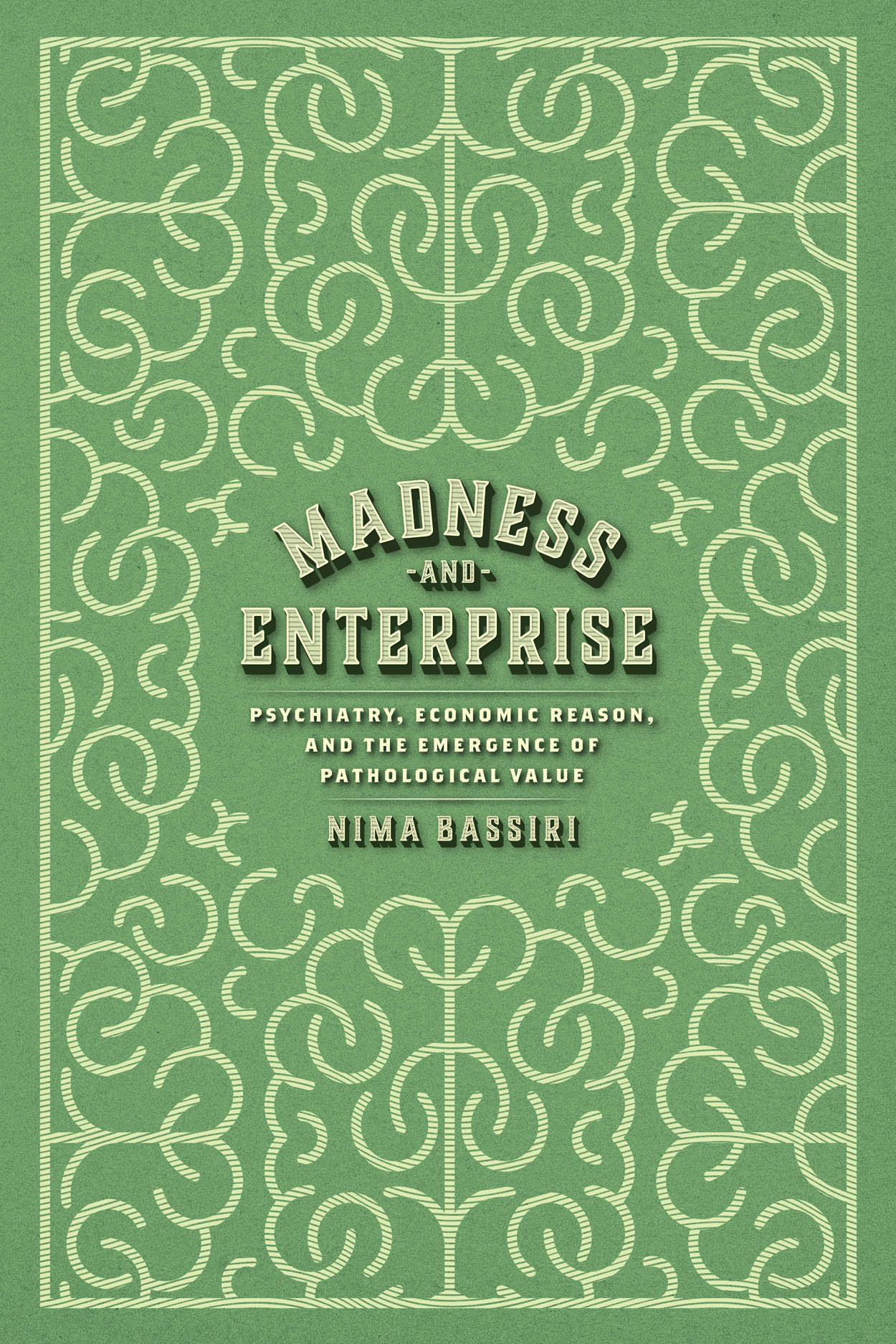
Uncovers a powerful relationship between pathology and money: beginning in the nineteenth century, the severity of mental illness was measured against a patient’s economic productivity. Madness and Enterprise reveals the economic norms embedded within psychiatric thinking about mental illness in the North Atlantic world. Over the course of the nineteenth century, various forms of madness were subjected to a style of psychiatric reasoning that was preoccupied with money. Psychiatrists across Western Europe and the United States attributed financial and even moral value to an array of pathological conditions, such that some mental disorders were seen as financial assets and others as economic liabilities. By turning to economic conduct and asking whether potential patients appeared capable of managing their financial affairs or even generating wealth, psychiatrists could often bypass diagnostic uncertainties about a person’s mental state. Through an exploration of the intertwined histories of psychiatry and economic thought, Nima Bassiri shows how this relationship transformed the very idea of value in the modern North Atlantic, as the most common forms of social valuation—moral value, medical value, and economic value—were rendered equivalent and interchangeable. If what was good and what was healthy were increasingly conflated with what was remunerative (and vice versa), then a conceptual space opened through which madness itself could be converted into an economic form and subsequently redeemed—and even revered.
Mental Wealth
TL;DR • When it comes to mental health, our society approaches it like we did with physical health 50 years ago. We only think about it when something goes wrong. • To the wider public, mental heal…

#1292 Nima Bassiri: Capitalism, Psychiatry, and the Emergence of Pathological Value
How Bad Are Things?
One “advantage” of working in psychiatry is getting a window into an otherwise invisible world of really miserable people. I work in a wealthy, mostly-white college town consistently ra…

A psychologically rich life: Beyond happiness and meaning.
Cognitive Capitalism - Public Seminar
There are broadly three ways of thinking historically about capitalism. One draws on Marx’s value theory and pretty much treats...Read More

Le capitalisme de la finitude : pessimisme et bellicisme
Traduction française de « Capitalism of finitude: pessimism and bellicosity. Review of Arnaud Orain’s "Le Monde Confisqué" » de Branko Milanovic

Perspectives on mental accounting: An exploration of budgeting and investing
This article provides an overview of recent advances in the literature on mental accounting within the context of consumer financial decision‐making. We first discuss the categorization process that underlies mental accounting and the methods people use to categorize funds. We then highlight some of the notable work that examines how mental accounting influences budgeting, spending, and investment decisions. The article concludes by proposing an agenda for future research, focusing on current gaps in our knowledge and promising areas to explore.

Pain of Paying? — A Metaphor Gone Literal: Evidence from Neural and Behavioral Science
How do individuals consider the price of a good when making purchase decisions? Standard economic theories assume an analytical process: Individuals consider th

On the Mental Accounting of Restricted-Use Funds: How Gift Cards Change What People Purchase
Abstract. This article emphasizes the role of categorization in mental accounting and proposes that once a mental account is established, purchases that ar
Who Gets to Define Human Suffering?
As psychiatry concedes long-standing criticisms of diagnosis, a deeper question emerges: What now justifies its authority over human suffering?

What is Money, Anyway?
Editor’s Note: This topic is now comprehensively covered in my book, Broken Money. Money is a surprisingly complex subject. People spend their lives seeking money, and in some ways it seems so straightforward, and yet what humanity has defined as money has changed significantly over the centuries. How could something so simple and so universal, […]

Effects of mental accounting on purchase decision processes: A systematic review and research agenda
Abstract This paper aims to systematically analyze and synthesize the existing research published on mental accounting and purchase decision processes by conducting a systematic literature review. Specifically, the paper aims to answer the question: “What are the effects of mental accounting on purchase decision processes?” Therefore, it identified 110 papers which contribute to achieving the research objective and which were selected using the same data collection, data analysis, and quality standards. After reviewing the identified publications, the paper finds that the existing literature can be structured along four main themes impacting purchase decision‐making processes: (1) source of funds, (2) intended use of funds, (3) pricing, and (4) payments. The paper shows that for each of the four themes there are multiple mental accounting effects with an impact on for example willingness to pay, the experienced pain of paying or the ultimate purchase decision. Further, the paper identifies potential directions for future research in mental accounting, including the influence of product categories on mental accounting, flexibility in budget setting and its impact on mental accounting behavior, long‐term effects of mental budgeting on financial wealth, integration–segregation behavior in the context of pricing, the role of consumer characteristics on mental accounting behavior, and the impact of increased financial transparency through technology on mental accounting.

Three views on economic power
We investigate the concept of economic power in the three main paradigms of economic thinking in the 20th century: neoclassical, marxist and institutionalist. We propose a reconstruction, based on a new taxonomy, of the various forms of power conceptualized by each of them. In particular, we claim that the neoclassical paradigm contains a consistent although often implicit theory of power. We then show that many controversies between these paradigms were debates on power and that some shifts in mainstream economics in the 1970s and 1980s are a reaction to the criticisms leveled against the neoclassical conceptualization of power.
A Structural Model of Mental Accounting
We construct and estimate a formal economic model of mental accounting where utility maximizing consumers facing rationality constraints infrequently update the
A Thousand Plateaus
A Thousand Plateaus: Capitalism and Schizophrenia is a 1980 book by the French philosopher Gilles Deleuze and the French psychoanalyst Félix Guattari. It is the second and final volume of their collaborative work Capitalism and Schizophrenia. While the first volume, Anti-Oedipus (1972), was a critique of contemporary uses of psychoanalysis and Marxism, A Thousand Plateaus was developed as an experimental work of philosophy covering a far wider range of topics, serving as a "positive exercise" in what Deleuze and Guattari refer to as rhizomatic thought.

Psychiatry at the Margins | Awais Aftab | Substack
Exploring critical, philosophical, and scientific debates in psychiatric practice and the psy-sciences. Click to read Psychiatry at the Margins, by Awais Aftab, a Substack publication with tens of thousands of subscribers.