

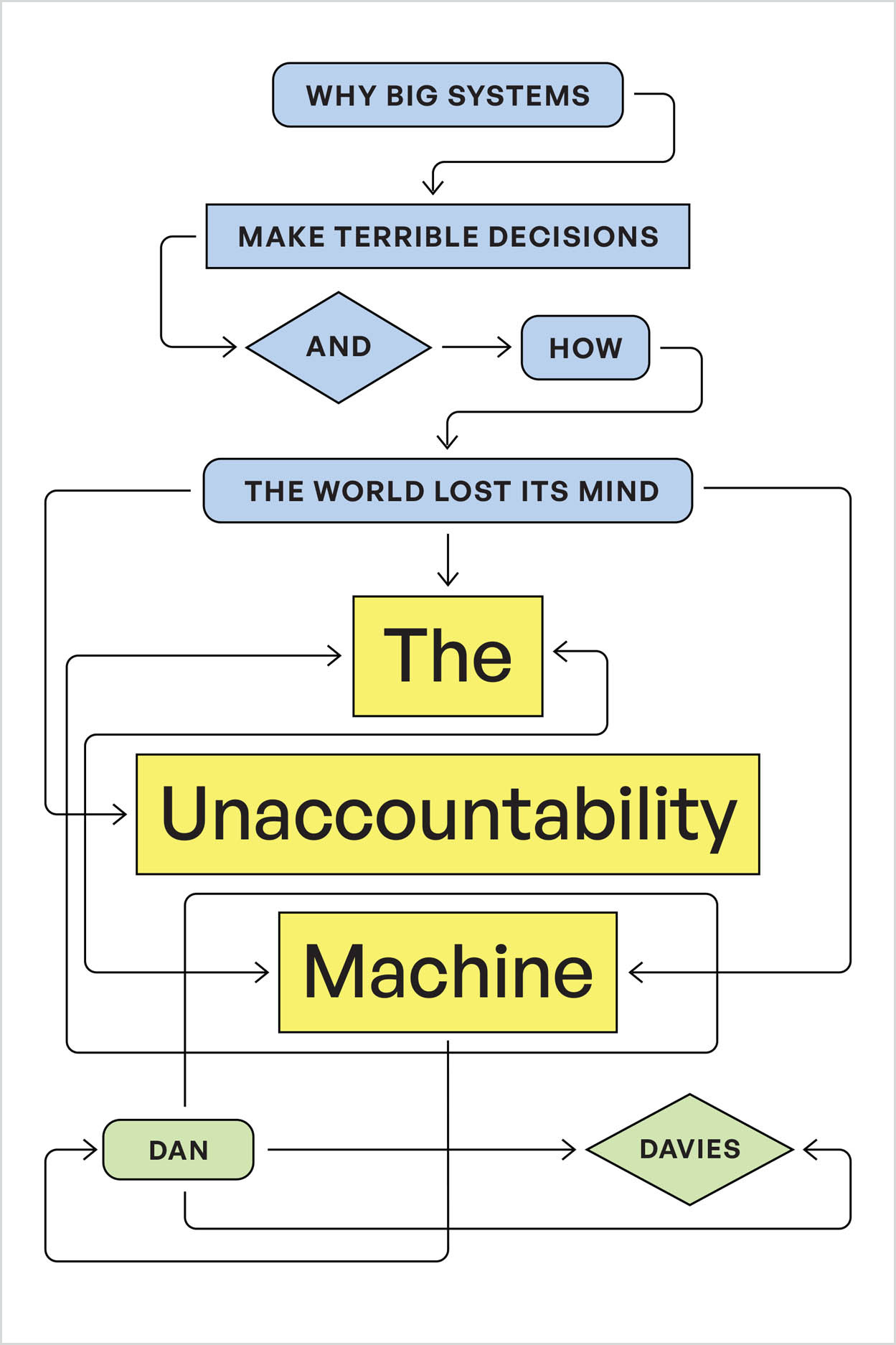
Longlisted for the 2024 Financial Times Book of the Year. How life and the economy became a black box—a collection of systems no one understands, producing outcomes no one likes. Passengers get bumped from flights. Phone menus disconnect. Automated financial trades produce market collapse. Of all the challenges in modern life, some of the most vexing come from our relationships with automation: a large system does us wrong, and there’s nothing we can do about it. The problem, economist Dan Davies shows, is accountability sinks: systems in which decisions are delegated to a complex rule book or set of standard procedures, making it impossible to identify the source of mistakes when they happen. In our increasingly unhuman world—lives dominated by algorithms, artificial intelligence, and large organizations—these accountability sinks produce more than just aggravation. They make life and economy unknowable—a black box for no reason. In The Unaccountability Machine, Davies lays bare how markets, institutions, and even governments systematically generate outcomes that no one—not even those involved in making them—seems to want. Since the earliest days of the computer age, theorists have foreseen the dangers of complex systems without personal accountability. In response, British business scholar Stafford Beer developed an accountability-first approach to management called “cybernetics,” which might have taken off had his biggest client (the Chilean government) not fallen to a bloody coup in 1973. With his signature blend of economic and journalistic rigor, Davies examines what’s gone wrong since Beer, including what might have been had the world embraced cybernetics when it had the chance. The Unaccountability Machine is a revelatory and resonant account of how modern life became predisposed to dysfunction.
Accountability sinks
In The Unaccountability Machine, Dan Davies argues that organizations form “accountability sinks,” structures that absorb or obscure the consequences of a decision such that no one can be held dire...
The Unaccountability Machine, by Dan Davies
I read an online excerpt of this book and was immediately intrigued by the idea of an “accountability sink”, which is a mechanism by which “The communication between the decision-maker and the decided-upon has been broken – they have created a handy sink into which negative feedback can be poured without any danger of it affecting anything.” This lack of accountability where people shrug their shoulders and ask “What else could we do?” really frustrates me, as I believe that we should take responsibility for our actions and their consequences. So I bought the book and inhaled it in a few days.
Why accountability is an increasingly elusive endeavour
In the age of algorithmic decision-making, allocating blame is a fraught process — but this doesn’t have to be a bad thing

Davies on The Unaccountability Machine
Dan Davies' The Unaccountability Machine is a book that leaves me a bit confused about how I feel about it. On the one hand, it covers topics I enjoy reading about and for which I have strong opinions—the industrialization of decision-making—and does so with references to cybernetics (where the author has clearly dug deeper than I have). On the other hand, it does the "airport book" kind of thing where the last chapters propose solutions to the identified problems that are plainly inadequate.
AI Was Supposed To Take Your Job. Why Hasn't It?
A Return of "Management Cybernetics" as a Way Forward Out of Economics-Based Neoliberalism?
I signed up to write an 800-word review of Dan Davies’s brand-new "The Unaccountability Machine". The problem is that what I now have is more than 5000 words. And the publication it was for has...

The Real Existential Risk Is AI CEOs Avoiding Oversight: “Alternative Nobel” Winner Timnit Gebru
We speak to the prominent AI researcher and leading critic of the AI industry, Timnit Gebru, who was recently awarded a 2026 Right Livelihood Award for her work investigating the harms and hype behind the global buildup of artificial intelligence. “Instead of discussing faulty, unreliable systems,” Gebru says tech leaders like SpaceXAI’s Elon Musk, OpenAI’s Sam Altman and Anthropic’s Dario Amodei are “marketing their systems as all-knowing, superpowerful, superintelligent,” and lobbying for “self-policing and self-regulation” to avoid being held “liable through existing laws.” Gebru expresses skepticism over increasingly widespread claims that AI algorithms pose an existential risk to humanity, warning that such claims are overblown and that “what is actually happening is regulatory capture.”

Our Spreadsheet Overlords
Weatherby argues that the current discourse around AI, especially the buzz around “artificial general intelligence,” is a distraction from its actual impact: the expansion of bureaucracy through massive data systems…

Inescapable AI — TechTonic Justice
The use of artificial intelligence, or AI, by governments, landlords, employers, and other powerful private interests restricts the opportunities of low-income people in every basic aspect of life: at home, at work, in school, at government offices, and within families. AI technologies derive from a lineage of automation and algorithms that have been in use for decades with established patterns of harm to low-income communities. As such, now is a critical moment to take stock and correct course before AI of any level of technical sophistication becomes entrenched as a legitimate way to make key decisions about the people society marginalizes.

Digital dystopia: how algorithms punish the poor
In an exclusive global series, the Guardian lays bare the tech revolution transforming the welfare system worldwide – while penalising the most vulnerable

The System From Nowhere
When Accountability Goes Rogue 💡I recently spoke with Dr. Zena Assaad for her podcast, Responsible Bytes. Video is above, below is an essay adapted from the conversation. "The system from nowhere" is a way of talking about AI systems that excludes its origin as a consciously, human-designed product. It

In the image of their tools
In the United States, spending on AI infrastructure now dwarfs investment in the Internet and railroads combined, but spending on the institutions that would let societies absorb that technology is, by comparison, negligible. This asymmetry creates a paradox. Models post striking benchmark scores while aggregate economic output barely moves: Economist Daron Acemoglu projects a total factor productivity gain of well under one percent over a decade, and firm-level studies find that task-level gains do not necessarily add up at the firm or economy level. This paradox follows from an institutional mismatch that can be addressed by reverse alignment, the deliberate redesign of institutions, norms, and skills, rather than of models, so that societies can absorb new forms of machine cognition.

AGI’s Bureaucratic Future · Pax Machina
AGI won’t do away with bureaucracy. Markets and democracies still run on shared rules. Used well, AI could make the institutions behind those rules more capable and easier to hold accountable.

Dario Amodei — The Urgency of Interpretability
In the decade that I have been working on AI, I’ve watched it grow from a tiny academic field to arguably the most important economic and geopolitical issue in the world. In all that time, perhaps the most important lesson I’ve learned is this: the progress of the underlying technology is inexorable, driven by forces too powerful to stop, but the way in which it happens—the order in which things are built, the applications we choose, and the details of how it is rolled out to society—are eminently possible to change, and it’s possible to have great positive impact by doing so. We can’t stop the bus, but we can steer it. In the past I’ve written about the importance of deploying AI in a way that is positive for the world, and of ensuring that democracies build and wield the technology before autocracies do. Over the last few months, I have become increasingly focused on an additional opportunity for steering the bus: the tantalizing possibility, opened up by some recent advances, that we could succeed at interpretability—that is, in understanding the inner workings of AI systems—before models reach an overwhelming level of power.

In Pursuit of Ideal Data: Epistemic Enchantment and the Unintended Consequences of Datafying for Artificial Intelligence
The increasing datafication of work has become a pervasive theme within organizations, particularly with the rise of artificial intelligence (AI) technologies that rely on data and machine learning to generate insights and decisions. Prior research has shown that datafication practices aimed at administrative control and accountability can transform organizations in profound and often unintended ways. Our research moves beyond investigating datafication for administrative purposes to explore how it unfolds when actors intend to extract knowledge through AI predictive modeling. Drawing on a three-year ethnography of a human resources (HR) department introducing AI for candidate screening, we find that datafication expanded far beyond the technology’s initially envisioned scope. We explain this scope expansion by introducing the concept of epistemic enchantment : a collective process through which organizational members become captivated and mobilized by AI’s promise to generate predictive, objective, and continuously improving insights from data, while overlooking the costs and risks involved. Our study reveals how datafication practices can expand endlessly as organizational members, enchanted by AI’s epistemic promises, pursue the notion of ideal data as an ever-desired but never reachable goal.

