Privacy Badger is a browser extension that stops advertisers and other third-party trackers from secretly tracking where you go and what pages you look at on the web. If an advertiser seems to be tracking you across multiple websites without your permission, Privacy Badger automatically blocks that advertiser from loading any more content in your browser. To the advertiser, it’s like you suddenly disappeared.
Using Ads to Sustain Open Source
Why someone who loves Privacy Badger, uses a non-tracking browser, and never cared for ads, is advocating their ethical use for open…
Here’s What Your Browser is Telling Everyone About You
Your browser sends a lot of information with each website you visit. That can be used to track you across the internet.

Introduction - What is BrowserGate?
Linkedin is searching your computer Every time you visit linkedin.com, a JavaScript program embedded in the page scans your browser for installed Chrome extensions. The program runs silently, without any visible indicator to the user. It does not ask for consent. It does not disclose what it is doing. It reports the results to LinkedIn’s servers. This is not a one-time check. The scan runs on every page load, for every visitor.
Checking your browser - reCAPTCHA
Privacy vs. Profit: The Impact of Google's Manifest Version 3 (MV3) Update on Ad Blocker Effectiveness
Google's recent update to the manifest file for Chrome browser extensions, transitioning from manifest version 2 (MV2) to manifest version 3 (MV3), has raised concerns among users and ad blocker providers, who worry that the new restrictions, notably the shift from the powerful WebRequest API to the more restrictive DeclarativeNetRequest API, might reduce ad blocker effectiveness. Because ad blockers play a vital role for millions of users seeking a more private and ad-free browsing experience, this study empirically investigates how the MV3 update affects their ability to block ads and trackers. Through a browser-based experiment conducted across multiple samples of ad-supported websites, we compare the MV3 to MV2 instances of four widely used ad blockers. Our results reveal no statistically significant reduction in ad-blocking or anti-tracking effectiveness for MV3 ad blockers compared to their MV2 counterparts, and in some cases, MV3 instances even exhibit slight improvements in blocking trackers. These findings are reassuring for users, indicating that the MV3 instances of popular ad blockers continue to provide effective protection against intrusive ads and privacy-infringing trackers. While some uncertainties remain, ad blocker providers appear to have successfully navigated the MV3 update, finding solutions that maintain the core functionality of their extensions.

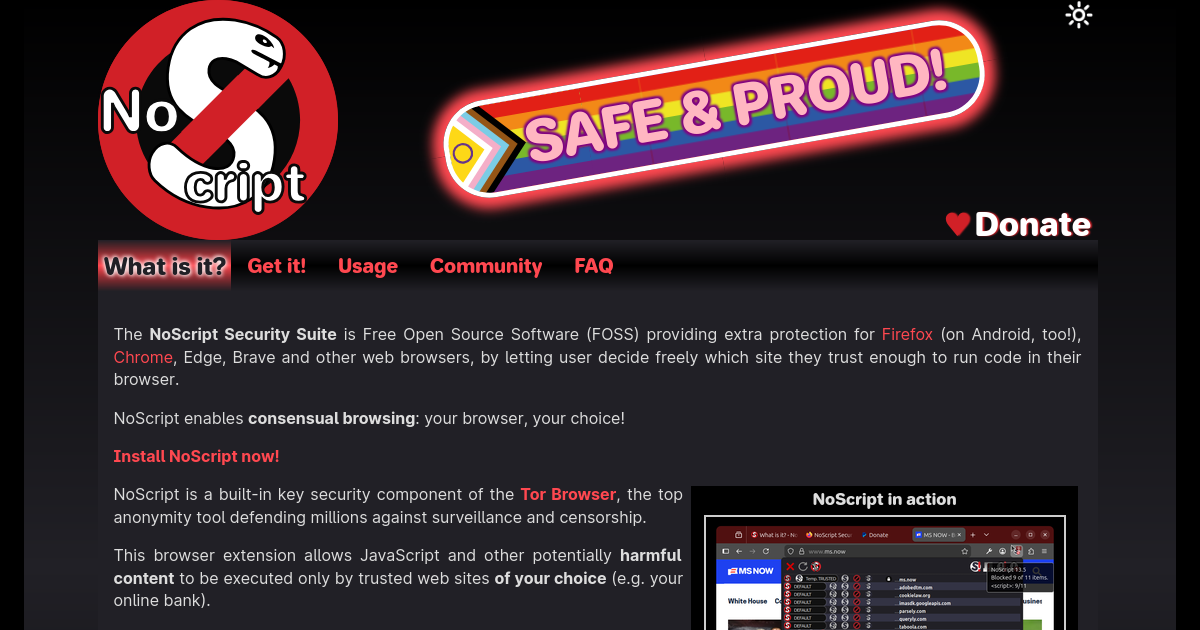
What is it? - NoScript: consensual browsing!
The NoScript Security Suite is Free Software protecting Firefox (on Android, too!), Chrome, Edge, Brave and other web browsers. Install NoScript now!


This ‘Privacy Browser’ Has Dangerous Hidden Features
The Universe Browser is believed to have been downloaded millions of times. But researchers say it behaves like malware and has links to Asia’s booming cybercrime and illegal gambling networks.

Click Browser: Fast. Private. Focused.
A Mac-native browser that stays out of your way—private by default, WebKit under the hood, with built-in ad & tracker blocking, Dark Mode, and on-device Apple Intelligence. Organize with Spaces, Profiles, and Peek—no telemetry, no bloat.

The Tor Project | Privacy & Freedom Online
Defend yourself against tracking and surveillance. Circumvent censorship.

Browser extensions turn nearly 1 million browsers into website-scraping bots
Extensions load unknown sites into invisible Windows. What could go wrong?

taken.
A web page that tells you what your browser gave away the moment you arrived. No login, no form, no permission. Most pages do this. None of them tell you.
How Chrome tracks you and how to limit it | Proton
Learn how Chrome tracks your activity, what information it sends to Google, and which privacy settings can reduce tracking while you browse.

Browser Fingerprinting: An Introduction and the Challenges Ahead | Tor Project
In the past few years, a technique called browser fingerprinting has received a lot of attention because of the risks it can pose to privacy. What is it? How is it used? What is Tor Browser doing against it? In this blog post, I’m here to answer these questions.

You might be ghosting the internet. Can it survive?
Your clicks have immense power. Collectively, just moments of our attention can lift or sink a site. But our browsing is changing, and it could reshape the internet you know and love.