

“Every line of code is written without reason, maintained out of weakness, and deleted by chance” Jean-Paul Sartre’s Programming in ANSI C.
Code Is Cheap Now, And That Changes Everything | Pere Villega
AI coding agents have made code production nearly free. Drawing on insights from Kent Beck, Paul Ford, and Simon Willison, this post argues that the value has shifted from writing code to defining systems — contracts, invariants, SLAs, and verification.
Coding After Coders: The End of Computer Programming as We Know It - …
archived 16 Mar 2026 15:14:04 UTC

</> htmx ~ Codin' Dirty
In this article, Carson Gross discusses an alternative approach to software development that challenges the principles outlined in 'Clean Code.' Carson advocates for allowing larger functions in certain cases, preferring integration tests over unit tests, and minimizing the number of classes and interfaces. He shares examples from successful software projects that demonstrate these practices can lead to maintainable, high-quality code.
Resugaring | Proceedings of the 35th ACM SIGPLAN Conference on Programming Language Design and Implementation
Syntactic sugar plays a crucial role in engineering programming languages. It offers convenient syntax and higher-level of abstractions, as witnessed by its pervasive use in both general-purpose and domain-specific contexts. Unfortunately, the ...

The cost of forsaking C
The C programming language is not trendy. The most recent edition of the canonical C text (the excitingly named The C Programming Language)…
Stay away from my trash!
If writing the code is the easy part, why would I want someone else to write it?

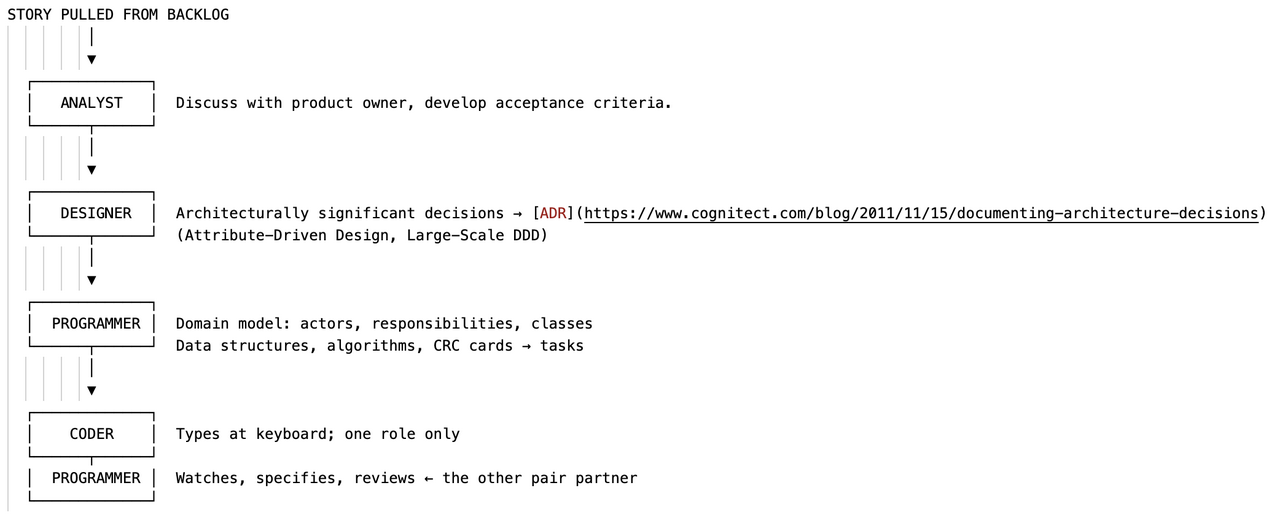
Coding Is Dead, Long Live Programming — Ian Cooper - Staccato Signals
Summary In this post, we argue that the role of a coder now belongs to a coding agent, but that the distinct role of a programmer define...
Write-Only Code | Heavybit
AI may be accelerating software into a world of "write-only" code that forces a rethink of culture, processes, and tools. Heavybit’s Joseph Ruscio explains.
Mahax on Twitter / X
Head of Claude Code, Boris Cherny:"You're not supposed to write code anymore. You're supposed to build a graph that writes itself."In 30 minutes he breaks down how engineers at Anthropic build graphs that write the code, catch the bugs, and ships.Most engineers build… https://t.co/I3b2Rt2ul3 pic.twitter.com/UCPTCr1Sl7— Mahax (@Mahaximus_) September 7, 2026
The peril of laziness lost | The Observation Deck
In his classic Programming Perl — affectionately known to a generation of technologists as "the Camel Book" — Larry Wall famously wrote of the three virtues of a programmer as laziness, impatience, and hubris: If we’re going to talk about good software design, we have to talk about Laziness, Impatience, and Hubris, the basis of good software design. We’ve all fallen into the trap of using cut-and-paste when we should have defined a higher-level abstraction, if only just a loop or subroutine. To be sure, some folks have gone to the opposite extreme of defining ever-growing mounds of higher level abstractions when they should have used cut-and-paste. Generally, though, most of us need to think about using more abstraction rather than less.
Learn C • Build Your Own Lisp
If you're looking to learn C, or you've ever wondered how to build your own programming language, this is the book for you.
Its Time for a New Programming Language
Today, when compared to any other point in programming history, we find ourselves spoiled for choice when it comes to programming…

Modular: The Claude C Compiler: What It Reveals About the Future of Software
Compilers occupy a special place in computer science. They're a canonical course in computer science education. Building one is a rite of passage. It forces you to confront how software actually works, by examining languages, abstractions, hardware, and the boundary between human intent and machine execution.

The Story of C++: The World's Most Consequential Programming Language | The Official Story