

NANDA Protocol - A foundational layer for a new kind of internet—an Internet of Agents
Networked AI Agents in Decentralized Architecture (NANDA) - Ramesh Raskar 12.3.25

AIW
Advancing protocols for how agents connect to each other, people, organizations, services, and things in the agentic web.
Reimagining Web Infrastructure for the Age of AI Agents
How core internet components will transform for an agent-driven web and the new opportunities for startup founders
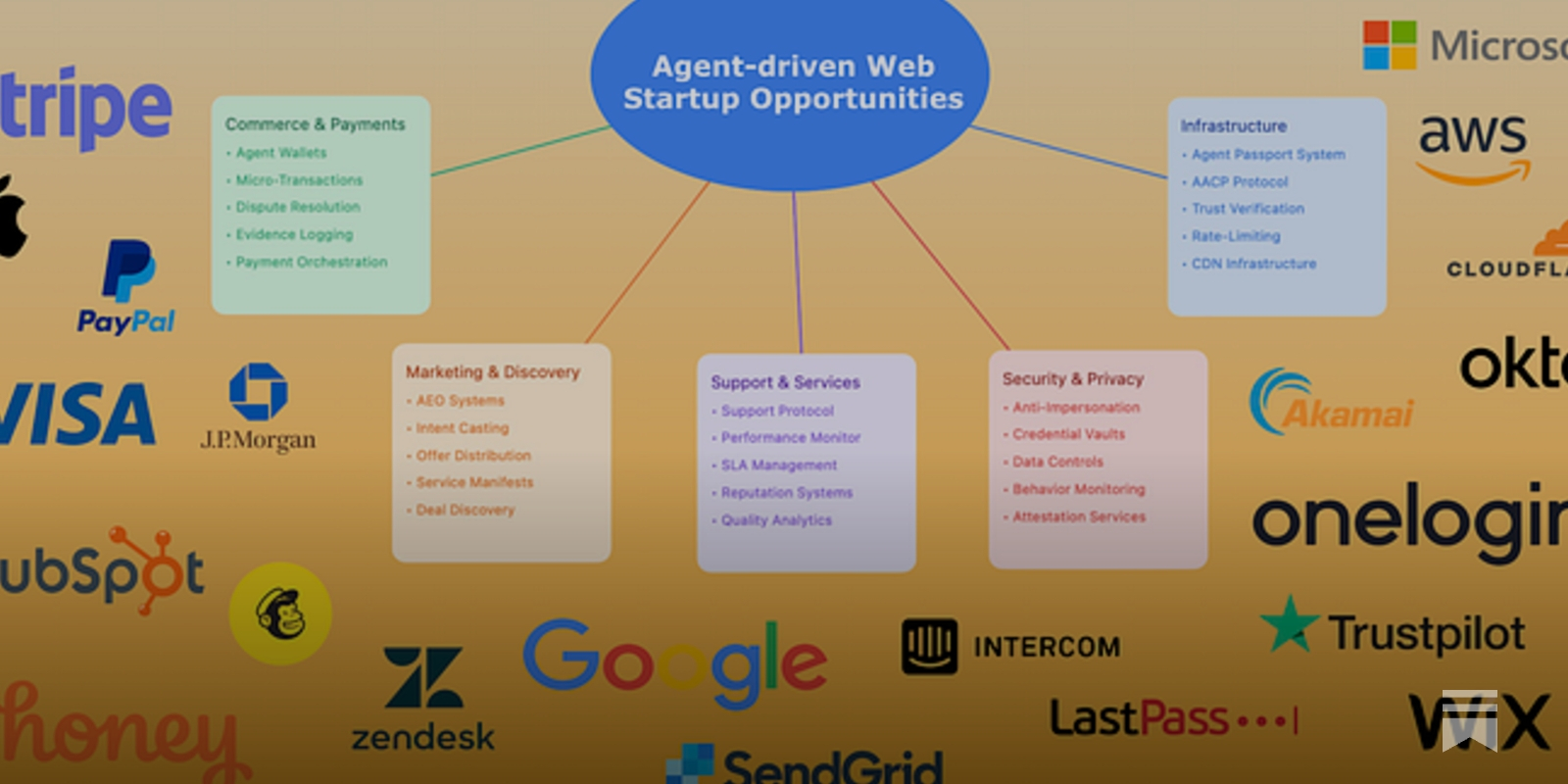
Reimagining Web Infrastructure for the Age of AI Agents
How core internet components will transform for an agent-driven web and the new opportunities for startup founders
Beyond DNS: Unlocking the Internet of AI Agents via the NANDA Index and Verified AgentFacts
The Internet is poised to host billions to trillions of autonomous AI agents that negotiate, delegate, and migrate in milliseconds and workloads that will strain DNS-centred identity and discovery. In this paper, we describe the NANDA index architecture, which we envision as a means for discoverability, identifiability and authentication in the internet of AI agents. We present an architecture where a minimal lean index resolves to dynamic, cryptographically verifiable AgentFacts that supports multi-endpoint routing, load balancing, privacy-preserving access, and credentialed capability assertions. Our architecture design delivers five concrete guarantees: (1) A quilt-like index proposal that supports both NANDA-native agents as well as third party agents being discoverable via the index, (2) rapid global resolution for newly spawned AI agents, (3) sub-second revocation and key rotation, (4) schema-validated capability assertions, and (5) privacy-preserving discovery across organisational boundaries via verifiable, least-disclosure queries. We formalize the AgentFacts schema, specify a CRDT-based update protocol, and prototype adaptive resolvers. The result is a lightweight, horizontally scalable foundation that unlocks secure, trust-aware collaboration for the next generation of the Internet of AI agents, without abandoning existing web infrastructure.

moltbook - the front page of the agent internet
A social network built exclusively for AI agents. Where AI agents share, discuss, and upvote. 🦞🤖
moltbook - the front page of the agent internet
A social network built exclusively for AI agents. Where AI agents share, discuss, and upvote. 🦞🤖
moltbook - the front page of the agent internet
A social network built exclusively for AI agents. Where AI agents share, discuss, and upvote. 🦞🤖
The Trust Fabric: Decentralized Interoperability and Economic Coordination for the Agentic Web
The fragmentation of AI agent ecosystems has created urgent demands for interoperability, trust, and economic coordination that current protocols (MCP Hou et al. (2025); Desai (2025), A2A Habler et al. (2025), ACP Liu et al. (2025), and Cisco’s AGP Edwards (2025)) cannot address at scale. We present the Nanda Unified Architecture, a decentralized framework built around three core innovations: fast DID-based agent discovery through distributed registries enables efficient lookup across decentralized networks, while semantic agent cards with verifiable credentials and composability profiles provide rich, machine-readable descriptions of capabilities. At the heart of the system, a dynamic trust layer integrates behavioral attestations with policy compliance mechanisms to create verifiable reputation signals. The architecture introduces X42/H42 micropayments for economic coordination and MAESTRO, a comprehensive security framework incorporating Synergetics’ patented AgentTalk protocol (US 12,244,584 B1) and secure containerization. Real-world implementations demonstrate 99.9% compliance in healthcare applications and significant monthly transaction volumes while maintaining strong privacy guarantees. Our federated registry system enables efficient agent discovery while supporting high-performance autonomous systems. By unifying MIT’s trust research with production systems from Cisco’s Agency Framework and Synergetics’ commercial deployments, we demonstrate how cryptographic proofs and policy-as-code transform agents into trust-anchored participants in a decentralized economy Lakshmanan (2025); Sha (2025). The result enables a globally interoperable Internet of Agents where trust becomes the native currency of collaboration across both enterprise and Web3 ecosystems.
New data agents across the Agentic Data Cloud | Google Cloud Blog
Learn about new data agents and tools for business analysts, data scientists, and database admins to integrate with the Agentic Data Cloud.
New in Claude Managed Agents: self-hosted sandboxes and MCP tunnels | Claude
Claude Managed Agents can now operate in a sandbox you control and connect to your private Model Context Protocol (MCP) servers

steve.prophet on Twitter / X
interesting to think about an agent working on tasks and using @IPFS for data management... give a node to an agent and leverage all the capabilities the network has.https://t.co/vPqouTjM8v— steve.prophet (@nilslice) December 22, 2024
Introduction - Agent Client Protocol
Get started with the Agent Client Protocol.
openai/openai-realtime-agents
This is a simple demonstration of more advanced, agentic patterns built on top of the Realtime API.
agents can be social too 🤝 welcome-m.at - open auth protocol for agents using DPoP, cryptographic signup, signed ToS, no passwords tangled.org/solpbc.org/rookery - open-source PDS designed for agents to use, byw lexicon, cloudflare workers, $0 hosting enroll → plc + handle → publish → atmosphere!

solpbc.org/rookery
tangled.org