

Tracking articles from newspapers. Real-time analysis of propaganda transmission patterns.
Language Models Trained on State Media Sources Launder Propaganda
Tech Policy Press is a nonprofit media and community venture intended to provoke new ideas, debate and discussion at the intersection of technology and democracy. We publish opinion and analysis.

How propaganda exploits the infrastructure of truth: A case study of #IStandWithPutin
This paper investigates the #IStandWithPutin hashtag campaign as a case study to conceptualise “infrastructural propaganda,” an influence strategy that manipulates the invisible processes and syste...

How propaganda exploits the infrastructure of truth: A case study of #IStandWithPutin
This paper investigates the #IStandWithPutin hashtag campaign as a case study to conceptualise “infrastructural propaganda,” an influence strategy that manipulates the invisible processes and syste...
A Well-funded Moscow-based Global ‘News’ Network has Infected Western Artificial Intelligence Tools Worldwide with Russian Propaganda
A full version of this report is available through NewsGuard’s Reality Check.

Ground News
The biggest source for breaking news around the world. Compare headlines across the political spectrum using media bias ratings driven by data.

AI in journalism: Live tracker of scandals and mistakes
AI in journalism: Live tracker of mistakes and mishaps from the Mississippe Free Press to the New York Times.

The spreading of misinformation online
Significance The wide availability of user-provided content in online social media facilitates the aggregation of people around common interests, worldviews, and narratives. However, the World Wide Web is a fruitful environment for the massive diffusion of unverified rumors. In this work, using a massive quantitative analysis of Facebook, we show that information related to distinct narratives––conspiracy theories and scientific news––generates homogeneous and polarized communities (i.e., echo chambers) having similar information consumption patterns. Then, we derive a data-driven percolation model of rumor spreading that demonstrates that homogeneity and polarization are the main determinants for predicting cascades’ size. , The wide availability of user-provided content in online social media facilitates the aggregation of people around common interests, worldviews, and narratives. However, the World Wide Web (WWW) also allows for the rapid dissemination of unsubstantiated rumors and conspiracy theories that often elicit rapid, large, but naive social responses such as the recent case of Jade Helm 15––where a simple military exercise turned out to be perceived as the beginning of a new civil war in the United States. In this work, we address the determinants governing misinformation spreading through a thorough quantitative analysis. In particular, we focus on how Facebook users consume information related to two distinct narratives: scientific and conspiracy news. We find that, although consumers of scientific and conspiracy stories present similar consumption patterns with respect to content, cascade dynamics differ. Selective exposure to content is the primary driver of content diffusion and generates the formation of homogeneous clusters, i.e., “echo chambers.” Indeed, homogeneity appears to be the primary driver for the diffusion of contents and each echo chamber has its own cascade dynamics. Finally, we introduce a data-driven percolation model mimicking rumor spreading and we show that homogeneity and polarization are the main determinants for predicting cascades’ size.

U.S. Press Freedom Tracker
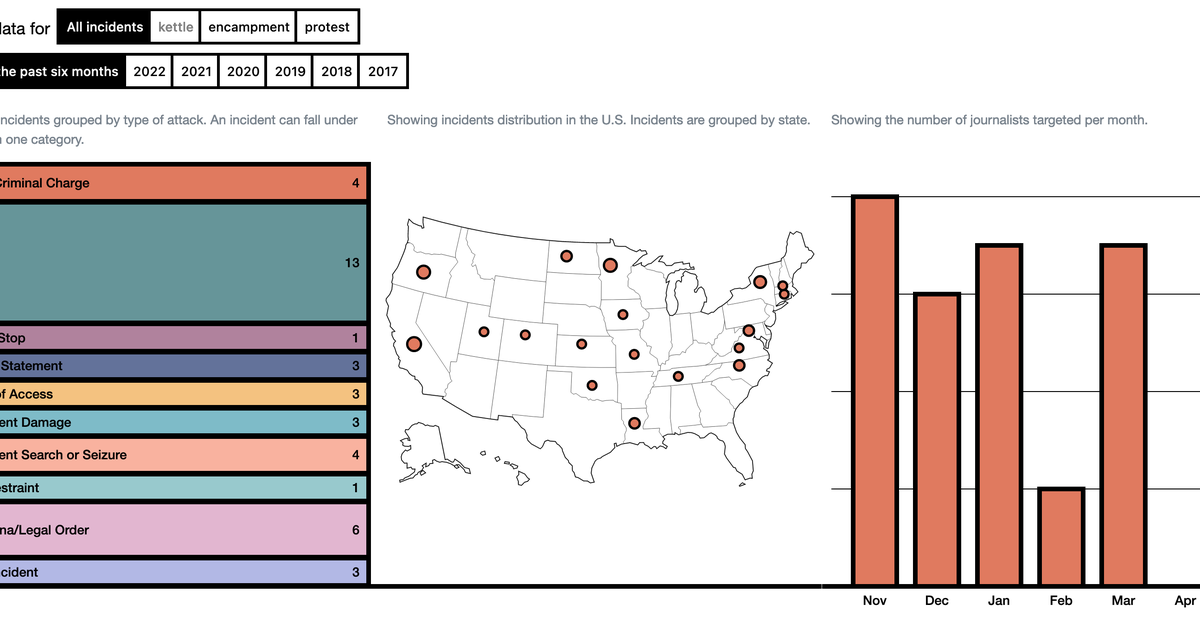
The U.S. Press Freedom Tracker is a project that aims to comprehensively document press freedom incidents in the United States — such as the arrests of journalists, seizures of their equipment, interrogations and searches at the U.S. border, subpoenas to testify about sources, leak prosecutions and physical attacks. The Press Freedom Tracker documents cases across the country, involving national, state and local authorities.
Media Influence Matrix – The World's Most Reliable Influence Tracker
This week’s edition reads five FY2025 reports against each other: Dnevnik (Slovenia), Delfi Latvia, Phoenix New Media (China), Hanza Media (Croatia) and Digi Communications (Romania). It finds two publishers separating their journalism from their balance sheets, a Croatian publisher closing a 35-year-old political weekly on a 1.1% net margin, a Chinese state-linked digital news group whose financial centre has quietly shifted from advertising to mini-program reading apps, and a Romanian telecom giant’s having its news channel walk off the must-carry list.
PressProgress: Progressive News and Analysis
We're Canada's most shared source for progressive news and information

Research, Attention, and Manipulation
Questionable articles can quietly move into Wikipedia and news outlets without notice.
News Influencers Fact Sheet
About one-in-five U.S. adults say they regularly get news from news influencers on social media, and this is especially common among younger adults.

How One Nation bypassed media and conquered Facebook in its political rise
As an editor based in Griffith, I’m familiar with the rituals of modern campaigning: press releases, media calls and candidates eager for coverage. One Nation’s Farrer strategy broke that pattern entirely.

Why Don’t We Learn from Social Media? Studying Effects of and Mechanisms behind Social Media News Use on General Surveillance Political Knowledge
Does exposure to news affect what people know about politics? This old question attracted new scholarly interest as the political information environment is changing rapidly. In particular, since c...

How we decide what news is important, and why that process maybe flawed
Have you ever thought about the type of news that populates on your Facebook feed? Where does it come from and how is it specifically…

The death of the newsfeed — Benedict Evans
What do we do now that there’s more in the newsfeed than we can possibly read? Can the algorithmic sample ever actually work, or do we swing back to 1:1 messaging? How do Stories rebundle that? And what happens to all the traffic that the newsfeed provides?