


Public sector teams must go beyond the in-house or off-the-shelf dichotomy to take advantage of open protocols, which offer a unique way to manage both software costs and geopolitical exposure
The Purpose of Protocols
Every open social protocol generates shared resources, but none has produced a governance framework adequate to those resources. So who fills that vacuum?

The Purpose of Protocols
Every open social protocol generates shared resources, but none has produced a governance framework adequate to those resources. So who fills that vacuum?

Dangerous Protocols - Summer of Protocols
Protocols are frequently touted as the liberating alternative to walled technological gardens, but the historical purpose of protocols has always been to simplify decision-making and reduce human agency. How do we reconcile these two narratives? I explore the dangerous side of protocols, and how their ability to drive coordination means they also have

Introducing the Protocol Institute
Building a field and community to steward the planetary-scale process of protocolization

Protocols for Publishers
A series bringing together publishers, developers, and researchers to explore open protocols for a sustainable agentic web.
Protocols, Not Platforms: A Technological Approach to Free Speech
What is clear is that there is no simple solution to these challenges, and most of the ones that are normally presented tend not to deal with the reality of the problems or to understand the technical and societal challenges that likely make them impossible.

Block - Open Source
By collaborating in the open, we create higher quality software, hardware, and protocols through relentless collective examination, and also ensure our systems, hardware, and protocols evolve to meet real-world needs.

The Politics of Open Infrastructures: Power, Governance, and Justice in Digital Knowledge Practices
This volume examines how openness is designed, governed, contested and lived in contemporary digital knowledge infrastructures. From open source software and internet standards, to citizen science platforms, public sector data systems and alternative computing practices, the book shows that infrastructures are never neutral technical backbones.

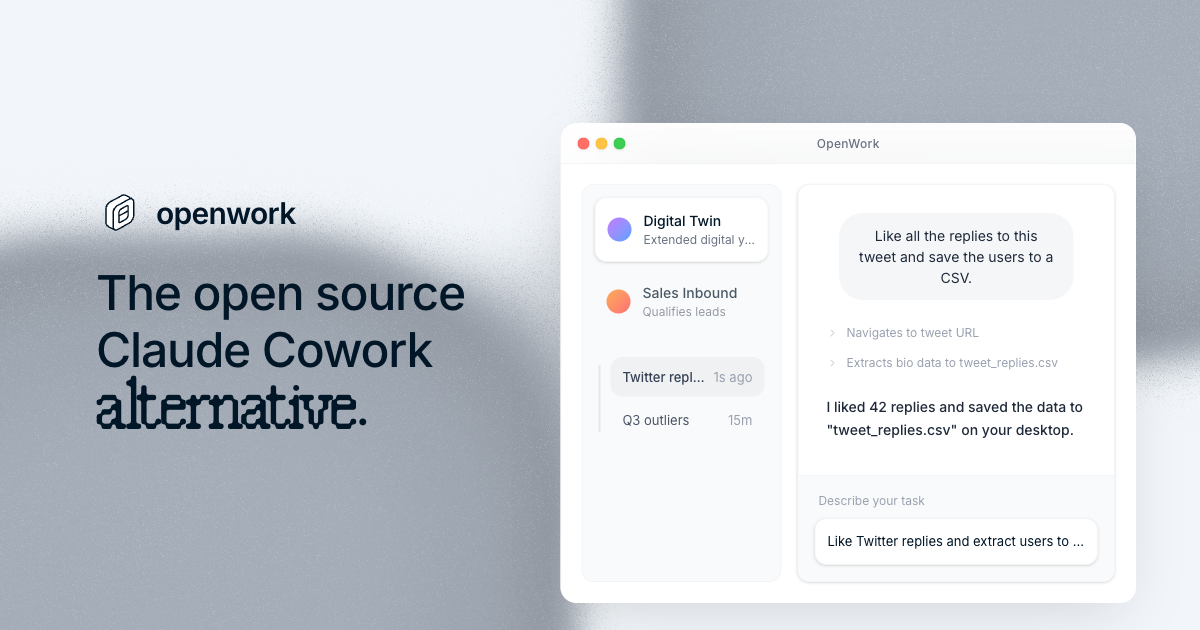
OpenWork — Open source Claude Cowork alternative for teams
Bring your own model and provider, wire in your tools and context, and ship reusable agent setups across your org — with guardrails built in.
Chad Kohalyk (@chadkoh@indieweb.social)
Web publishing is facing its next challenge: a new iteration of centralizing platforms. BUT there is also a new wave of open protocols and standards that can help us gain our independence. Next month in NYC we are gathering a group of frontier technologists and popular web publishers to discuss how we can sail into this next platform shift as captains. #ProtocolsForPublishers https://pfp.unternet.co
Bryan Newbold: Protocol engineering
A protocol engineer at the social-media platform Bluesky describes building an open protocol around a fast-growing social media platform.

I can see a whole lot of people agreeing with this. Kinda the same with open source in general, but few open source projects are social protocols seeking widespread adoption. It's a particular flavor of narrative disconnection from reality we have to bridge out of to get out of our own way.

⠁⠀⠀⠀⠠
Every @proto developer sounds like this to me:
I don't deal in protocol wars, I place lots of bets on open tech. But there's a reason I don't typically expect durable open protocols to come from VC backed for-profit. If ATProto succeeds long term — it does show promise — it'll be in spite of Bluesky PBC, and thanks to the rest of the ecosystem.
Web publishing is facing its next challenge: a new iteration of centralizing platforms. BUT there is also a new wave of open protocols+standards to gain independence. Next month in NYC let's discuss how we can sail into this next platform shift as captains. #ProtocolsForPublishers pfp.unternet.co
Protocols for Publishers
pfp.unternet.coAnother reason why it’s so important that we have open protocols for social media.

Kai Kupferschmidt
One of the issues that has come up again and again in my reporting on misinformation and social media is the massive influence social media companies have on research in the field. Last night a preprint dropped that tries to get at this with some numbers. My piece in @science.org (and 🧪🧵 coming):


