


Always blaming yourself or assuming others think ill of you? A CBT therapist shares ways to break these self-critical habits
Managing intrusive thoughts | Lifeline
Dealing with overwhelming and distressing thoughts can be difficult, but knowing how to handle them can make a big difference to how you feel. Learn why you might be experiencing intrusive thoughts and strategies that can help you manage them.
Refusing to Be the Victim – How to Adopt a “Player” Mindset at Work
You can’t expect others to fix your problems. When you take responsibility for making the best of any situation, you have the power to make things better.

Do not give up your brain
It's tempting to just let tools think for you, but you still need to be able to think for yourself and stay sharp.

Metacognitive Myopia: A Major Obstacle on the Way to Rationality
The notion of metacognitive myopia refers to a conspicuous weakness of the quality control of memory and reasoning processes. Although people are often remarkably sensitive even to complex samples of information when making evaluative judgments and decisions, their uncritical and naive tendency to take the validity of sampled information for granted constitutes a major obstacle to rational behavior. After illustrating this phenomenon with reference to prominent biases (base-rate neglect, misattribution, perseverance), we decompose metacognitive myopia into two distinct but intertwined functions, monitoring and control. We offer explanations for why effectively monitoring the biases resulting from information sampling in an uncertain world is so difficult and why the control function is severely restricted by the lack of volitional control over mental actions. Because of these and other difficulties, metacognitive myopia constitutes a major obstacle to rational judgment and decision making.

Self-Distancing: What It Is and How You Can Use It to Make Better Decisions – Effectiviology
It’s hard to set your emotions aside when you’re faced with a difficult decision. This is problematic, since our emotions often cause us to make the wrong decision in important areas of life, including in our relationships, our finances, and our health.
Why speaking to yourself in the third person makes you wiser | Aeon Ideas
Wisdom and good decision making are within your power: just as soon as you start speaking of yourself in the third person

How to Think for Yourself
Mindful Judgment and Decision Making
A full range of psychological processes has been put into play to explain judgment and choice phenomena. Complementing work on attention, information integration, and learning, decision research over the past 10 years has also examined the effects of goals, mental representation, and memory processes. In addition to deliberative processes, automatic processes have gotten closer attention, and the emotions revolution has put affective processes on a footing equal to cognitive ones. Psychological process models provide natural predictions about individual differences and lifespan changes and integrate across judgment and decision making (JDM) phenomena. “Mindful” JDM research leverages our knowledge about psychological processes into causal explanations for important judgment and choice regularities, emphasizing the adaptive use of an abundance of processing alternatives. Such explanations supplement and support existing mathematical descriptions of phenomena such as loss aversion or hyperbolic discounting. Unlike such descriptions, they also provide entry points for interventions designed to help people overcome judgments or choices considered undesirable.

Resistance Is Futile. To Change Habits, Try Replacement Instead. (Published 2018)
An inconvenient bit of neuroscience: The more you try not to think about a bad habit, the harder it gets to resist. So think about something else.

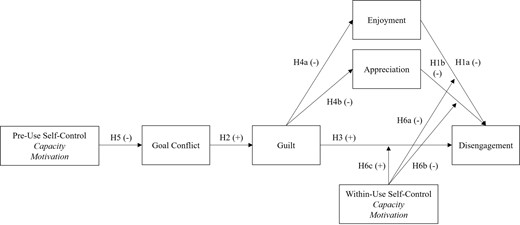
Too amused to stop? Self-control and the disengagement process on Netflix
Abstract. Consuming media entertainment often challenges recipients’ self-control. While past research related self-control almost exclusively to whether i
The Top Idea in Your Mind
July 2010I realized recently that what one thinks about in the shower in the morning is more important than I'd thought. I knew it was a good time to have ideas. Now I'd go further: now I'd say it's hard to do a really good job on anything you don't think about in the shower.Everyone who's worked on difficult problems is probably familiar with the phenomenon of working hard to figure something out, failing, and then suddenly seeing the answer a bit later while doing something else. There's a kind of thinking you do without trying to. I'm increasingly convinced this type of thinking is not merely helpful in solving hard problems, but necessary. The tricky part is, you can only control it indirectly. [1]I think most people have one top idea in their mind at any given time. That's the idea their thoughts will drift toward when they're allowed to drift freely. And this idea will thus tend to get all the benefit of that type of thinking, while others are starved of it. Which means it's a disaster to let the wrong idea become the top one in your mind.What made this clear to me was having an idea I didn't want as the top one in my mind for two long stretches.I'd noticed startups got way less done when they started raising money, but it was not till we ourselves raised money that I understood why. The problem is not the actual time it takes to meet with investors. The problem is that once you start raising money, raising money becomes the top idea in your mind. That becomes what you think about when you take a shower in the morning. And that means other questions aren't.I'd hated raising money when I was running Viaweb, but I'd forgotten why I hated it so much. When we raised money for Y Combinator, I remembered. Money matters are particularly likely to become the top idea in your mind. The reason is that they have to be. It's hard to get money. It's not the sort of thing that happens by default. It's not going to happen unless you let it become the thing you think about in the shower. And then you'll make little progress on anything else you'd rather be working on. [2](I hear similar complaints from friends who are professors. Professors nowadays seem to have become professional fundraisers who do a little research on the side. It may be time to fix that.)The reason this struck me so forcibly is that for most of the preceding 10 years I'd been able to think about what I wanted. So the contrast when I couldn't was sharp. But I don't think this problem is unique to me, because just about every startup I've seen grinds to a halt when they start raising money � or talking to acquirers.You can't directly control where your thoughts drift. If you're controlling them, they're not drifting. But you can control them indirectly, by controlling what situations you let yourself get into. That has been the lesson for me: be careful what you let become critical to you. Try to get yourself into situations where the most urgent problems are ones you want to think about.You don't have complete control, of course. An emergency could push other thoughts out of your head. But barring emergencies you have a good deal of indirect control over what becomes the top idea in your mind.I've found there are two types of thoughts especially worth avoiding � thoughts like the Nile Perch in the way they push out more interesting ideas. One I've already mentioned: thoughts about money. Getting money is almost by definition an attention sink. The other is disputes. These too are engaging in the wrong way: they have the same velcro-like shape as genuinely interesting ideas, but without the substance. So avoid disputes if you want to get real work done. [3]Even Newton fell into this trap. After publishing his theory of colors in 1672 he found himself distracted by disputes for years, finally concluding that the only solution was to stop publishing:
Opinion | Think Less, Think Better (Published 2016)
A wandering mind has less innovative thoughts.

How to gain more from reading by taking it all in more slowly | Psyche Guides
There’s more to words than meets the eye. Deepen your appreciation of literature through the art of slow, attentive reading

The Engineering Manager’s Guide to Emotional Tolerance
Five ways to lead with emotion without losing yourself in the process.

Warning labels shift perceptions of sycophantic AI, but not its influence
Recent work has raised concerns about the influence of sycophantic AI on user judgment and relationships. One proposed mitigation, which has received regulatory attention, is to warn users about potentially harmful AI behaviors such as sycophancy. In a preregistered experiment in which participants (N = 2,610) discussed real interpersonal conflicts with an AI system, we test whether warning labels mitigate sycophancy's influence. We find that a basic AI disclosure (``This chatbot is AI'') has no detectable effect. Labeling the system as sycophantic (``...may agree with you and validate you even when you are wrong...'') does shift users' perceptions, reducing perceived objectivity and trust, but it does not reliably reduce sycophancy's influence on users' self-perceived rightness or their willingness to repair the conflict. Our results reveal a gap between AI perception and AI influence: by shifting perception without reducing influence, warning-based interventions may offer a false sense of protection. Addressing the harms of sycophancy will therefore require understanding the specific mechanisms through which it shapes judgment, and improving model behavior itself.
