


We spoke to over 200 campaigners and reviewed 10 years of research on framing. Here are the five key lessons we learned...
Morality vs. Politics as a Framing Problem: How (Not) to Misunderstand the Fight Against Climate Change
Topoi - This paper is guided by two research hypotheses: (1) In contemporary public discourse, many of the most urgent political problems are predominantly framed and understood in moral terms; (2)...
Deep Storytelling: Collective Sensemaking and Layers of Meaning in U.S. Elections
Misinformation and disinformation about elections remain pressing concerns for researchers, policymakers, and the public. Critics, however, argue that fears surrounding these issues are exaggerated due to a lack of evidence of impact. This debate highlights the challenges inherent in assessing the impacts of misinformation, as the drivers of false and misleading content often exist in the context of a specific claim. To address this issue, we examined false and misleading information surrounding the 2020 and 2022 U.S. national elections, focusing on the contextual features of online conversations that fueled various rumors. We developed two qualitative codebooks, creating the second after realizing that the first, which labeled individual tweets, failed to capture broader rumoring dynamics. By integrating multi-layered qualitative coding with thematic analysis and quantitative visualizations, we show how influencers, political elites, and audiences collaboratively told deep stories from 2020 through 2022. As these stories were told, audiences interpreted events in 2022 through the lens of the 2020 story, guided by influencers' cues, leading to an evolution in storytelling style between the two election cycles. This ongoing performance was tailored to align with the incentive structures, affordances, and attention economy of social media. We combine deep stories with theories of collective sensemaking and rumoring, creating a framework to better assess the contextual features surrounding false and misleading information.

An s-frame agenda for behavioral public policy research
We have previously argued thatbehavioral scientists have been testing and advocating individualistic (i-frame) solutions to policy problems that have systemic (s-frame) causes and require systemic solutions. Here, we consider the implications of adopting an s-frame approach for research. We argue that an s-frame approach will involve addressing different types of questions, which will, in turn, require a different toolbox of research methods.
Metaphor and the Political War
Metaphor and the Political War
America’s Right-Wing Propaganda Problem Might Be Terminal - Dame Magazine
America’s descent into mass delusion isn’t happenstance. The demise of courageous journalism isn’t a happy accident. Its replacement with engagement-chasing infotainment and propaganda isn’t an error. It’s a global assault on reason and informed consensus, and corporations and authoritarian bullies like Donald Trump are both architects and benefactors. For decades, academics warned anybody who’d listen
There is no fresh air: A problem with the concept of echo chambers
Standardly, echo chambers are thought to be structures that we should avoid. Agents should keep away from them, to be able to assess a fuller range of evidence and avoid having their confidence in that information manipulated. This paper argues against that standard view. Not only can echo chambers be neutral or good for us, but the existing definitions apply so widely that such chambers are unavoidable. We are all in large numbers of echo chambers at any time – they can be found not just on social media or in political groups, but in almost every social or epistemic group we could categorise ourselves into. Because we are finite and fallible, we cannot escape them and need to exist in them just to get by. The concept, then, does not actually capture something as structurally problematic as the paradigmatic cases would suggest. Our way of using the term in social epistemology needs to change.
Opinion | How an Online Mob Created a Playbook for a Culture War (Published 2019)
The powerful lesson of a 5-year-old harassment campaign: How to wage a post-truth information war.

Ezra Klein’s “Why We’re Polarized” and the Drawbacks of Explainer Journalism
A Darwinian reading of American politics leaves little room for the motivations of conscious, rational agents.

Manufacturing Consent: The Political Economy of the Mass Media
A bold and eye-opening exposé on how power and propaganda distort the news, now more relevant than ever • With an updated introduction“[A] compelling indictment of the news media’s role in covering up errors and deceptions in American foreign policy.”—The New York Times Book Review Renowned scholars Edward S. Herman and Noam Chomsky reveal how U.S. news media, far from being independent watchdogs, often function as tools of elite influence. With probing analysis, they present their Propaganda Model, a framework that explains how systemic bias shapes the stories we’re told, the voices we hear, and the truths that remain hidden.Through deeply researched case studies, from the Vietnam War to coverage of “worthy” vs. “unworthy” victims, Manufacturing Consent exposes the structural forces that drive news organizations to reinforce power rather than question it. It’s a sobering portrait of a media system more interested in maintaining order than informing the public.This edition includes an introduction updating key examples and expanding the Propaganda Model’s relevance to issues like the coverage of NAFTA, the media’s treatment of global protests, and environmental regulation.Manufacturing Consent is a powerful assessment of how propagandistic the U.S. mass media are, how they systematically fail to live up to their self-image as providers of the kind of information that people need to make sense of the world, and how we can understand their function in a radically new way.Whether you’re a student, activist, or citizen looking to see beyond the headlines, this book will transform how you understand the media—and the world around you.

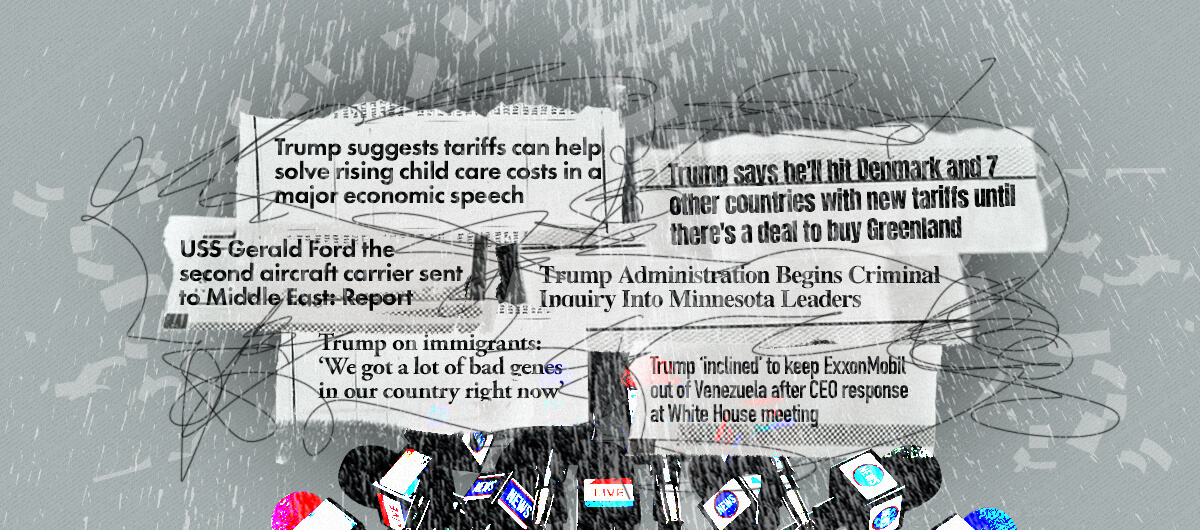
Why ‘Flooding the Zone’ Works for Trump - Dame Magazine
Trump’s allies openly described a strategy to overwhelm the press with simultaneous crises. The structure of modern journalism makes it work
Disinformation as Cultural Narrative: Conceptualizing Disinformation as Cross-Platform, Identity-Affirming, Cathartic Stories
Rather than framing disinformation as false facts which can be countered by true facts, we propose a model of disinformation as narrative by tracing three case studies of successful disinformation ...

The Liar’s Dividend: Can Politicians Claim Misinformation to Evade Accountability?
This study addresses the phenomenon of misinformation about misinformation, or politicians "crying wolf"' over fake news. Strategic and false claims that stories are fake news or deepfakes may benefit politicians by helping them maintain support after a scandal. We posit that this benefit, known as the "liar's dividend," may be achieved through two politician strategies: by invoking informational uncertainty or by encouraging oppositional rallying of core supporters. We administer five survey experiments to over 15,000 American adults detailing hypothetical politician responses to stories describing real politician scandals. We find that claims of misinformation representing both strategies raise politician support across partisan subgroups. These strategies are effective against text-based reports of scandals, but are largely ineffective against video evidence and do not reduce general trust in media. Finally, these false claims produce greater dividends for politicians than alternative responses to scandal, such as remaining silent or apologizing.


