This paper investigates the ramifications of information feed integration on user engagements and contributions in online content-sharing platforms by exploiting a natural experiment occurred in a leading knowledge-sharing platform that integrated informal social posts with professional knowledge content in one feed. Our results show that the juxtaposition of incongruous types of content increased mindset switching and cognitive strain, thus hurting user engagements. We also reveal a novel crowding-out effect, viz., the integration heightened concerns that posting informal social posts would dilute the contributor’s professional image, thus inhibiting user contributions. Our findings hold important practical implications for all platforms that host (or are considering hosting) diverse types of user-generated content (UGC). Additional content curation tools can potentially enhance user engagement and retention, but their effectiveness hinges on a foundational and crucial element—the presentation format of heterogeneous content types. Essentially, the value of curating informal social posts in a knowledge-sharing platform would diminish when those content intrudes upon and conflict with the professional domain. This insight underscores that any UGC platforms, when adopting a diversity-oriented strategy, should pay close attention to heterogeneity between different content types for the purpose of optimizing user experiences and promoting user contributions. , Many online communities that rely on effortful, voluntary content contributions offer additional content curation tools to facilitate social interactions and encourage user contributions. Any platform that offers two or more heterogeneous content types (e.g., expert knowledge and social posts) faces a choice about the presentation format: whether to display the content types separately or in an integrated information feed. We leverage a natural experiment on Zhihu, a Q&A platform that offers a social-interaction-oriented functionality called Ideas. Zhihu initially presented answers (expert knowledge content) and ideas (social posts) in two different information feeds, but the platform integrated ideas into the same information feed as answers in June 2019. We find that information feed integration significantly decreased user engagement with and contribution of both ideas and answers. We hypothesize that users decreased their engagement because the juxtaposition of incongruous types of content increased mindset switching and cognitive strain. This hypothesis is supported by an additional laboratory experiment. We also present evidence showing that contributions decreased both because of the decrease in engagement (weaker social recognition incentives) and because integration heightened concerns that posting ideas would dilute the contributor’s professional image. Our findings have important theoretical and practical implications for any platform that hosts heterogeneous content. History: Xiaoquan (Michael) Zhang served as the senior editor and Yili (Kevin) Hong served as associate editor for this article. Funding: Z. Cao acknowledges this research was funded by National Natural Science Foundation of China [Grants 72201238, 72192823]. G. Li acknowledges this research was funded by National Natural Science Foundation of China [Grant 72102047] and Shanghai Pujiang Program [Grant 21PJC006]. Supplemental Material: The e-companion is available at https://doi.org/10.1287/isre.2022.0043 .
Bonsai: Intentional and Personalized Social Media Feeds
Social media feeds use predictive models to maximize engagement, often misaligning how people consume content with how they wish to. We introduce Bonsai, a system that enables people to build personalized and intentional feeds. Bonsai implements a platform-agnostic framework comprising Planning, Sourcing, Curating, and Ranking modules. This framework allows users to express their intent in natural language and exert fine-grained control over a procedurally transparent feed creation process. We evaluated the system with 15 Bluesky users in a two-phase, multi-week study. We find that participants successfully used our system to discover new content, filter out irrelevant or toxic posts, and disentangle engagement from intent, but curating intentional feeds required more effort than they are used to. Simultaneously, users sought system transparency mechanisms to effectively use (and trust) intentional, personalized feeds. Overall, our work highlights intentional feedbuilding as a viable path beyond engagement-based optimization.

A perspective on friction interventions to curb the spread of misinformation
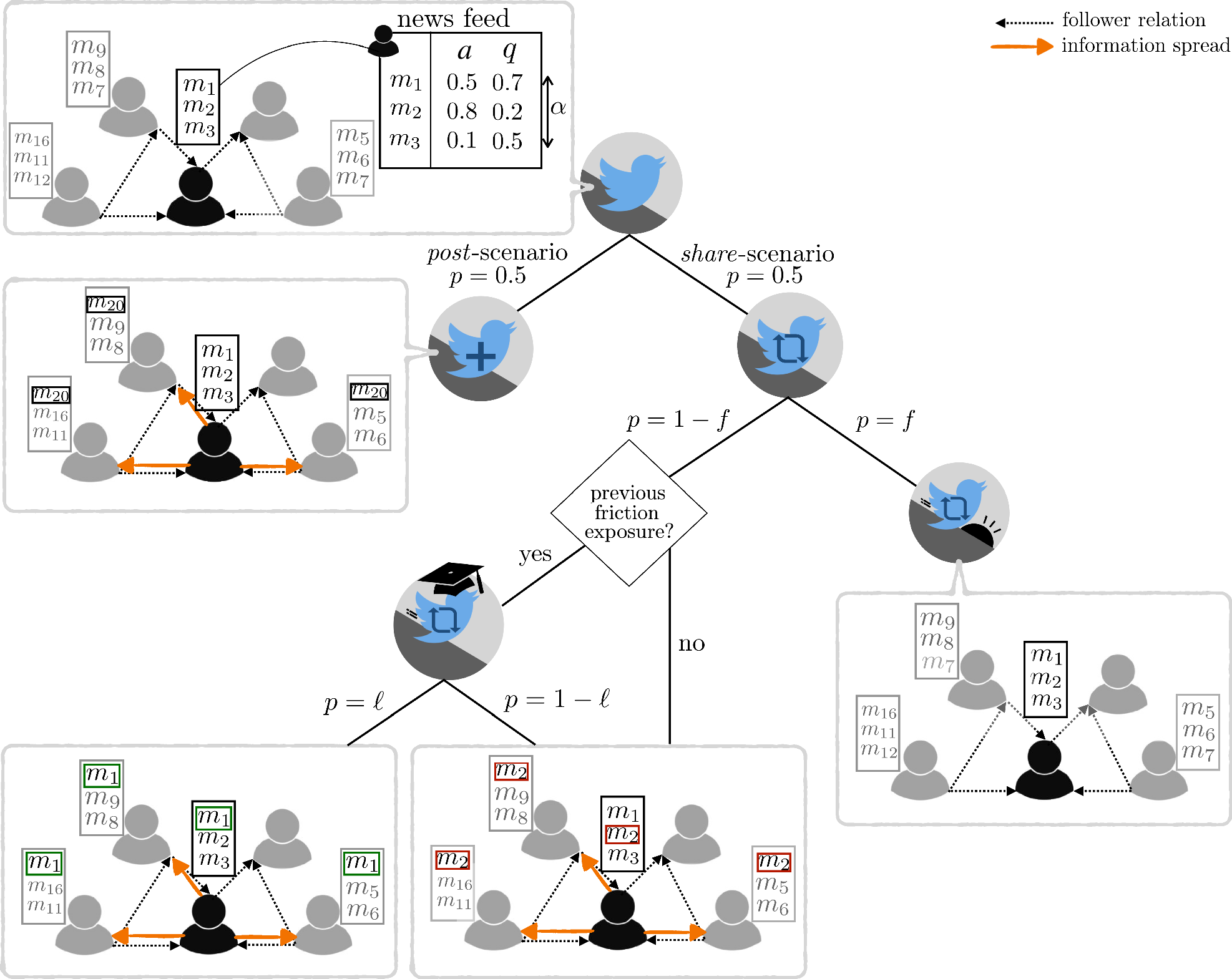
Social media has enabled the spread of information at unprecedented speeds and scales, and with it the proliferation of high-engagement, low-quality content. Friction—behavioral design measures that make the sharing of content more cumbersome—might be a way to raise the quality of what is spread online. In this perspective, we propose a scalable field experiment to study the effects of friction with a learning component to educate users on the platform’s community standards. Preliminary simulations from an agent-based model suggest that while friction alone may decrease the number of posts without improving their quality, it could significantly increase the average quality of posts when combined with learning. The model also suggests that too much friction could be counterproductive. Experimental interventions inspired by these findings would be minimally invasive.
Sharing of misinformation is habitual, not just lazy or biased
Why do people share misinformation on social media? In this research ( N = 2,476), we show that the structure of online sharing built into social platforms is more important than individual deficits in critical reasoning and partisan bias—commonly cited drivers of misinformation. Due to the reward-based learning systems on social media, users form habits of sharing information that attracts others' attention. Once habits form, information sharing is automatically activated by cues on the platform without users considering response outcomes such as spreading misinformation. As a result of user habits, 30 to 40% of the false news shared in our research was due to the 15% most habitual news sharers. Suggesting that sharing of false news is part of a broader response pattern established by social media platforms, habitual users also shared information that challenged their own political beliefs. Finally, we show that sharing of false news is not an inevitable consequence of user habits: Social media sites could be restructured to build habits to share accurate information.

Sharing of misinformation is habitual, not just lazy or biased
Why do people share misinformation on social media? In this research ( N = 2,476), we show that the structure of online sharing built into social platforms is more important than individual deficits in critical reasoning and partisan bias—commonly cited drivers of misinformation. Due to the reward-based learning systems on social media, users form habits of sharing information that attracts others' attention. Once habits form, information sharing is automatically activated by cues on the platform without users considering response outcomes such as spreading misinformation. As a result of user habits, 30 to 40% of the false news shared in our research was due to the 15% most habitual news sharers. Suggesting that sharing of false news is part of a broader response pattern established by social media platforms, habitual users also shared information that challenged their own political beliefs. Finally, we show that sharing of false news is not an inevitable consequence of user habits: Social media sites could be restructured to build habits to share accurate information.
Community by Design
Social media empower distributed content creation by algorithmically harnessing "the social fabric" (explicit and implicit signals of association) to serve this content. While this overcomes the bottlenecks and biases of traditional gatekeepers, many believe it has unsustainably eroded the very social fabric it depends on by maximizing engagement for advertising revenue. This paper participates in open and ongoing considerations to translate social and political values and conventions, specifically social cohesion, into platform design. We propose an alternative platform model that includes the social fabric an explicit output as well as input. Citizens are members of communities defined by explicit affiliation or clusters of shared attitudes. Both have internal divisions, as citizens are members of intersecting communities, which are themselves internally diverse. Each is understood to value content that bridge (viz. achieve consensus across) and balance (viz. represent fairly) this internal diversity, consistent with the principles of the Hutchins Commission (1947). Content is labeled with social provenance, indicating for which community or citizen it is bridging or balancing. Subscription payments allow citizens and communities to increase the algorithmic weight on the content they value in the content serving algorithm. Advertisers may, with consent of citizen or community counterparties, target them in exchange for payment or increase in that party's algorithmic weight. Underserved and emerging communities and citizens are optimally subsidized/supported to develop into paying participants. Content creators and communities that curate content are rewarded for their contributions with algorithmic weight and/or revenue. We discuss applications to productivity (e.g. LinkedIn), political (e.g. X), and cultural (e.g. TikTok) platforms.
Social Media Is Now Parasocial Media
When practitioners used the term “social media” to describe the internet tools that emerged in the mid-aughts, they were giving a name to the kinds of platforms and protocols that allowed people to socialize with friends and communities of interest by using digital technologies. Twenty years later, users of social media are far more likely to scroll than post – and the content that they consume is often strategically produced and algorithmically curated. In this essay, I argue that the very essence of social media has changed. To more effectively interrogate what we are witnessing, we need to stop presuming that these tools are “social media” and begin recognizing that they are now “parasocial media.” Doing so raises new questions about digitally mediated sociality, not to mention the politics and governance of these platforms.

Value misalignment in X’s feed algorithm is a reflection of value tensions in engagement
Social media feed algorithms rank content that is purported to be preferred by users, but the engagement behaviors that drive these algorithms are (at best) indirect proxies for users’ explicitly self-stated values. Are the resulting feeds value aligned, and if not, why? We investigate this question by annotating the basic human values expressed in participants’ X (Twitter) feeds (N = 715 US users), analyzing the relationship between the posts’ value expressions and the posts’ amplification in the ranked “For You” Page feed, and then comparing the amplified values to users’ own values. We observe that the inventory of posts from followed accounts reflects users’ self-stated values—but that there is an overall negative correlation (misalignment) between users’ explicit values and the value expressions the algorithm is more likely to amplify. We turn to engagement behavior to understand this misalignment and observe that users’ engagement behaviors can be misaligned with their stated values—likely causing the algorithm to learn and reflect these misaligned values. We also detect partisan differences consistent with this theory: While the algorithm amplifies values negatively correlated with both Democrats’ and Republicans’ self-stated values, they are more misaligned for Democrats. And in fact replying, a heavily weighted form of engagement, is associated with values that are less aligned for both Democrats’ and Republicans’ self-stated values, and is even more misaligned for Democrats. Taken together, these findings offer a glimpse into the tensions between the values that people hold and those that provoke reactions, and how these value tensions can produce misaligned outcomes.

Value misalignment in X’s feed algorithm is a reflection of value tensions in engagement
Social media feed algorithms rank content that is purported to be preferred by users, but the engagement behaviors that drive these algorithms are (at best) indirect proxies for users’ explicitly self-stated values. Are the resulting feeds value aligned, and if not, why? We investigate this question by annotating the basic human values expressed in participants’ X (Twitter) feeds (N = 715 US users), analyzing the relationship between the posts’ value expressions and the posts’ amplification in the ranked “For You” Page feed, and then comparing the amplified values to users’ own values. We observe that the inventory of posts from followed accounts reflects users’ self-stated values—but that there is an overall negative correlation (misalignment) between users’ explicit values and the value expressions the algorithm is more likely to amplify. We turn to engagement behavior to understand this misalignment and observe that users’ engagement behaviors can be misaligned with their stated values—likely causing the algorithm to learn and reflect these misaligned values. We also detect partisan differences consistent with this theory: While the algorithm amplifies values negatively correlated with both Democrats’ and Republicans’ self-stated values, they are more misaligned for Democrats. And in fact replying, a heavily weighted form of engagement, is associated with values that are less aligned for both Democrats’ and Republicans’ self-stated values, and is even more misaligned for Democrats. Taken together, these findings offer a glimpse into the tensions between the values that people hold and those that provoke reactions, and how these value tensions can produce misaligned outcomes.
Middleware for Feed Recommendation in Practice: How Feed Creators Build, Maintain, and Sustain Custom Feeds on Bluesky
Scholars have long proposed third-party middleware as an alternative to centralized algorithmic feeds: feeds built and distributed by independent feed creators. This vision saw no large-scale instantiation until Bluesky, a decentralized microblogging platform, introduced custom feeds in 2023. Although central to the middleware ecosystem, we know little about how feed creators understand their role, build feeds, and sustain them. Through interviews with n = 26 feed creators and third-party developers of feed-building tools, and analysis of n = 88,302 custom feeds, we identify two creator orientations---utility-providing and community-building. Additionally, creators struggle to maintain feeds that fully realize middleware ideals: they lack granular interaction data, receive little feedback, and lack technical expertise to act on either. Finally, creators sustain their feeds as unpaid hobbyists with little platform support and are divided on whether to monetize beyond covering costs. We conclude with design and policy implications for strengthening the middleware feed ecosystem.
The echo chamber effect on social media
Significance We explore the key differences between the main social media platforms and how they are likely to influence information spreading and the formation of echo chambers. To assess the different dynamics, we perform a comparative analysis on more than 100 million pieces of content concerning controversial topics (e.g., gun control, vaccination, abortion) from Gab, Facebook, Reddit, and Twitter. The analysis focuses on two main dimensions: 1) homophily in the interaction networks and 2) bias in the information diffusion toward like-minded peers. Our results show that the aggregation in homophilic clusters of users dominates online dynamics. However, a direct comparison of news consumption on Facebook and Reddit shows higher segregation on Facebook. , Social media may limit the exposure to diverse perspectives and favor the formation of groups of like-minded users framing and reinforcing a shared narrative, that is, echo chambers. However, the interaction paradigms among users and feed algorithms greatly vary across social media platforms. This paper explores the key differences between the main social media platforms and how they are likely to influence information spreading and echo chambers’ formation. We perform a comparative analysis of more than 100 million pieces of content concerning several controversial topics (e.g., gun control, vaccination, abortion) from Gab, Facebook, Reddit, and Twitter. We quantify echo chambers over social media by two main ingredients: 1) homophily in the interaction networks and 2) bias in the information diffusion toward like-minded peers. Our results show that the aggregation of users in homophilic clusters dominate online interactions on Facebook and Twitter. We conclude the paper by directly comparing news consumption on Facebook and Reddit, finding higher segregation on Facebook.

The case against efficiency: friction in social media
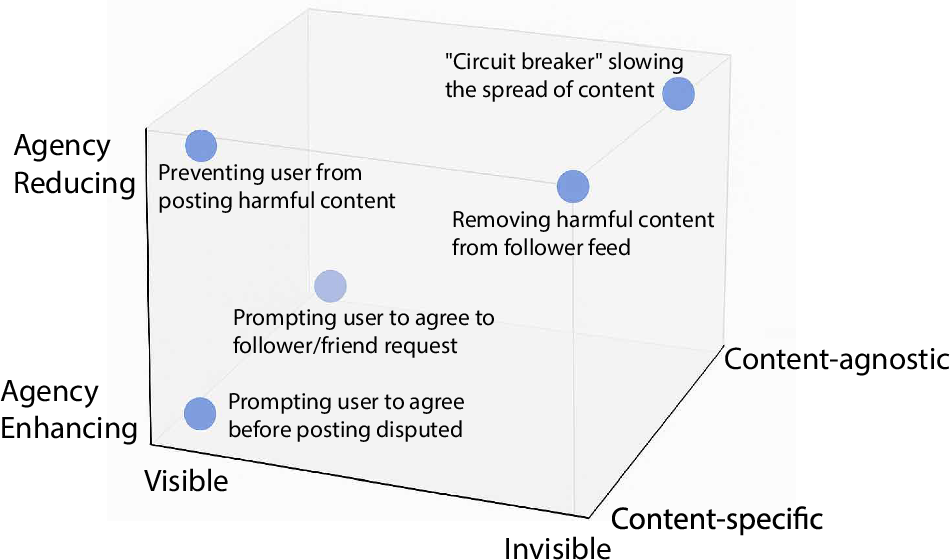
Social media platforms frequently prioritize efficiency to maximize ad revenue and user engagement, often sacrificing deliberation, trust, and reflective, purposeful cognitive engagement in the process. This manuscript examines the potential of friction—design choices that intentionally slow user interactions—as an alternate approach. We present a case against efficiency as the dominant paradigm on social media and advocate for a complex systems approach to understanding and analyzing friction. Drawing from interdisciplinary literature, real-world examples, and industry experiments, we highlight the potential for friction to mitigate issues like polarization, disinformation, and toxic content without resorting to censorship. We propose a state space representation of friction to establish a multidimensional framework and language for analyzing the diverse forms and functions through which friction can be implemented. Additionally, we propose several experimental designs to examine the impact of friction on system dynamics, user behavior, and information ecosystems, each designed with complex systems solutions and perspectives in mind. Our case against efficiency underscores the critical role of friction in shaping digital spaces, challenging the relentless pursuit of efficiency and exploring the potential of thoughtful slowing.
Shifts in U.S. Social Media Use, 2020–2024: Decline, Fragmentation, and Enduring Polarization
Using nationally representative data from the 2020 and 2024 American National Election Studies (ANES), this paper describes how U.S. social media use has shifted across platforms, demographics, and politics. Overall platform reach declined, driven by growth in the share of Americans — especially the youngest and oldest cohorts — who report using no social media. Visiting and posting activity on Twitter/X and Facebook have fallen by nearly 50% since 2020, with the decline on Twitter/X driven primarily by reduced participation among Democratic users. While Facebook, YouTube, and Twitter/X lost ground, TikTok and Reddit grew modestly, consistent with a more fragmented digital public sphere. Platform audiences aged and became slightly more educated and racially diverse. Politically, most platforms shifted toward Republican users while remaining, on balance, Democratic-leaning. Twitter/X experienced the largest change: among posters, the partisan balance swung over 70 percentage points from Democrats to Republicans. Across platforms, political posting remains closely tied to affective polarization, as the most partisan respondents are also the most active. As casual users disengage while polarized partisans remain vocal, online discourse becomes narrower and more ideologically extreme.
How cognitive elaboration fosters knowledge acquisition on social media—a field experiment
Abstract. Social media technologies have been criticized as ineffective sources of information because users seem to increase their subjective but not thei
Illusion of knowledge through Facebook news? Effects of snack news in a news feed on perceived knowledge, attitude strength, and willingness for discussions
Research indicates that using social network sites as a source for news increases perceived knowledge even if, objectively, people fail to acquire knowledge. This might result from the frequent repetition of topics in news posts caused by multiple news outlets posting about the same news topics and the algorithm that favors similar postings. These repeated encounters can have a positive effect on the perception of knowing more, even if actual learning hardly occurs. An experiment (N = 810, representative of German Internet users) tested these assumptions. Participants were assigned to one of four groups and received a news feed with no information, few news posts, many news posts, or a full-length news article. Results indicate that many news posts increased perceived knowledge that is not paralleled by a gain in factual knowledge. Perceived knowledge mediates effects of reading many news posts on more extreme attitudes and the willingness for discussions. Even if participants who read the news article gained factual knowledge, they did not feel more knowledgeable than participants who were exposed to a news feed containing news posts. The results emphasize the meaning of engaging with full news articles, both for learning facts and for more accurate knowledge assessments.
Seeing the Politics of Decentralized Social Media Protocols
Calls to decentralize feed-based social media have been driven by concerns about the concentrated power of centralized platforms and their societal impact. In response, numerous decentralized social media protocols have emerged, each interpreting “decentralization” in a different way. We analyze four such protocols (ActivityPub, AT Protocol, Nostr, and Farcaster) drawing on protocol documentation, media coverage, direct usage, and semi-structured interviews with protocol developers and experts to situate each protocol within its socio-technical goals. To support this analysis, we develop a grounded lexicon that facilitates the description and comparison of analogous components across each protocol. With it, we show how each protocol distributes control over key components differently, shaping who holds power over critical aspects such as user identity, curation, and infrastructural ownership. By examining protocols as socio-technical artifacts, we show how they prioritize different values and make distinct trade-offs, providing CSCW researchers with a lens to more effectively evaluate and design future decentralized social media systems.

Redesigning algorithms to intervene on social norm misperceptions during a national election
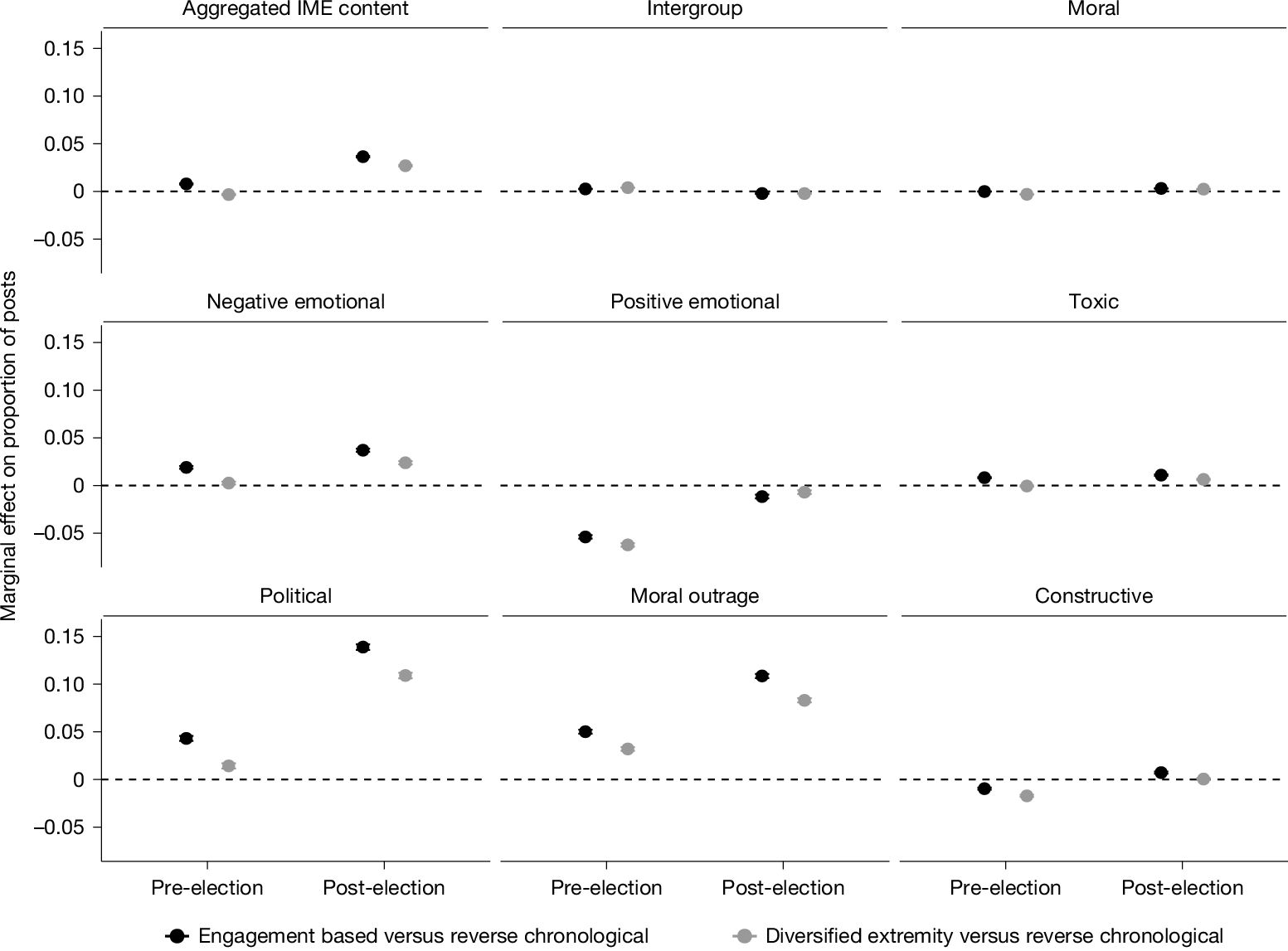
For the first time in history, civic discourse commonly occurs in digital environments in which algorithms influence exposure to social information1,2. It is increasingly important to understand whether and how these algorithms affect political discourse3–5. Here we built custom feed-ranking algorithms with full control over their features, and randomly assigned 2,000 participants to use them for 8 weeks (before and after the 2024 US presidential election). We tested whether an engagement-based algorithm (used on major social media platforms6,7) amplifies intergroup, moralized and emotional (IME) information in ways that skew perceptions of social norms around political dialogue5,8, and whether it increased engagement with IME content and perceptions of partisan animosity (compared with a reverse-chronological feed9,10). We also developed and tested a ‘diversified extremity’ algorithm to reduce the influence of extreme users11–13 to improve the accuracy of social norm perception14–16 and reduce perceptions of partisan animosity. We found that engagement-based feeds amplified IME and toxic content relative to reverse-chronological feeds, with the largest increases in moral outrage and political content. Engagement-based feeds also reduced prescriptive norm perception accuracy (albeit in an unexpected direction) and increased perceived partisan animosity. However, they did not significantly alter users’ own engagement behaviours. The diversified extremity algorithm reduced IME and toxic content exposure, improved prescriptive norm accuracy, yet maintained comparable platform enjoyment—suggesting that reducing the influence of extreme users can curb algorithmic distortions without diminishing user experience.