We investigate the impact of employer matching contributions on leakage at job termination. , The U.S. government imposes a 10% penalty to discourage preretirement leakage—cash withdrawal from 401(k) retirement savings before the age of 59.5 years. In our data set with 162,360 terminating employees covered by 28 retirement plans, 41.4% of employees leaked by cashing out 401(k) savings at job separation, most draining their entire accounts. We investigate the impact of employer matching contributions on leakage at job termination. The “composition” of funds in one’s 401(k) balance matters: leakage increases with employer contribution proportion. Micropatterns in our data align more with behavioral than with economic explanations of this effect. We estimate that a 50% increase in employer/employee match rate increases leakage probability by 6.3% at job termination. However, there could be a 35.3% reduction in leakage probability if employees ignore the perceived incentive generated by the account composition effect. Approximately 60% of accumulated assets from a 50% increase in match rate leak out of the system due to the account composition effect attributable to the percentage of assets contributed by the employer. Employers with more generous matches care about their employees’ well-being in retirement, but unintentionally nudge employees to cash out when they change jobs. We highlight proposals to help employers curb avoidable leakage. History: K. Sudhir served as the senior editor and Tat Chan served as associate editor for this article. Funding: This work was supported by the Social Sciences and Humanities Research Council of Canada [Grant 435-2018-0509]. Supplemental Material: The data files and online appendices are available at https://doi.org/10.1287/mksc.2022.1404 .
Misunderstanding Savings Growth: Implications for Retirement Savings Behavior
People systematically underestimate exponential growth. This article illustrates this phenomenon, its implications, and some potential interventions in the context of saving for retirement, where savings grow exponentially over long periods of time. Experiment 1 shows that a majority of participants expect savings over 40 years to grow linearly rather than exponentially, leading them to grossly underestimate their account balance at retirement. Experiment 2 demonstrates that this misunderstanding leads to underestimates of the cost of waiting to save, which makes putting off saving more attractive than it should be. Finally, Experiments 3–5 show that highlighting the exponential growth of savings motivates both college students and employees to save more for retirement. Making clear to employees the exponential growth of savings before they make crucial decisions about how much to save may be a simple and effective means of increasing retirement savings.

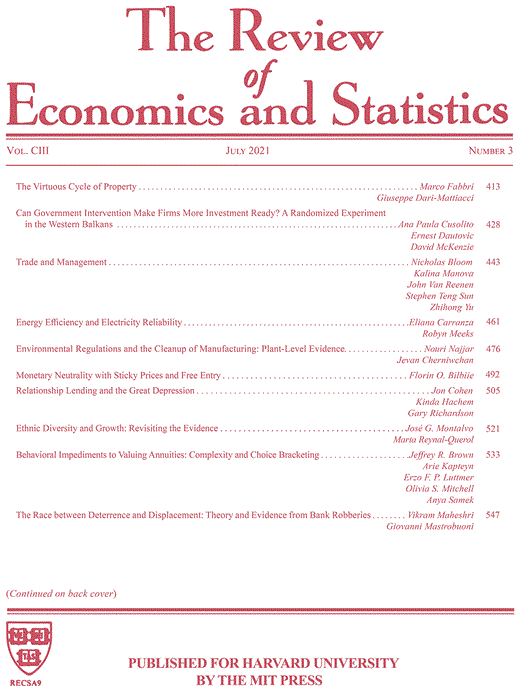
Behavioral Impediments to Valuing Annuities: Complexity and Choice Bracketing
Abstract This paper examines two behavioral factors that diminish people's ability to value a lifetime income stream or annuity, drawing on a randomized experiment with about 4,000 adults in a U.S. nationally representative sample. We find that increasing the complexity of the annuity choice reduces respondents' ability to value the annuity, measured by the difference between the sell and buy values they assign to the annuity. When we limit narrow choice bracketing by inducing people to think first about how quickly or slowly to spend down assets in retirement, their ability to value an annuity increases.
Mental accounting of product returns
Abstract Product returns incur a substantial financial loss for retailers. We demonstrate how, when, and why cross‐selling during the product returns process can reduce this loss in revenue. We find consumers more readily spend money refunded from product returns than unspent money. We theorize that this refund effect occurs because consumers psychologically realize the loss of money when purchasing products and earmark that money for spending. Thus, consumers feel a smaller psychological loss when spending refunded money than unspent money on a subsequent purchase. In six experiments, we find consumers spend refunded money more freely than unspent money, even more than windfall gains like lottery winnings, on products in similar and different product categories (e.g., groceries vs. apparel). However, the refund effect only holds when consumers do not expect to return products at the point of purchase and before refunded money is commingled with money in other accounts. Our findings identify a new fungibility violation due to mental accounting (i.e., a new source effect), and illustrate its value for generating, validating, and explaining revenue retention strategies.

Temporal Reframing and Participation in a Savings Program: A Field Experiment
This study explores whether framing savings in more or less granular formats can increase sign-ups for a recurring deposit program in a FinTech environment. , A growing number of American workers are now freelancers and thus, responsible for their own retirement savings, yet they face psychological hurdles that hamper them from saving enough money for the long term. Although prior theory-derived interventions have been successful in addressing some of these obstacles, encouraging participation in saving programs is a challenging endeavor for policy makers and consumers alike. In a field setting, we test whether framing savings in more or less granular formats (for example, saving daily versus monthly) can encourage continued saving behavior through increasing the take up of a recurring deposit program. Among thousands of new users of a financial technology app, we find that framing deposits in daily amounts as opposed to monthly amounts quadruples the number of consumers who enroll. Furthermore, framing deposits in more granular terms reduced the participation gap between lower- and higher-income consumers: three times as many consumers in the highest rather than lowest income bracket participated in the program when it was framed as a $150 monthly deposit, but this difference in participation was eliminated when deposits were framed as $5 per day.
Getting to the Top of Mind: How Reminders Increase Saving
We provide evidence from field experiments with three different banks that reminder messages increase commitment attainment for clients who recently opened commitment savings accounts. Messages that mention both savings goals and financial incentives are particularly effective, whereas other content variations such as gain versus loss framing do not have significantly different effects. Nor do we find evidence that receiving additional late reminders has an additive effect. These empirical results do not map neatly into existing models, so we provide a simple model where limited attention to exceptional expenses can generate undersaving that is in turn mitigated by reminders. Data, as supplemental material, are available at http://dx.doi.org/10.1287/mnsc.2015.2296 . This paper was accepted by Teck-Hua Ho, behavioral economics.

Consumption Response to Credit Expansions: Evidence from Experimental Assignment of 45,307 Credit Lines
In a field experiment that constructs a randomized credit limit shock, participants borrow to spend 11 cents on the dollar in the first quarter and 28 cents by the third year. Effects extend to those far from the limit, those who had the new limits as available credit, and those with a liquid asset buffer. In the short-run, flexible and installment contracts are used in tandem, with unconstrained using installments more. Long-run borrowing is predominantly using installments. Near limits, participants borrow when credit expands but save out of constraints when limits are tight. Findings support a buffer-stock interpretation emphasizing precautionary saving.
The Effects of Financial Incentives in Experiments: A Review and Capital-Labor-Production Framework
We review 74 experiments with no, low, or high performance-based financial incentives. The modal result has no effect on mean performance (though variance is usually reduced by higher payment). Higher incentive does improve performance often, typically judgment tasks that are responsive to better effort. Incentives also reduce “presentation” effects (e.g., generosity and risk-seeking). Incentive effects are comparable to effects of other variables, particularly “cognitive capital” and task “production” demands, and interact with those variables, so a narrow-minded focus on incentives alone is misguided. We also note that no replicated study has made rationality violations disappear purely by raising incentives.
Identifying heterogeneity using recursive partitioning: evidence from SMS nudges encouraging voluntary retirement savings in Mexico
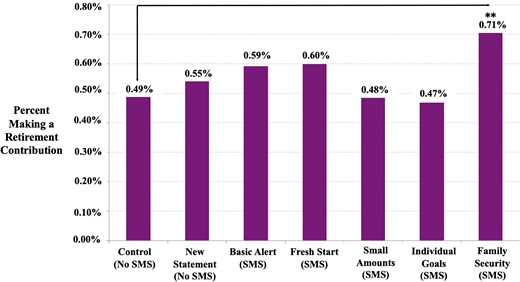
Abstract Individuals regularly struggle to save for retirement. Using a large-scale field experiment (N=97,149) in Mexico, we test the effectiveness of several behavioral interventions relative to existing policy and each other geared toward improving voluntary retirement savings contributions. We find that an intervention framing savings as a way to secure one’s family future significantly improves contribution rates. We leverage recursive partitioning techniques and identify that the overall positive treatment effect masks subpopulations where the treatment is even more effective and other groups where the treatment has a significant negative effect, decreasing contribution rates. Accounting for this variation is significant for theoretical and policy development as well as firm profitability. Our work also provides a methodological framework for how to better design, scale, and deploy behavioral interventions to maximize their effectiveness.
Salary Transparency at Stack Overflow - Stack Overflow
We believe (and developers tell us) that job seekers should be empowered with as much information as possible when looking for a job – especially salary. So we ran an experiment on Stack Overflow Jobs to see if the evidence would support it. Remarkably, we learned that job listings which include a salary range got 75% more clicks than job listings that don’t. With this experiment, we’re even more convinced that transparency isn’t just the right thing to do, it’s good for companies, too. Along with much of the tech community, we were impressed with Buffer’s boldness and leadership in salary transparency. So…

Wage Theft Costs American Workers as Much as $50 Billion a Year
Wage theft is a nationwide epidemic that costs American workers as much as $50 billion a year, a new Economic Policy Institute report finds. In An Epidemic of Wage Theft Is Costing Workers Hundreds of Millions of Dollars a Year, EPI Vice President Ross Eisenbrey and EPI intern Brady Meixell examine incidences of wage theft—employers’…

Choose to Lose: Health Plan Choices from a Menu with Dominated Option*
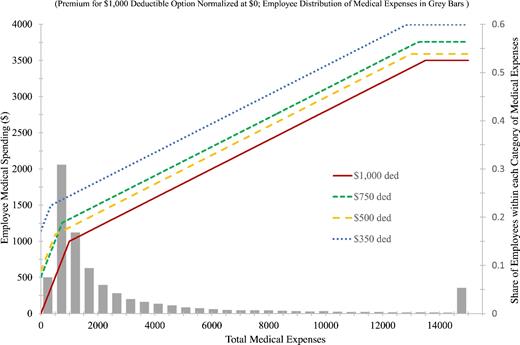
Abstract We examine the health plan choices that 23,894 employees at a U.S. firm made from a large menu of options that differed only in financial cost-sharing and premium. These decisions provide a clear test of the predictions of the standard economic model of insurance choice in the absence of choice frictions because plans were priced so that nearly every plan with a lower deductible was financially dominated by an otherwise identical plan with a high deductible. We document that the majority of employees chose dominated plans, which resulted in excess spending equivalent to 24% of chosen plan premiums. Low-income employees were significantly more likely to choose dominated plans, and most employees did not switch into more financially efficient plans in the subsequent year. We show that the choice of dominated plans cannot be rationalized by standard risk preference or any expectations about health risk. Testing alternative explanations with a series of hypothetical-choice experiments, we find that the popularity of dominated plans was not primarily driven by the size and complexity of the plan menu, nor informed preferences for avoiding high deductibles, but by employees’ lack of understanding of health insurance. Our findings challenge the standard practice of inferring risk preferences from insurance choices and raise doubts about the welfare benefits of health reforms that expand consumer choice.
Consumer Spending during Unemployment: Positive and Normative Implications
Using de-identified bank account data, we show that spending drops sharply at the large and predictable decrease in income arising from the exhaustion of unemployment insurance (UI) benefits. We use the high-frequency response to a predictable income decline as a new test to distinguish between alternative consumption models. The sensitivity of spending to income we document is inconsistent with rational models of liquidity-constrained households, but is consistent with behavioral models with present-biased or myopic households. Depressed spending after exhaustion also implies that the consumption-smoothing gains from extending UI benefits are four times larger than from raising UI benefit levels. (JEL D14, D91, E21, E24, E70, J65)
Reading the Fine Print: Information Disclosure in the Brazilian Credit Card Market
Consumer credit regulations usually require that lenders disclose interest rates. However, in the absence of specific prominence requirements, lenders can conceal the interest rate in the fine print while still complying with the law. I examine the effect of such a strategy using a field experiment in Brazil in which a credit card company offered their clients payment plans to pay off their balances. Using randomized contract interest rates and the degree of rate disclosure, I show that most clients are rate sensitive, whether or not rates are prominently disclosed. The elasticity of payment plan enrollment with respect to the interest rate ranges from −0.711 to −0.880. High-risk clients are an exception; these clients are rate sensitive only when disclosure is prominent. I also show that clients are influenced by nudges that favor longer-term contracts. Conditional on enrollment, the proportion of clients who choose a longer-term contract is 40 percentage points higher when a longer-term contract is featured in the advertisement layout. This effect, however, is weaker when stakes are higher. Data, as supplemental material, are available at http://dx.doi.org/10.1287/mnsc.2015.2281 . This paper was accepted by Wei Jiang, finance.
Role Integration Increases the Fungibility of Mentally Accounted Funds
Bridging the gap between the mental accounting and identities/roles literatures, the present research examines how the extent to which an individual's life roles (e.g., “employee,” “spouse”) are integrated (i.e., have more flexible and permeable psychological boundaries between them) moderates the fungibility of mentally accounted funds. Specifically, individuals with more integrated roles are more able to circumvent the constraints typically imposed by mental budgeting and earmarking; therefore, they are more likely to use funds that are allocated or budgeted for the purposes of one role to service the needs/wants of another role. This holds regardless of whether funds have been (1) allocated to a broader role-specific mental account for future expenditures or (2) earmarked for a specific purchase. The authors find evidence that the effect of role integration arises because those with more integrated roles believe that making purchases for one role using funds allocated or budgeted for the other role is more justifiable.
Improving Customer Compatibility with Tradeoff Transparency
Through a large-scale field experiment with 393,036 customers considering opening a credit card account with a nationwide retail bank, we investigate how providing transparency into an offering’s tradeoffs affects subsequent rates of customer acquisition and long-run engagement. Although we find tradeoff transparency to have an insignificant effect on acquisition rates, customers who were shown each offering’s tradeoffs selected different products than those who were not. Moreover, prospective customers who experienced transparency and subsequently chose to open an account went on to exhibit higher-quality service relationships over time. Monthly spending was 9.9% higher and cancellation rates were 20.5% lower among those who experienced transparency into each offering’s tradeoffs. Increased product use and retention accrued disproportionately to customers with prior category experience: more-experienced customers who were provided transparency spent 19.2% more on a monthly basis and were 33.7% less likely to defect after nine months. Importantly, we find that these gains in engagement and retention do not come at the expense of customers’ financial well-being: the probability of making late payments was reduced among customers who experienced transparency. We further find that the positive effects of tradeoff transparency on engagement and retention were attenuated in the presence of a promotion that provided financial incentives to choose particular offerings. Taken together, these results suggest that providing transparency into an offering’s tradeoffs may be an effective strategy for informing customer choices, leading to better outcomes for customers and firms alike. This paper was accepted by Vishal Gaur, operations management. Funding: Funding for this research, apart from the costs Commonwealth Bank of Australia internally incurred to support the experiment, was provided by Harvard Business School. R. W. Buell has received compensation from Commonwealth Bank of Australia in the past for executive education teaching. Supplemental Material: The online appendix and data files are available at https://doi.org/10.1287/mnsc.2024.4985 .
Employment protection legislation reforms and the rising cost of job loss
A widely cited argument in favour of easing employment protection rules is that greater flexibility in hiring and firing can lead to increased job matching efficiency and productivity, but this may come at a cost for certain groups of workers. This column examines the impact of the 2012 ‘Fornero Reform’ in Italy, which lowered the legal and financial risks associated with dismissals for employers in order to encourage firms to offer more open-ended contracts and thus help bridge the divide between permanent and temporary employment. In practice, the reform increased the cost of job loss, particularly for younger and more vulnerable workers.