


Through a large-scale field experiment with 393,036 customers considering opening a credit card account with a nationwide retail bank, we investigate how providing transparency into an offering’s tradeoffs affects subsequent rates of customer acquisition and long-run engagement. Although we find tradeoff transparency to have an insignificant effect on acquisition rates, customers who were shown each offering’s tradeoffs selected different products than those who were not. Moreover, prospective customers who experienced transparency and subsequently chose to open an account went on to exhibit higher-quality service relationships over time. Monthly spending was 9.9% higher and cancellation rates were 20.5% lower among those who experienced transparency into each offering’s tradeoffs. Increased product use and retention accrued disproportionately to customers with prior category experience: more-experienced customers who were provided transparency spent 19.2% more on a monthly basis and were 33.7% less likely to defect after nine months. Importantly, we find that these gains in engagement and retention do not come at the expense of customers’ financial well-being: the probability of making late payments was reduced among customers who experienced transparency. We further find that the positive effects of tradeoff transparency on engagement and retention were attenuated in the presence of a promotion that provided financial incentives to choose particular offerings. Taken together, these results suggest that providing transparency into an offering’s tradeoffs may be an effective strategy for informing customer choices, leading to better outcomes for customers and firms alike. This paper was accepted by Vishal Gaur, operations management. Funding: Funding for this research, apart from the costs Commonwealth Bank of Australia internally incurred to support the experiment, was provided by Harvard Business School. R. W. Buell has received compensation from Commonwealth Bank of Australia in the past for executive education teaching. Supplemental Material: The online appendix and data files are available at https://doi.org/10.1287/mnsc.2024.4985 .
The Effect of Payment Transparency on Consumption: Quasi-Experiments from the Field
Recent research suggests that the method of making a payment can influence the willingness to pay and consumption behavior. In this manuscript, we argue that payment mechanisms differ from each other along the dimensions of transparency, and that the degree of transparency correlates positively with the pain of paying using the mechanism, and negatively with consumption and spending. We replicate previous experimental results using quasi-experiments from the field, and find that the lower the payment transparency, the greater is the consumption. However, this effect is weak for products whose consumption rates are inflexible.
What else can your payment card do? Multifunctionality of payment modes can reduce payment transparency
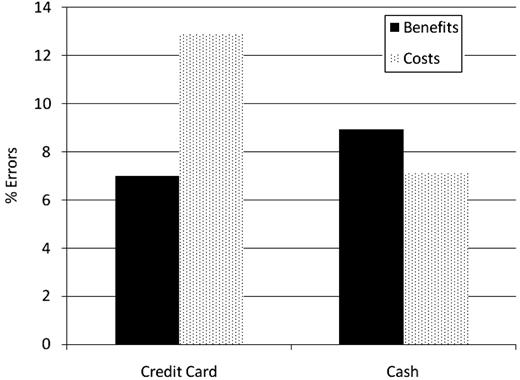
Payment modes (e.g., cash vs. credit card) vary in the transparency of the outflow of money. Smartcards (multifunctional cards), which bundle payment with non-payment functions (e.g., loyalty programs, identification, and other information functions), have become an increasingly popular payment mode. This shift toward multifunctionality in payment modes is assumed to reduce payment transparency and consequently to decrease consumers’ recall accuracy of past expenditures. We employ a field study to examine recall accuracy for recent purchases with cash, a single-function card, and a multifunctional card. We find that recall accuracy is lower when using a single- or a multifunction card than cash. We also find that it is not the multifunctionality of the card that results in a higher recall error but the individual usage patterns: A higher usage frequency of the non-payment functions results in a higher recall error.
Are Self‐Service Customers Satisfied or Stuck?
This paper investigates the impact of self‐service technology (SST) usage on customer satisfaction and retention. Specifically, we disentangle the distinct effects of satisfaction and switching costs as drivers of retention among self‐service customers. Our empirical analysis examines 26,924 multi‐channel customers of a nationwide retail bank. We track each customer's channel usage, overall satisfaction, and retention over a 1‐year period. We find that, relative to face‐to‐face service, customers who use self‐service channels for a greater proportion of their transactions are either no more satisfied, or less satisfied with the service they receive, depending on the channel. However, we also find that these same customers are predictably less likely to defect to a competitor if they are heavily reliant on self‐service channels characterized by high switching costs. Through a mediation model, we demonstrate that, when self‐service usage promotes retention, it does so in a way that is consistent with switching costs. As a robustness check, we examine the behavior of channel enthusiasts, who concentrate transactions among specific channels. Relative to more diversified customers, we find that self‐service enthusiasts in low switching cost channels defect with greater frequency, while self‐service enthusiasts in high switching cost channels are retained with greater frequency.

Do Payment Mechanisms Change the Way Consumers Perceive Products?
Abstract. Do payment mechanisms change the way consumers perceive products? We argue that consumers for whom credit cards (cash) have been primed focus mor
Do Customers Learn from Experience? Evidence from Retail Banking
We study customers' adoption and subsequent switching decisions with regard to a menu of three-part tariff plans offered by a commercial bank. Using a rich panel data set covering 70,510 fee-based checking accounts over 30 months, before and after the introduction of the plans, we find that most customers adopt non-cost-minimizing plans, preferring plans with large monthly allowances and high fixed payments. Furthermore, after adoption, customers who exceed their allowances and consequently pay overage fees are more likely to switch to plans with larger allowances than customers who do not experience such fees. Notably, after switching, these overage-paying customers pay higher monthly payments than before. In contrast, switching customers who did not pay overage payments before switching pay less after switching. Our findings, unlike those of previous research on experience-based learning, suggest that the behavior of experienced customers does not converge to the predictions of neoclassical models. We propose that “overage aversion,” which is closely related to loss aversion and mental accounting, is the most plausible explanation for our findings. This paper was accepted by John List, behavioral economics.
Minimum Payments Alter Debt Repayment Strategies Across Multiple Cards
U.S. households currently hold $770 billion in credit card debt, often managing repayments across multiple accounts. The authors investigate how minimum payment requirements (i.e., the requirement to allocate at least some money to each account with a balance) alter consumers’ allocation strategies across multiple accounts. Across four experiments, they find that minimum payment requirements cause consumers to increase dispersion (i.e., spread their repayments more evenly) across accounts. The authors term this change in strategy “the dispersion effect of minimum payments” and provide evidence that it can be costly for consumers. They find that the effect is partially driven by the tendency for consumers to interpret minimum payment requirements as recommendations to pay more than the minimum amount. While the presence of the minimum payment requirement is unlikely to change, the authors propose that marketers and policy makers can influence the effects of minimum payments on dispersion by altering the way that information is displayed to consumers. Specifically, they investigate five distinct information displays and find that choice of display can either exaggerate or minimize dispersion and corresponding costs. They discuss implications for consumers, policy makers, and firms, with a particular focus on ways to improve consumer financial well-being.
Do Liquidity Constraints and Interest Rates Matter for Consumer Behavior? Evidence from Credit Card Data
Abstract. This paper utilizes a unique data set of credit card accounts to analyze how people respond to credit supply. Increases in credit limits generate
“Repayment-by-Purchase” Increases Consumer Debt Repayment
This article tests the effect of a novel credit card payment format—repayment-by-purchase—on consumers’ payments toward credit card debt. In contrast to typical balance repayment, where consumers make repayments relative to a total amount owed, repayment-by-purchase prompts consumers to select items (e.g., a Starbucks coffee) or categories of purchase (e.g., restaurant and café purchases) and to make payments toward their related debt. A field experiment first suggests that customers who opted into repayment-by-purchase paid 12.18% more toward their statement balance than a control group. Subsequently, five lab experiments show that consumers repaying-by-purchase increase repayment by an average of 22.47% over typical balance repayment. Process evidence suggests that these differences may be driven by repayment-by-purchase's power to increase purchase salience, which in turns increases perceptions of progress toward reducing debt. Consistent with this theory, the effect of repayment-by-purchase on bill repayment emerges regardless of whether consumers repay durable versus nondurable goods, and for specific items or categories of purchases, as long as the bill uses labels that are concrete enough to raise past purchase salience.
Information disclosure and credit card repayments: evidence from Malaysia
Purpose This study analyzes the role of information disclosure in influencing credit card repayments by focusing on three intervention methods for improving repayment decisions among credit cardholders. Design/methodology/approach This study uses the survey method to collect data. Four questionnaires are designed to identify which types of disclosure elicit better repayment decisions among credit cardholders. The participants were approached using the mall intercept method, and a total of 1,775 responses were obtained. Findings Estimations using means comparison tests show that not providing minimum payment information improves repayments. The expected benefits are not delivered by the provision of higher minimum payment information or additional information that highlights the negative effects of making the minimum repayment only. Further analysis using logit estimation reconfirms the benefit of not providing minimum payment information. However, when such information is given, low minimum payment information elicits better repayment decisions than high minimum payment information or additional information. Repayment worsens under the additional information condition compared to the high minimum payment condition. Research limitations/implications The findings of this study have a bearing on the decisions of policy makers, credit card issuers and consumers. Originality/value This paper clarifies the role of information in improving debt repayment decisions.
How Do Consumers Avoid Penalty Fees? Evidence from Credit Cards
Using data from multiple card issuers, we show that the most common penalty fee type incurred by credit card holders, late payment fees, declines sharply over the first few months of card life. This phenomenon is wholly due to some consumers adopting automatic payments after a late payment event, thereby insuring themselves against future late payment fees. Nonadopters, who remain on manual-only payments, experience an unchanged high likelihood of future fees, despite exhibiting ample levels of available liquidity. Our results show that heterogeneity in adopting account management features of financial products, such as automatic payments, is important for understanding who avoids financial mistakes. This paper was accepted by Gustavo Manso, finance.
Purchase Justifiability Drives Payment Choice: Consumers Pay with Card to Remember and Cash to Forget
AbstractAlthough consumers often have multiple payment methods at their fingertips, such as cash and credit/debit cards, prior research is silent on how consumers choose between them. We home in on a key element of purchase—purchase justifiability—that affects how consumers choose to pay. Analysis of 118,042 real-world purchases and six experiments reveals that when consumers are motivated to forget (vs. remember) a purchase because they see it as difficult (vs. easy) to justify, they have an increased preference to pay with cash (vs. card) because cards create a “paper/electronic trail” that aids memory retrieval. These payment preferences are strongest among consumers most likely to recall/track their card spending, and manifest only when card expenses are trackable. We reconcile our results with the classic effect of payment method on pain of paying and discuss implications for merchants and for financial institutions designing payment methods of the future.

Rewards and Misperceived Spending: Experimental Evidence from Credit Cards
Using proprietary data, a survey, and an experiment with a major bank in China, this paper studies how credit card rewards affect perceived and actual consumer

Differences in Consumer Purchase Behavior by Credit Card Payment System
Abstract. A conceptualization of the relationships between alternative payment systems and various environmental and behavioral variables, which may serve
Always Leave Home Without It: A Further Investigation of the Credit-Card Effect on Willingness to Pay
In studies involving genuine transactions of potentially high value we show that willingness-to-pay can be increased when customers are instructed to use a credit card rather than cash. The effect may be large (up to 100%) and it appears unlikely that it arises due solely to liquidity constraints. In addition to demonstrating the effect, we provide a methodology for detecting it, and our findings suggest a source of variance to test alternative explanations.
Disclosure: Psychology Changes Everything
We review literature examining the effects of laws and regulations that require public disclosure of information. These requirements are most sensibly imposed in situations characterized by misaligned incentives and asymmetric information between, for example, a buyer and seller or an advisor and advisee. We review the economic literature relevant to such disclosure and then discuss how different psychological factors complicate, and in some cases radically change, the economic predictions. For example, limited attention, motivated attention, and biased assessments of probability on the part of information recipients can significantly diminish, or even reverse, the intended effects of disclosure requirements. In many cases, disclosure does not much affect the recipients of the information but does significantly affect the behavior of the providers, sometimes for the better and sometimes for the worse. We review research suggesting that simplified disclosure, standardized disclosure, vivid disclosure, and social comparison information can all be used to enhance the effectiveness of disclosure policies.

Disclosing the costs of co-holding liquid assets and high-interest debt has limited impact on behavior
Abstract Why do consumers simultaneously maintain low-yield liquid assets and high-interest revolving debt? This behavior, known as ``co-holding,'' affects 23\% of credit card users in our sample from a major international bank and costs the typical co-holder hundreds of dollars annually in unnecessary interest charges. Our analysis of 38 months of detailed banking records reveals that co-holding is remarkably persistent, with typical co-holders maintaining this behavior for most months observed. Our analysis also reveals that co-holding is not a static financial position: co-holders regularly deposit and withdraw from asset accounts while simultaneously making new credit card purchases. To test whether co-holding could be addressed through information disclosure, we conducted a large-scale field experiment (n = 125,328), providing clear information about co-holding behavior and its costs. Customers received targeted messages through their bank's mobile app, where they could easily transfer money from assets to pay down debt. Despite sufficient power to detect economically small effects, we found no meaningful changes in debt repayment amount, though customers did respond in other ways---making more frequent repayments and paying above required minimums. These results challenge explanations based on limited attention or information gaps and suggest that simple information disclosure, even when carefully designed and delivered through trusted channels, may not effectively address costly financial behaviors.
