Steward ownership is a proven ownership model that has been in place for many decades – having been implemented by companies like Zeiss (Germany), Novo Nordisk (Denmark), Patagonia (USA), Bosch (Germany), Signal (USA), BuurtzorgT (Netherlands), Carlsberg (Denmark) and many others around the world.
What's steward ownership? - Purpose
Steward ownership is a proven ownership model that has been in place for many decades – having been implemented by companies like Zeiss (Germany), Novo Nordisk (Denmark), Patagonia (USA), Bosch (Germany), Signal (USA), BuurtzorgT (Netherlands), Carlsberg (Denmark) and many others around the world.
Steward-ownership
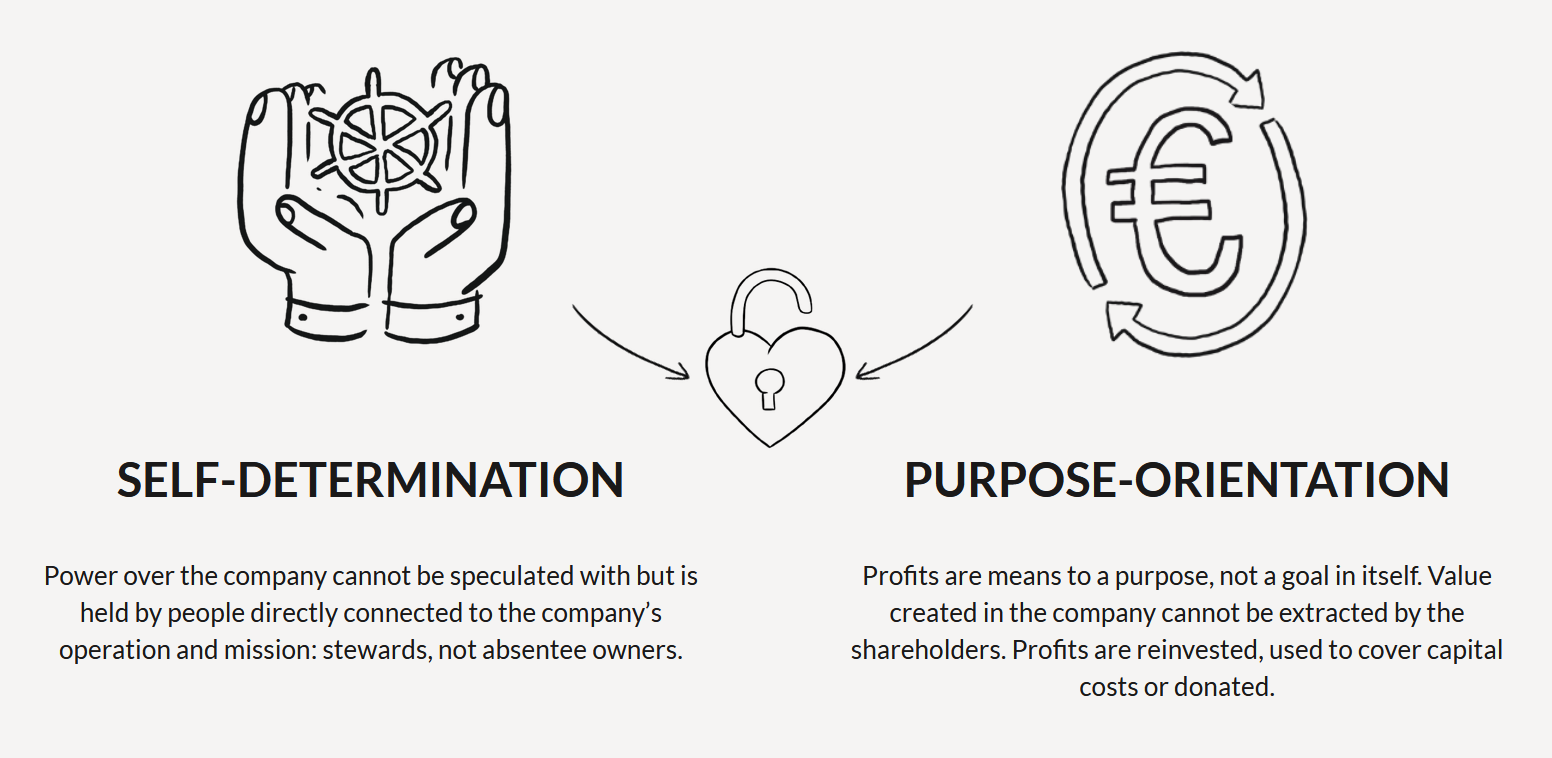
Steward-ownership structures a company's ownership in a way that separates economic rights (related to money) from voting rights (related to decision-making power).[1] Steward-ownership is considered an alternative to shareholder primacy models.[2] Steward-ownership can be implemented using different legal forms depending on the type of company and jurisdiction.[3]
Steward Ownership, Sustainability, and Capitalism: Part 1
Steward-ownership is capitalism 2.0
In my previous post, I explained why we need to change incentive structures if we want to build companies that are a force for good in…

Company as a Commons
What if excess wealth derived from business couldn't be privatized? Through the levers of steward-ownership, companies can protect their purpose-oriented long term mission from the maligned incentives of absentee stakeholders.
Built, Owned & Stewarded in Europe
Steward & Employee Ownership keep mission, capital and talent rooted in Europe. We're asking the EU to make it an option.
Composable Trust, Part 2: Separating Trust from Governance - Eclectic Corvine Muses
”Who belongs” and “What belonging means” are different questions. What happens if one steward stops answering both?
Alkemio
Alkemio, a purpose-driven organization based in the Netherlands, found a way to reward both financial backers and employees contributing their time within a steward-ownership framework. The founders aimed to create a structure that would:

Democratic Ownership Funds: Creating Shared Wealth and Power
Recent decades have seen a rapid and little-discussed transformation in corporate ownership structure, with vital consequences for company behaviour and inequality.

Shareholder Democracy Is a Corporate Governance Myth That Won’t Die
In a new article, we challenge one of corporate law’s most persistent narratives: the concept of “shareholder democracy.” With people on opposing sides of recent high-profile battles at compa…

Introducing the Ownership Model Canvas
A new tool to re-align business success with ownership

Database of Alternative Ownership Enterprise Investment Funds And Vehicles
Transform Finance is pleased to release a new database for investors interested in Alternative Ownership Enterprises (AOEs). Alternative Ownership Enterprises (AOEs) are firms that significantly shift economic value and decision-making power toward the non-investor stakeholders they impact, such as workers, producers, consumers, community members, or even a non-financial purpose.

Just Enough Governance: Introducing Steward Governance for DASL
When we started working on DASL, it was little more than an experiment. We talked to as many people as we could who had been interested in content addressing but couldn't make it work for their needs. The result was radically focused on interoperability and adoption, on a mission

WSJ News Exclusive | Private-Equity Giants Back New Nonprofit Promoting Employee Ownership
More than 60 groups, including banks and pension funds, have also signed on to support Ownership Works, which aims to promote broad-based stock ownership as a means of curbing income inequality.

Collective funding, governance and prioritization of a browser engine projects · Issue #11 · w3c/breakouts-day-2025
Session description Today, each of the three main, open source browser engine projects have a steward organization which contribute, by far, the lion's share of the project's commits - 75-9...
Who owns nature ?
International policies for the protection of the Environment rest on a very specific conception of nature, which appeared in Europe during the Enlightenment. This conception is far from being shared by all the peoples of the earth, who value different cosmological principles. According to Philippe Descola, the preservation of biodiversity can only become fully effective if it takes into account this plurality in the understanding of nature. At the instigation of international (…)