

I love calculator
The other day I was randomly browsing in a bookstore and stumbled by Empire of the Sum: The Rise and Reign of the Pocket Calculator. As I was flipping through its pages, a realization dawned on me with some force: I... love... calculator. I don't mean as a physical device that you would wish to purchase and use today. I mean as a product of technology and a symbol of a kind of philosophy. Behold:
Fidget
Fidget is a library for representing, compiling, and evaluating large-scale math expressions, i.e. hundreds or thousands of arithmetic clauses. It's mainly designed as a backend for implicit surfaces, but the library is flexible enough for many different uses!
KaTeX – The fastest math typesetting library for the web
Simple API, no dependencies – yet super fast on all major browsers.

Old and new apps, via modern coding agents
I have been interested in machine-assisted ways to do and teach mathematics from as far back as 1999, when I started coding several applets in Java 1.0, both for my complex analysis and linear alge…

Times Tables — Learn, Play and Print the Multiplication Tables
Practise every times table from 1 to 12 with free games, speed tests, printable charts and worksheets. Works on phones, tablets and computers. No sign-up.

It Is Fun to Pretend That Hard Things Are Easy!
A new online math platform promises to teach math 4x faster. Here is how!

All elementary functions from a single binary operator
A single two-input gate suffices for all of Boolean logic in digital hardware. No comparable primitive has been known for continuous mathematics: computing elementary functions such as sin, cos, sqrt, and log has always required multiple distinct operations. Here I show that a single binary operator, eml(x,y)=exp(x)-ln(y), together with the constant 1, generates the standard repertoire of a scientific calculator. This includes constants such as e, pi, and i; arithmetic operations including addition, subtraction, multiplication, division, and exponentiation as well as the usual transcendental and algebraic functions. For example, exp(x)=eml(x,1), ln(x)=eml(1,eml(eml(1,x),1)), and likewise for all other operations. That such an operator exists was not anticipated; I found it by systematic exhaustive search and established constructively that it suffices for the concrete scientific-calculator basis. In EML (Exp-Minus-Log) form, every such expression becomes a binary tree of identical nodes, yielding a grammar as simple as S -> 1 | eml(S,S). This uniform structure also enables gradient-based symbolic regression: using EML trees as trainable circuits with standard optimizers (Adam), I demonstrate the feasibility of exact recovery of closed-form elementary functions from numerical data at shallow tree depths up to 4. The same architecture can fit arbitrary data, but when the generating law is elementary, it may recover the exact formula.

Mathematicians still don’t know the fastest way to multiply numbers
A 23-year-old student overturned an ancient conjecture about one of math’s simplest operations

qutebrowser | qutebrowser
qutebrowser's primary maintainer, The-Compiler, is currently working part-time on qutebrowser, funded by donations.
A balanced review of Math Academy | Hacker News
(At the time I recommended my son start doing Math Academy, I had done 3722 XP myself, which is about 60 hours' worth.)
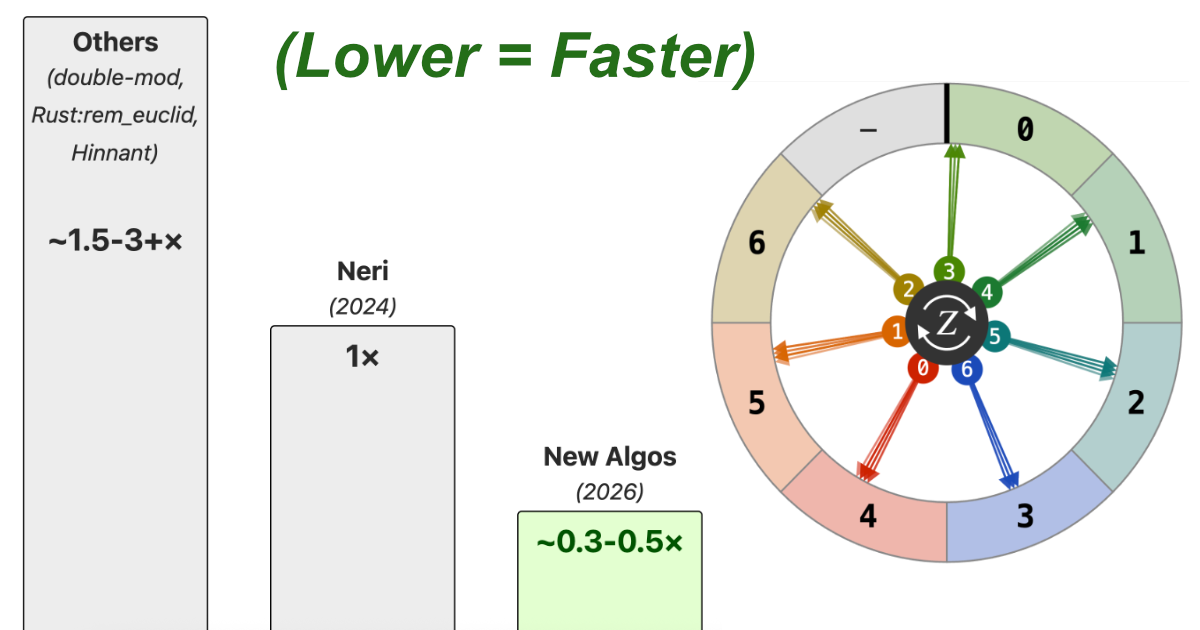
A faster way to calculate the day-of-the-week
A range of fast modulus techniques that beat compiler output
Regnestykker
Sheets with calculus exercises suitable for kids that are learning the first basic arithmetic operations.
Calculating with lenses | Proceedings of the 20th ACM SIGPLAN workshop on Partial evaluation and program manipulation
Functional programs are particularly well suited to formal manipulation by equational reasoning. In particular, it is straightforward to use calculational methods for program transformation. Well-known transformation techniques, like tupling or the ...

Qoder - AI Coding Assistant | Autonomous Development Desktop
Qoder is a next-generation AI programming platform that offers intelligent code completion, AI conversational programming, and automatic code generation. It supports mainstream IDEs like VS Code and JetBrains. Download for free.
Qwikというフレームワークについて - console.lealog();
GitHub - BuilderIO/qwik: An Open-Source framework designed for best possible time to interactive, by focusing on resumability of server-side-rendering of HTML, …
Qt Platform Abstraction | Platform Integration | Qt 6.11.1
The Qt Platform Abstraction (QPA) is the main platform abstraction layer in Qt.