

We are publishing a list of QOJ problems for which LLMs, mostly GPT, have found solutions that are significantly faster than the authors’ intended solutions. If you would like to submit additional problems for inclusion in this list, please write an editorial on QOJ in the problem forum, mark it as anonymous, and leave a comment below.
clem 🤗 on Twitter / X
The main breakthrough of GPT-5 was to route your messages between a couple of different models to give you the best, cheapest & fastest answer possible.This is cool but imagine if you could do this not only for a couple of models but hundreds of them, big and small, fast and… pic.twitter.com/ww2ApYTN3D— clem 🤗 (@ClementDelangue) October 17, 2025

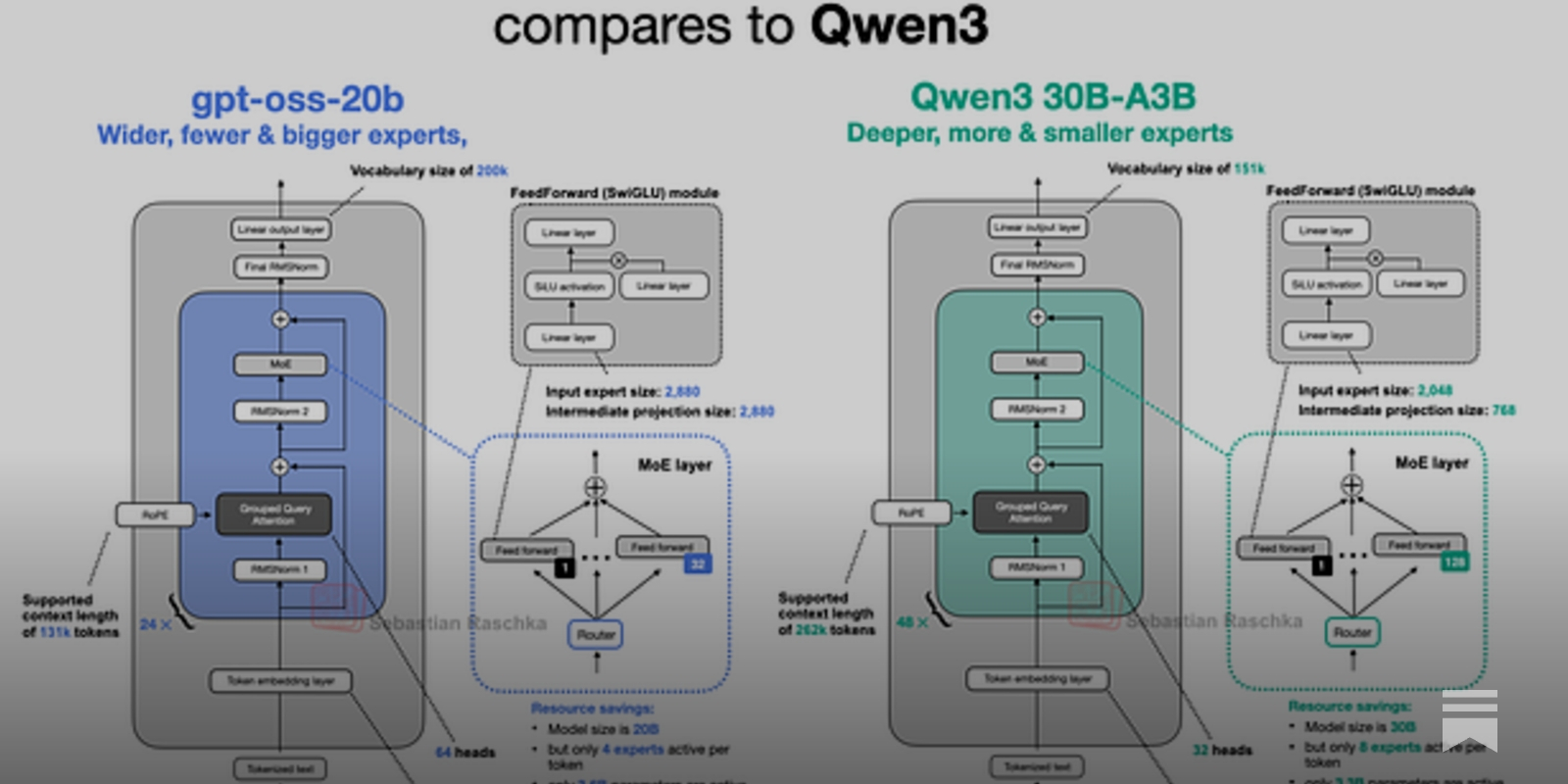
From GPT-2 to gpt-oss: Analyzing the Architectural Advances
And How They Stack Up Against Qwen3
Introducing GPT-5.4
Introducing GPT-5.4, OpenAI’s most most capable and efficient frontier model for professional work, with state-of-the-art coding, computer use, tool search, and 1M-token context.

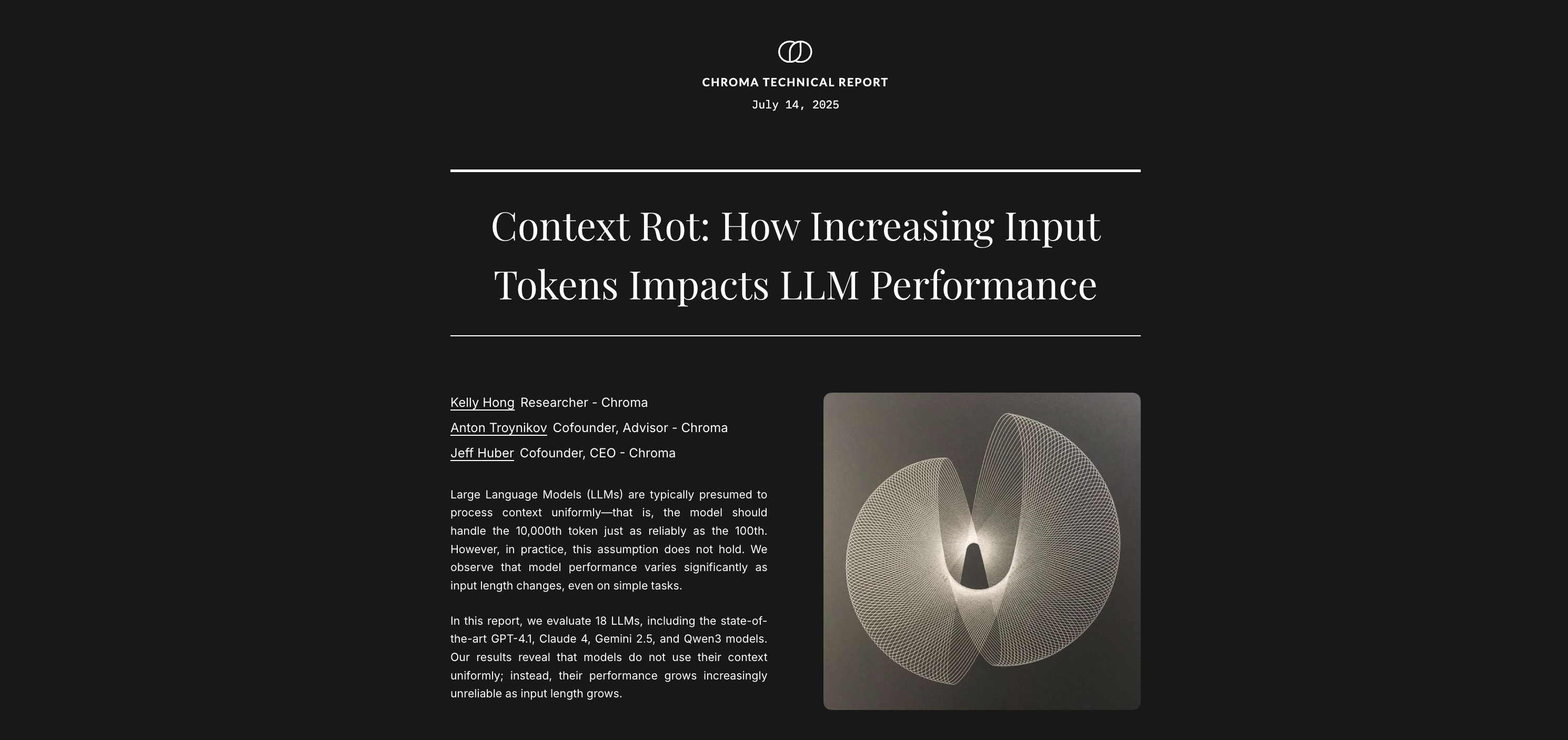
Context Rot: How Increasing Input Tokens Impacts LLM Performance
Large Language Models (LLMs) are typically presumed to process context uniformly—that is, the model should handle the 10,000th token just as reliably as the 100th. However, in practice, this assumption does not hold. We observe that model performance varies significantly as input length changes, even on simple tasks. In this report, we evaluate 18 LLMs, including the state-of-the-art GPT-4.1, Claude 4, Gemini 2.5, and Qwen3 models. Our results reveal that models do not use their context uniformly; instead, their performance grows increasingly unreliable as input length grows.
What sort of maths are LLMs good at?
For the sake of anyone who might read this blog post in the distant future (a month from now, say), let me mention that I am writing it a few days after OpenAI announced that it had solved ten majo…

LLM Leaderboard 2026 — Compare Top AI Models
Compare the latest LLM benchmarks for GPT, Claude, Gemini and more. Updated rankings across reasoning, coding, math, and multilingual tasks with pricing and speed data.
GPT Cloud Cover
Over on Bluesky, Zerodartz comments on the deluge of LLM-spewed content that’s already happening, and only likely to get worse: AI will be 99.9% of content in internet in a few years nobody is...
Noam Brown on Twitter / X
And yes we did try other major problems without success. Sadly no Millennium Prize problems (yet).But also, we didn’t spend a lot on each problem. It’s possible to push test-time compute much further.— Noam Brown (@polynoamial) August 1, 2026
GitHub - karpathy/nanoGPT: The simplest, fastest repository for training/finetuning medium-sized GPTs.
The simplest, fastest repository for training/finetuning medium-sized GPTs. - karpathy/nanoGPT
Solving a Million-Step LLM Task with Zero Errors
LLMs have achieved remarkable breakthroughs in reasoning, insights, and tool use, but chaining these abilities into extended processes at the scale of those routinely executed by humans,...

Mathematics with large language models as provers and verifiers
During 2024 and 2025 the discussion about the theorem-proving capabilities of large language models started reporting interesting success stories, mostly to do with difficult exercises (such as problems from the International Mathematical Olympiad), but also with conjectures [Feldman & Karbasi, arXiv:2509.18383v1] formulated for the purpose of verifying whether the artificial intelligence could prove it. In this paper we report a theorem proving feat achieved by ChatGPT by using a protocol involving different prover and verifier instances of the gpt-5 model working collaboratively. To make sure that the produced proofs do not suffer from hallucinations, the final proof is formally verified by the lean proof assistant, and the conformance of premises and conclusion of the lean code is verified by a human. Our methodology is by no means complete or exact. It was nonetheless able to solve five out of six 2025 IMO problems, and close about a third of the sixty-six number theory conjectures in [Cohen, Journal of Integer Sequences, 2025].
The Kaitchup Index: A Leaderboard for LLMs and Their Quantized Versions
Comparing formats like GGUF, GPTQ, and AWQ, with different bitwidths

Shouqiao Wang on Twitter / X
I solved 6 open Erdős problems in 5 days, using @OpenAI GPT-5.6 Sol.I have a math background, but the Codex workflow I used does not require deep mathematical knowledge.Here’s exactly how I approached it, including my prompts 🧵— Shouqiao Wang (@Qiaoqiao2001) July 22, 2026
LLMs Can Design Near-Optimal OR Algorithms
We ask whether large language models (LLMs) can design effective algorithms for well-specified operations research (OR) problems. We study inventory control, queueing network control, and assortment optimization. We evaluate two levels of LLM use: at level 1, the model receives one problem instance and returns a solution for that instance; at level 2, it receives only the problem class description and broad parameter ranges, and returns an algorithm that maps instance parameters to solutions. Human input is minimal: we give one untuned prompt that describes the problem, and the model has access to a Python sandbox tool with a fixed compute budget. The strongest model we test, gpt-5.6-sol, matches or outperforms the best existing method on almost all evaluated instances. This holds even at level 2, where the returned algorithm is fixed before seeing the evaluation instances. Performance also improves sharply across models released less than eight months apart, suggesting that this capability is moving quickly. Thus, for the well-specified operations problems we study, a single untuned LLM query can already produce algorithms competitive with specialized methods. These results suggest that frontier LLMs can be a serious empirical baseline for algorithm design in well-specified OR problems.
