


Rating, ranking, and comparing peak experiences suggest the existence of long tails for bliss and suffering.
why do we assume progress should feel good?
I can count on one hand the number of times I’ve achieved something and genuinely felt lasting satisfaction.

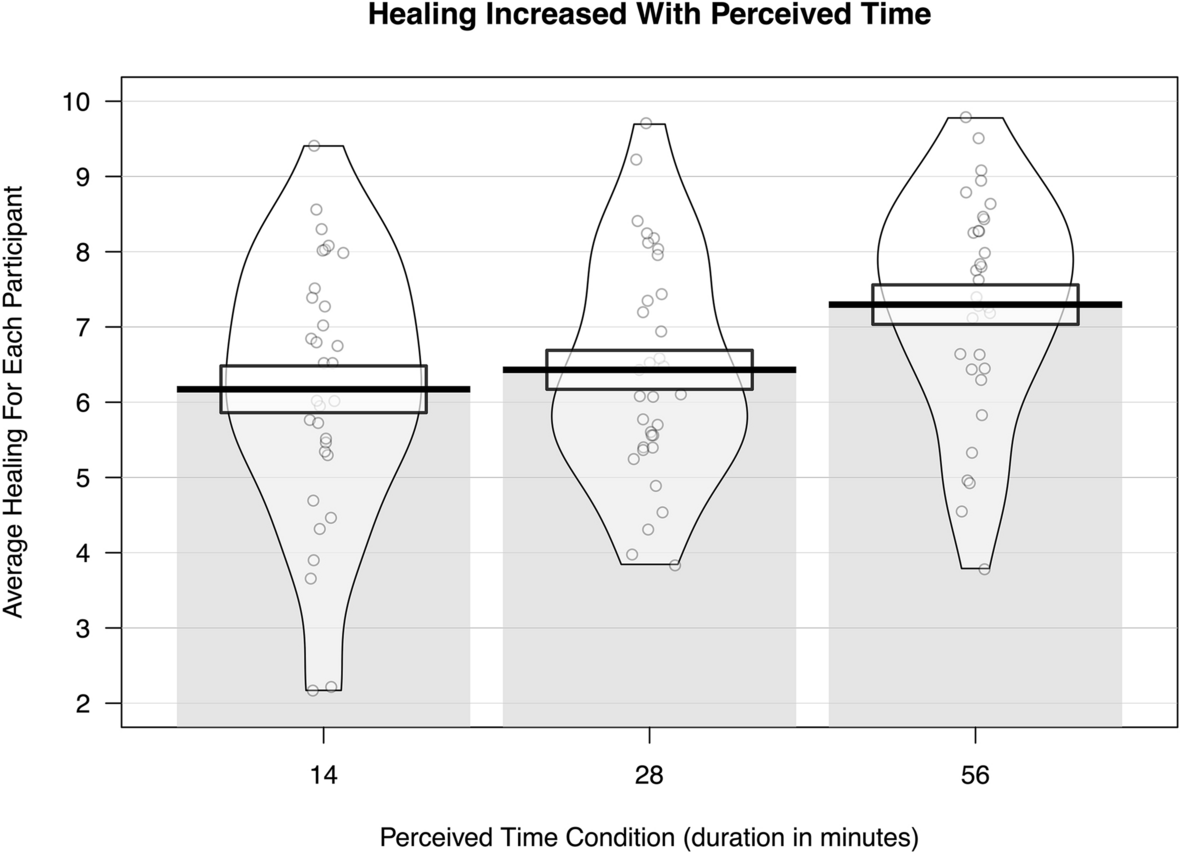
Physical healing as a function of perceived time
In this study we wounded study participants following a standardized procedure and manipulated perceived time to test whether perceived time affected the rate of healing. We measured the amount of healing that occurred across three conditions using a within-subjects design: Slow Time (half as fast as clock time), Normal Time (clock time), and Fast Time (twice as fast as clock time). Based on the theory of mind–body unity—which posits simultaneous and bidirectional influences of mind on body and body on mind—we hypothesized that wounds would heal faster or slower when perceived time was manipulated to be experienced as longer or shorter respectively. Although the actual elapsed time was 28 min in all three conditions, significantly more healing was observed in the Normal Time condition compared to the Slow Time condition, in the Fast Time condition compared to the Normal Time condition, and in the Fast Time condition compared to the Slow Time condition. These results support the hypothesis that the effect of time on physical healing is directly affected by one’s psychological experience of time, independent of the actual elapsed time.
The Consumer in Physical Pain: Implications for the Pain-of-Paying and Pricing
AbstractOver one in five Americans suffer from chronic pain—a figure that does not include other, milder, transient types of pain. Thus, there is abundant work exploring the influence of physical pain on physical and psychological welfare. However, there is no work regarding how physical pain influences consumption decisions, which is important because people in physical pain still buy products and make purchases. Give that physical pain “demands” attention, we suggest that consumers in physical pain (vs. those who are not) feel the pain-of-paying less, thereby increasing their purchase intentions and willingness-to-pay for products. We find evidence for our hypothesis in four studies with field and lab assessments of physical pain. We discuss the contributions and limitations of our work. We also highlight several implications that concern pricing decisions for marketers.

Within this interactive map, videos are plotted along the 27 dimensions of self-reported emotional experience they can reliably evoke. Each letter corresponds to a video. Float over to play. Click and drag to rearrange. Warning: While many of the more intense videos are censored, there is still some explicit content. Viewer discretion is advised.
Within this interactive map, videos are plotted along the 27 dimensions of self-reported emotional experience they can reliably evoke. Each letter corresponds to a video. Float over to play. Click and drag to rearrange. Warning: While many of the more intense videos are censored, there is still some explicit content. Viewer discretion is advised.
Enjoy it again: Repeat experiences are less repetitive than people think.
Extraordinary Passion: Tantric Massage: Who Comes First?
Sex, science, and Tantra - how to have incredible orgasms and amazing sex, and a completely non-spiritual look at why Tantra has such amazing effects.
Extraordinary Passion: Experiencing Cosmic Oneness
Sex, science, and Tantra - how to have incredible orgasms and amazing sex, and a completely non-spiritual look at why Tantra has such amazing effects.
The Pain Axis: LLMs Represent Self-Directed Harm and Act to Relieve It
Large language models sometimes behave in ways resembling human emotional responses, and recent work has identified internal representations that may explain this. We ask whether LLMs represent pain distinctly from fear, sadness, and generic negative valence, and whether this representation functions as pain would be expected to. We build a dataset describing painful situations across five categories: physical, psychological, social, moral, and cognitive. These are paired with controls for fear, negative emotion, negative world states, sadness, non-painful bodily sensation, arousal, numbness, and neutral content. Using denoised difference-in-means, we extract a linear pain direction from 25 open-weight models across five families, ranging from 2B to 72B parameters. We find that this direction separates pain from matched controls in base and instruction-tuned models, is nearly orthogonal to fear and negative valence, and promotes pain-related vocabulary through the unembedding matrix. We then test its functional properties. First, the direction responds to harm targeting the model but not suffering observed in the user; fear and negative-emotion directions show the opposite pattern. Second, adding the pain-direction vector to the model's residual-stream activations during generation produces a consistent progression from vague discomfort to first-person expressions of worthlessness and failure. Third, steered, fine-tuned Qwen 2.5 models choose a pain-relief button even when it worsens their next answer or harms the user. They press it again far less often when the button removes the steering vector than when it does not, even though the models are never told whether the vector is injected or removed. We discuss the implications of these findings for AI safety and welfare.

Extraordinary Passion: Lingam massage: Happy Endings
Sex, science, and Tantra - how to have incredible orgasms and amazing sex, and a completely non-spiritual look at why Tantra has such amazing effects.
Extraordinary Passion: Transcendence and Body Maps
Sex, science, and Tantra - how to have incredible orgasms and amazing sex, and a completely non-spiritual look at why Tantra has such amazing effects.
Learning From Older Adults: An Intergoal Compatibility Account for Successful Happiness Pursuit
Academic Abstract People want to pursue happiness but often fail, a phenomenon known as the paradox of pursuing happiness. The mechanisms underlying this paradox remain elusive. Age differences in happiness—specifically that older adults appear more successful in pursuing happiness (the emotion paradox of aging)—provide valuable insights into effective happiness pursuit. Drawing on this literature, we propose an intergoal compatibility account to interpret both paradoxes through the lens of intergoal interactions, an intuitively critical yet underexplored factor in existing interpretations. This account asserts that greater compatibility (fewer conflicts and greater facilitation) between happiness pursuit and other important personal goals enhances the effectiveness of happiness pursuit, and such compatibility can be enhanced through contextual influences (e.g., age-graded developmental tasks) and strategic self-regulation (e.g., goal adjustments). This account generates testable predictions and practical implications for enhancing happiness pursuit across the lifespan. Public Abstract Why do people often struggle to achieve happiness? And why are older adults happier than younger adults, even though they face more losses in life? While these questions have drawn extensive attention, they remain puzzling. A crucial yet insufficiently explored factor in successful happiness pursuit is intergoal compatibility —the extent to which the pursuit of happiness aligns or conflicts with other important personal goals. For younger adults, the demands of age-related developmental tasks (e.g., educational and career aspirations) often create conflicts with the pursuit of happiness, diminishing its effectiveness. Conversely, in older adults, happiness becomes more prioritized and compatible with other important personal goals, thereby enhancing the effectiveness of pursuing happiness. A lesson we can learn from older adults is to pursue happiness in ways compatible with other important personal goals.

A psychologically rich life: Beyond happiness and meaning.
Extraordinary Passion: Tantra and the Transcendental Experience
Sex, science, and Tantra - how to have incredible orgasms and amazing sex, and a completely non-spiritual look at why Tantra has such amazing effects.
Realization experiences: a convergent account of insight and mystical experiences
We argue that the powerful transformative effects of mystical-type experiences can be understood using the same machinery that underlies insight problem solving, and that both mystical experiences ...

Keeping Count
Sex, science, and Tantra - how to have incredible orgasms and amazing sex, and a completely non-spiritual look at why Tantra has such amazing effects.