


As Robert Oppenheimer watched a mushroom cloud from the first nuclear detonation bloom over a New Mexico test site, he repeated a line from the Hindu epic Bhagavad-Gita: “Now I am become Death, the destroyer of worlds.” The scientist who helped build the world’s most lethal weapon saw how physicists would forever confront the consequences of their discoveries.
Computer Says Kill: The Toxic Love Triangle of Big Tech, Big War & Big Science w/ David Gray Widder
Academia, Big Tech, and the military are caught in a sordid love triangle — and their love language is money.

The Whale and the Reactor: A Search for Limits in an Age of High Technology, Second Edition
“In an age in which the inexhaustible power of scientific technology makes all things possible, it remains to be seen where we will draw the line, where we will be able to say, here are possibilities that wisdom suggest we avoid.” First published to great acclaim in 1988, Langdon Winner’s groundbreaking exploration of the political, social, and philosophical implications of technology is timelier than ever. He demonstrates that choices about the kinds of technical systems we build and use are actually choices about who we want to be and what kind of world we want to create—technical decisions are political decisions, and they involve profound choices about power, liberty, order, and justice. A seminal text in the history and philosophy of science, this new edition includes a new chapter, preface, and postscript by the author.

“Computers enable fantasies” – On the continued relevance of Weizenbaum’s warnings
“The computer has long been a solution looking for problems—the ultimate technological fix which insulates us from having to look at problems.” – Joseph Weizenbaum (1983) Trying to kee…

The Irrational Decision: How We Gave Computers the Power to Choose for Us | Critical AI | Duke University Press
Jathan Sadowski is an associate professor in the Faculty of Information Technology at Monash University in Melbourne, Australia. He is the author of two books on technology and capitalism, Too Smart (2020) and The Mechanic and the Luddite (2025). He also cohosts the podcast This Machine Kills.
How Trump Is Dismantling America’s Scientific Research Machine
The system that has driven life-altering discoveries and helped make the United States a superpower is now under intense strain.

Technological risks are not the end of the world
There’s a scene in the movie Oppenheimer in which the protagonist is trying to explain to General Groves, his military overseer, the hazards of their endeavor. Groves asks Oppenheimer, “Are you saying there’s a chance that when we push that button, we destroy the world?“ The physicist says, “The chances are near zero.” When Groves, understandably alarmed, asks for clarification, Oppenheimer responds, “What do you want from theory alone?”

The Current Crisis: What's Happening to Science in America

Opinion: We Built A Broken Internet. Now We Need To Burn It To The Ground.
In an edited extract from his upcoming book <a href="https://www.amazon.com/dp/B07PS16XY9/" target="_blank">Ruined by Design</a>, Silicon Valley veteran Mike Monteiro explains how designers destroyed the world.

Rebuilding the Architecture of Science
Science built the modern world. It’s time to rebuild the world of science.
Take it from the insiders: Silicon Valley is eating your soul | John Harris
Former Google and Facebook executives are sounding the alarm about the pervasive power of tech, writes Guardian columnist John Harris

Facebook Executive In 2016: “Maybe Someone Dies In A Terrorist Attack Coordinated On Our Tools”
Facebook Vice President Andrew “Boz” Bosworth said that “questionable contact importing practices,” “subtle language that helps people stay searchable,” and other growth techniques are justified by the company’s connecting of people.

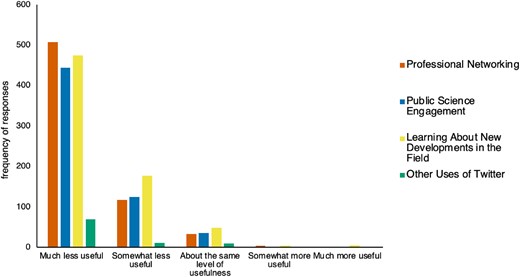
Scientists no Longer Find Twitter Professionally Useful, and have Switched to Bluesky
Synopsis Social media has become widely used by the scientific community for a variety of professional uses, including networking and public outreach. For the past decade, Twitter has been a primary home of scientists on social media. In recent years, new leadership at Twitter has made substantive changes that have resulted in increases in the prevalence of pseudoscience, conspiracy theory, and harassment on the platform, causing many scientists to seek alternatives. Bluesky has been suggested as a good alternative to Twitter, but the phenomenon of academics switching social media platforms has not previously been studied. Here we report on the results of a survey distributed to scientists on Twitter and Bluesky (n = 813). Results overwhelmingly confirm that changes to Twitter have made the social media platform no longer professionally useful or pleasant, and that many scientists have abandoned it in favor of Bluesky. Results show that for every reported professional benefit that scientists once gained from Twitter, scientists can now gain that benefit more effectively on Bluesky than on Twitter.
Reinventing Discovery: The New Era of Networked Science
In Reinventing Discovery, Michael Nielsen argues that w…

Remarkable how over a decade ago @michaelnielsen.bsky.social pointed the way towards solving long standing issues plaguing science to this day (issues that are all the more relevant in the age of AI mediated science)

Ronen Tamari
This is why @atproto.science is so relevant rn This compilation of essays indicates that scientists are most frustrated by insufficient “community tools and resources... Essential infrastructure for sharing, maintaining and building on existing work and data is also badly underdeveloped." >