


As banks, technology giants and would-be disruptors such as Square scrummage over the payment system of the future, German consumers seem perfectly happy with the payment system of the past. Germany remains one of the most cash-intensive advanced economies on earth.
Why Sweden's cashless society is no longer a utopia
Switching fully to card and app payments would put access to our money in the hands of private organizations for the first time in history.
Why Do Shoppers Use Cash? Evidence from Shopping Diary Data
Recent studies find that cash remains the dominant payment choice for small‐value transactions despite the prevalence of alternative payment methods such as debit and credit cards. An important policy question is whether consumers truly prefer using cash or merchants restrict card usage. Using unique shopping diary data, we estimate a payment choice model with individual heterogeneity, controlling for merchants' acceptance of cards. Based on a policy simulation imposing universal card acceptance among merchants, we find that overall cash usage would decrease by only 8.0 percentage points, implying that cash usage in small‐value transactions is driven mainly by consumer preferences.

The role of small and medium-sized enterprises in development: What can be learned from the German experience?
Small and medium-sized enterprises (SMEs) play an important role for development. Of importance are Schumpeterian SMEs, which include start-ups that trigger innovation, boost productivity and bring about structural change. Normal SMEs, which only adjust to market pressure, are also important for development and employment. Germany is a role model for SMEs. This is due to several important factors: Germany's local banking system, which is not profit oriented (made up of Sparkassen, or savings banks); the dual vocational system, with its combination of practical and theoretical education; the high social capital of strong employers' associations and trade unions; government support of SME clusters and a big, government-owned development bank (the KfW). SMEs in developing countries typically suffer from limited access to long-term and affordable finance, insufficient institutions for developing a skilled class of entrepreneurs and workers, a low income, and poor policies to support economic and social upgrading of SMEs. Economic upgrading in developing countries is necessary, but it will not be successful without social upgrading. Germany - with its high social capital within the framework of a social market economy, its financial and education system, and its government support for SMEs - can stimulate debates about SMEs in developing countries.
Explaining adoption and use of payment instruments by US consumers
Motivated by recent policy intervention into payments markets, we develop and estimate a structural model of adoption and use of payment instruments by U.S. consumers. Our structural model differentiates between the adoption and use of payment instruments. We evaluate substitution among payment instruments and welfare implications. Cash is the most significant substitute to debit cards in retail settings, whereas checks are the most significant in bill‐pay settings. Furthermore, low income consumers lose proportionally more than high income consumers when debit cards become more expensive, whereas the reverse is true when credit cards do.

Cash versus Debit Card: The Role of Budget Control
Due to the financial crisis, an increasing number of households face financial problems. This may lead to an increasing need for monitoring spending and budgets. We demonstrate that both cash and the debit card are perceived as helpful in this respect. We show that, on average, consumers responsible for financial decision making within a household find cash and the debit card equally helpful for monitoring their household finances. Individuals differ in major respects, however. In particular, low earners and the liquidity‐constrained prefer cash as a budgeting tool. Finally, we present evidence that at an aggregated level, such preferences strongly affect consumer payment behavior. These findings suggest that the substitution of cash by cards may slow down because of the financial crisis.

How your bank balance buys happiness: The importance of “cash on hand” to life satisfaction.
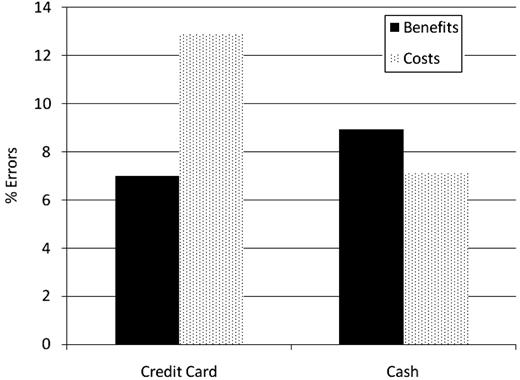
Do Payment Mechanisms Change the Way Consumers Perceive Products?
Abstract. Do payment mechanisms change the way consumers perceive products? We argue that consumers for whom credit cards (cash) have been primed focus mor
Germany’s fiscal stimulus plan shows Europe is learning the wrong lesson from Ukraine | Brookings
Robin Brooks considers the feasibility and impact of Germany's planned spending on the military and infrastructure.

Money makes the world go round Liza Minnelli
Consumer Rationality and Credit Cards
Borrowing on credit cards at high interest rates might appear irrational. However, even low transactions costs can make credit cards attractive relative to bank loans. Credit cards also provide liquidity services by allowing consumers to avoid some of the opportunity costs of holding money. The effect of alternative interest rates on the demand for card debits can explain why credit card interest rates only partially reflect changes in the cost of funds. Credit card interest rates that are inflexible relative to the cost of funds are not inconsistent with a competitive equilibrium that yields zero profits for the marginal entrant.
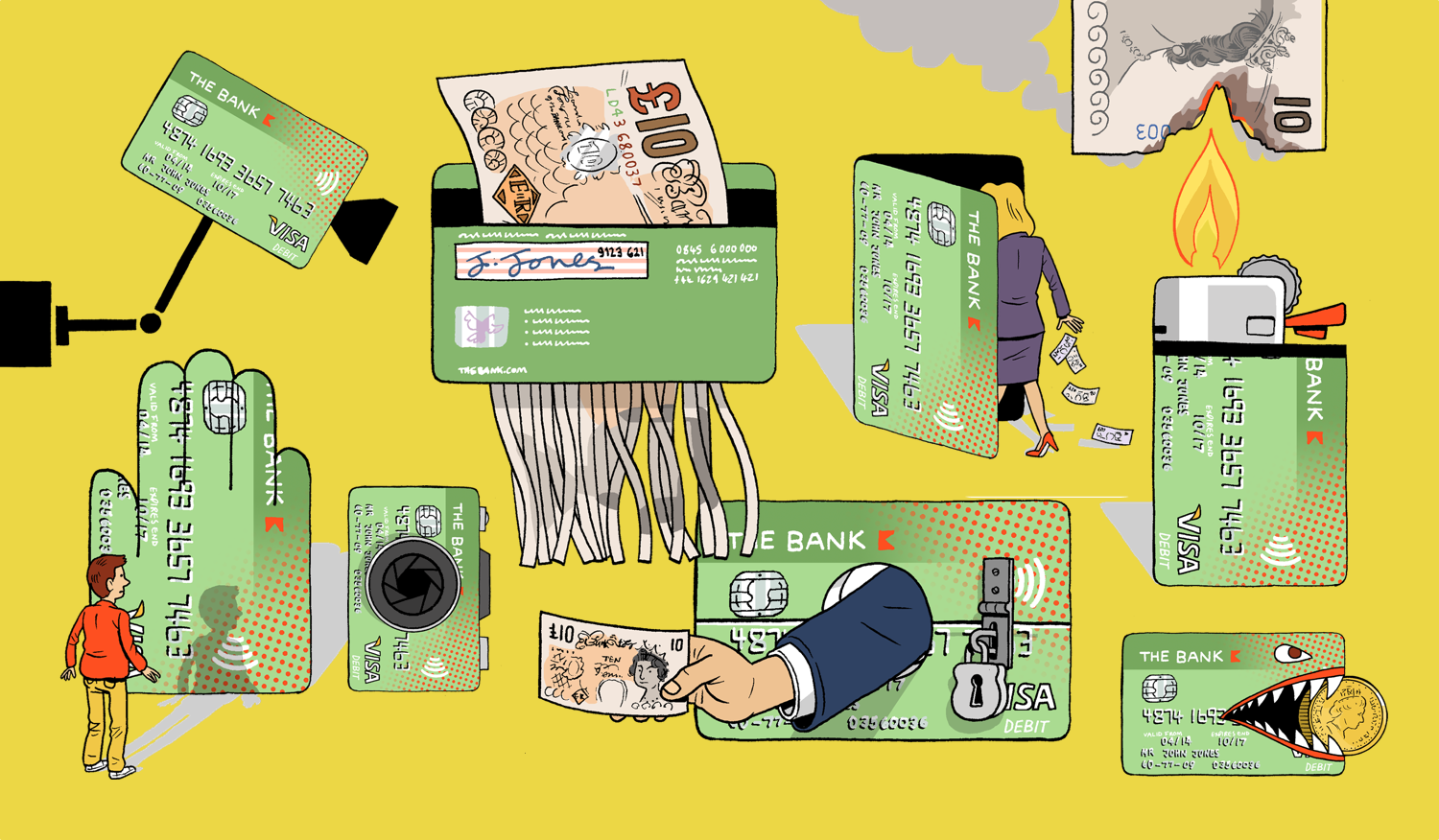
The War on Cash
Banks, governments, credit card companies and fintech evangelists all want us to believe our cashless future is inevitable and good. But this isn't a frictionless utopia says Brett Scott, and it's time to fight back
Purchase Justifiability Drives Payment Choice: Consumers Pay with Card to Remember and Cash to Forget
AbstractAlthough consumers often have multiple payment methods at their fingertips, such as cash and credit/debit cards, prior research is silent on how consumers choose between them. We home in on a key element of purchase—purchase justifiability—that affects how consumers choose to pay. Analysis of 118,042 real-world purchases and six experiments reveals that when consumers are motivated to forget (vs. remember) a purchase because they see it as difficult (vs. easy) to justify, they have an increased preference to pay with cash (vs. card) because cards create a “paper/electronic trail” that aids memory retrieval. These payment preferences are strongest among consumers most likely to recall/track their card spending, and manifest only when card expenses are trackable. We reconcile our results with the classic effect of payment method on pain of paying and discuss implications for merchants and for financial institutions designing payment methods of the future.


The Impact of Unconditional Cash Transfers on Consumption and Household Balance Sheets: Experimental Evidence from Two US States
Founded in 1920, the NBER is a private, non-profit, non-partisan organization dedicated to conducting economic research and to disseminating research findings among academics, public policy makers, and business professionals.
