


Replicate and generalize visual-neuroscience findings using the LAION-fMRI (LfMRI) 7T dataset.
Neuropeek — Accelerating the Neuro-AI convergence
Where brain data becomes shared knowledge. A community-driven platform federating neuroscience datasets, models, and tools to accelerate discovery.

Understanding the Limits of Vision Language Models Through the Lens of the Binding Problem
Recent work has documented striking heterogeneity in the performance of state-of-the-art vision language models (VLMs), including both multimodal language models and text-to-image models. These models are able to describe and generate a diverse array of complex, naturalistic images, yet they exhibit surprising failures on basic multi-object reasoning tasks -- such as counting, localization, and simple forms of visual analogy -- that humans perform with near perfect accuracy. To better understand this puzzling pattern of successes and failures, we turn to theoretical accounts of the binding problem in cognitive science and neuroscience, a fundamental problem that arises when a shared set of representational resources must be used to represent distinct entities (e.g., to represent multiple objects in an image), necessitating the use of serial processing to avoid interference. We find that many of the puzzling failures of state-of-the-art VLMs can be explained as arising due to the binding problem, and that these failure modes are strikingly similar to the limitations exhibited by rapid, feedforward processing in the human brain.
Inventing the future: A neuroscience research roadmap
The past decade of transformative advances in neurotechnology portends an exciting future for neuroscience. This NeuroView charts a strategic path to accelerate and integrate research discovery and speed the development of new cures for human brain disorders.

The brain in the machine: How AI could help explain how we think | IBM
Scientists are using large AI models to predict patterns of brain activity at scale, a development that researchers say is pushing neuroscience toward a new kind of digital imaging.

🚨 We're very happy to introduce TRIBE v2: a foundation model of the human brain's responses to sight, sound, and language. Leveraging 1,000+ hours of fMRI across 720 subjects, it generalizes… | Stéphane d'Ascoli | 16 comments
🚨 We're very happy to introduce TRIBE v2: a foundation model of the human brain's responses to sight, sound, and language. Leveraging 1,000+ hours of fMRI across 720 subjects, it generalizes zero-shot to new stimuli, tasks and people, finetunes efficiently, and enables in-silico experiments. ❓How does it work? Stemming from our v1, which won the Algonauts 2025 challenge, TRIBE v2 combines video, audio, and language embeddings to predict brain activity for any brain, then adapts to each individual. Key results: 📊 High-quality predictions — TRIBE v2 predicts brain activity across cortical and subcortical regions, significantly better than standard linear models, with a log-linear scaling law and no plateau in sight. 🎯 Zero-shot generalization — Without retraining, the predictions of TRIBE v2 are more correlated with group-averaged brain responses than almost any individual fMRI scan! A short finetuning step vastly improves over linear models trained, from scratch, on each individual. 🧪 In-silico experiments — Can we do useful experiments with TRIBE v2? Yes: classic vision and language paradigms replicate in-silico. It zero-shot recovers the FFA, PPA, EBA, VWFA, Broca's lateralization, and syntactic responses in STG — all without training on these artificial tasks. 🔍 Interpretability & multimodality — ICA on the weights rediscovers known functional networks (auditory, language, motion, default mode, visual) from naturalistic data alone. Ablating modalities further maps how vision, audition, and language integrate, with the largest gains at the temporo-parietal-occipital junction. 🧠 This effort is a step toward a foundation model of the human brain. Much remains to be understood, but we hope this opens a path for neuroscience, AI, and medical research alike. All code, weights, and a live demo are open — find it useful or mistaken in some conditions? Let us know, new test cases can only help improving this effort. 📄 Paper: https://lnkd.in/e7cbunJp 💻 Code: https://lnkd.in/ebwBVuJp ▶️ Demo: https://lnkd.in/eEUVxP4S 🤗 Model: https://lnkd.in/e2T8nPJP Joint work with Jérémy RAPIN, Yohann Benchetrit, Teon Brooks, Katie Begany, Joséphine Raugel, Hubert Banville and Jean-Rémi King. 🙏 Special thanks to Elisa Cascardi, Diego Marcos, Dominic Giardini, AI at Meta, and the open-source and neuroscience communities (in particular Lune Bellec and Bertrand Thirion for the amazing Courtois NeuroMod and IBC datasets) | 16 comments on LinkedIn
THINGS Initiative
Large-scale behavioral and neuroscience data for object recognition and understanding.

On Software, or the Persistence of Visual Knowledge
Wendy Hui Kyong Chun; On Software, or the Persistence of Visual Knowledge. Grey Room 2005; (18): 26–51. doi: https://doi.org/10.1162/1526381043320741

#precision #scaling #generalization #impact | Jean-Rémi King
Well, we did not expect that: in 10 days: 1.6K ⭐ on Github, 70K downloads on HuggingFace 🤗, >6M views on socials. 🧠 TRIBE v2, our new foundation model of the human brain responses to sight, sound, and language, has led to a surge of community demos, dozens of PRs and issues, and a level of engagement that rivals major flagships model at Meta (e.g. Llama4: 3.6M views, and DINOv3: 900K): https://lnkd.in/eQgqyDvf As this raised several questions, let me emphasize some elements of clarification: 1. #Precision: This model exclusively uses fMRI recordings. While powerful, these data are slow-paced proxy measurements of brain activity, and aggregate responses ~100k-3M neurons per data point. This means we are very far from a neuronal-level modeling of the brain. 2. #Scaling: We leveraged ~1,000 hours of naturalistic fMRI data. This is very substantial for a functional imaging study with naturalistic data; but still this is "small data" compared to medical or biology foundation models in general (e.g. structural MRI models are typically tens of thousands of individual brains). 3. #Generalization: The model shows surprising out-of-domain generalization, but it is **not** a replacement for new data collection. The model will almost surely fail in areas it hasn't seen: task-specific behaviors, memory protocols, touch sensation etc. And these are the "known unknowns" - I expect we'll discover many more unknown unknowns along the way. 4. #Impact: The goal of this model, and of our team in general, is fundamental research in neuroscience. While I am optimistic about how such foundation models will help clinical diagnosis, prognosis, and patient care, the physics of MRI is such that there is no clear path for making this kind of technology directly usable to consumer/wearable products. We're in for the science, hence the open sourcing: 📄 Paper: https://lnkd.in/e7cbunJp 💻 Code: https://lnkd.in/ebwBVuJp ▶️ Demo: https://lnkd.in/eEUVxP4S 🤗 Model: https://lnkd.in/e2T8nPJP
A foundation model of vision, audition, and language for in-silico neuroscience | Research - AI at Meta
Cognitive neuroscience is fragmented into specialized models, each tailored to specific experimental paradigms, hence preventing a unified model of...
Introducing TRIBE v2: AI Model Predicts Human Brain Responses | AI at Meta posted on the topic | LinkedIn
Today we're introducing TRIBE v2, a foundation model trained to predict how the human brain responds to almost any sight or sound. Building on our Algonauts 2025 award-winning architecture, TRIBE v2 draws on 500+ hours of fMRI recordings from 700+ people to create a digital twin of neural activity. It enables zero-shot predictions for new subjects, languages, and tasks, consistently outperforming standard modeling approaches. We’re releasing the model, codebase, paper, and an interactive demo to help researchers advance neuroscience, apply brain insights to build better AI, and use computational simulation to speed up breakthroughs in neurological disease diagnosis and treatment. Try the demo and learn more here: https://go.meta.me/tribe2 | 175 comments on LinkedIn
nubrain - A foundation model for neural decoding
Building the world's largest dataset of human brain activity.
GitHub - AIM-KannLab/BrainIAC | Giovanni Giulietti
One of the biggest hurdles in neuroimaging AI has always been the scarcity of labeled data, especially for rare conditions. But a recent study published in Nature Neuroscience introduces a potential solution: BrainIAC (Brain Imaging Adaptive Core). Unlike traditional models that are trained for one specific task, BrainIAC is a "foundation model", a large-scale AI model trained on vast amounts of data that can perform many different tasks and be adapted to specific applications. It was pretrained on a massive dataset of 48965 brain structural MRI sequences (T1w, T2w, FLAIR, T1CE) using self-supervised learning, allowing it to understand the "big picture" of brain anatomy across different ages and conditions. It has been tested across seven diverse and clinically meaningful applications: - brain age prediction - IDH mutation classification - Mild Cognitive Impairment (MCI) classification - diffuse glioma overall survival prediction - MR sequence classification - time-to-stroke prediction - tumor segmentation BrainIAC consistently outperformed traditional supervised learning approaches and other medical-specific models. The real "magic" happens in low-data scenarios. While traditional AI usually needs thousands of examples, BrainIAC can adapt to new tasks using only a few samples. BrainIAC can be used for structural brain MRI analysis through two main methods: - Web Usage (BrainIAC platform): the easiest way to use BrainIAC, providing a user-friendly interface to upload structural brain MRI data and run inference. - Local usage (GitHub repository): for more advanced and customized analysis. It allows complete control over the data preprocessing, model training, and inference pipelines. It requires Python 3.9+ and NVIDIA GPU with CUDA 11.0+. 🔗 BrainIAC paper: https://lnkd.in/dq6Gprgt 🔗 BrainIAC web platform https://lnkd.in/dpreadMp 🔗 BrainIAC GitHub repo: https://lnkd.in/duwSEg4V #MedicalAI #Neuroscience #HealthTech #BrainIAC #Radiology #Innovation #DeepLearning #PrecisionMedicine

The neuroimaging correlates of depression established across six large-scale population datasets
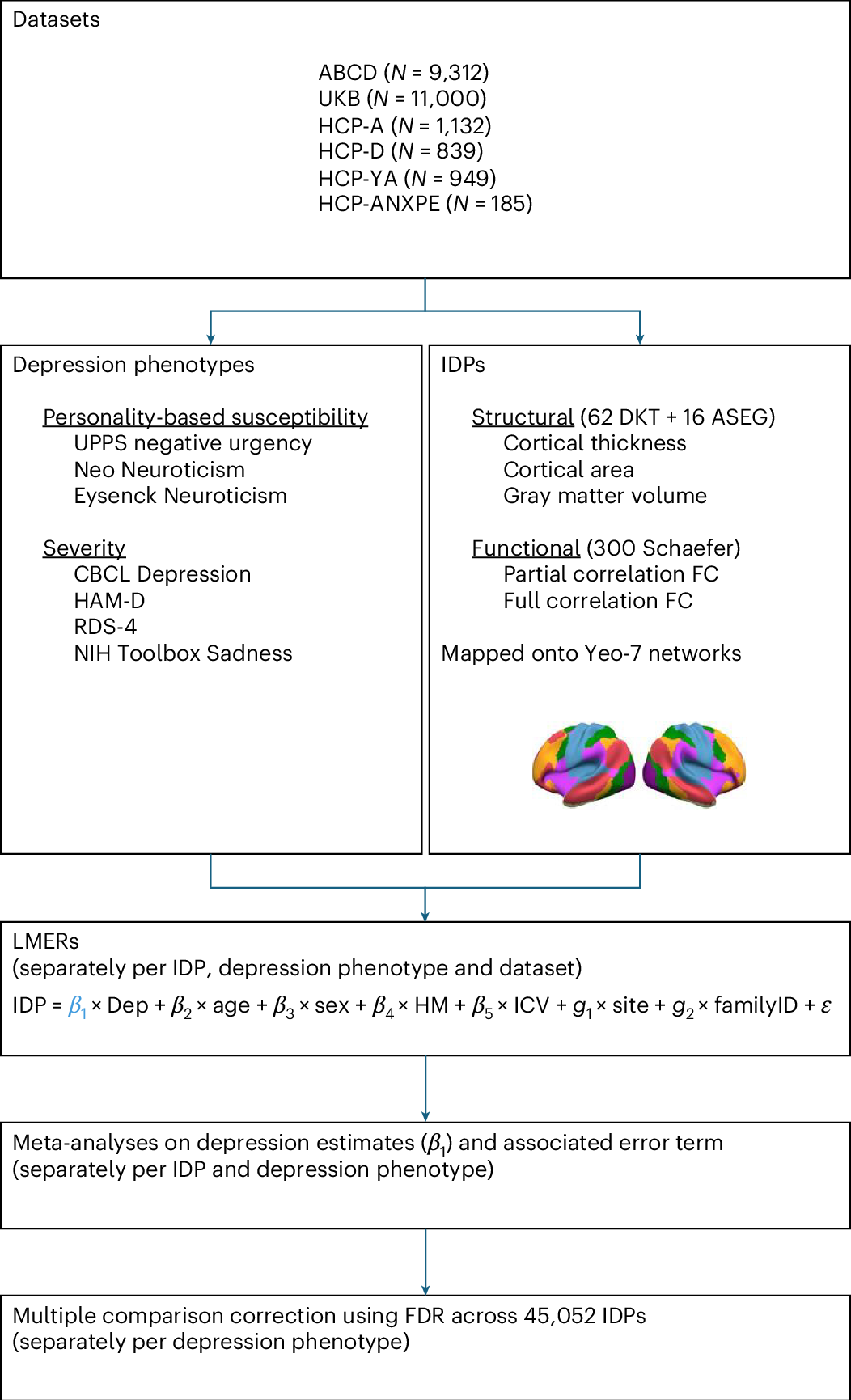
Depression has been linked to reduced size of subcortical regions and abnormal functional connectivity in frontal and default mode networks. However, recent meta-analyses have failed to identify significant converging correlates of depression across the literature such that a conclusive mapping of the neuroimaging correlates of depression remains elusive. We leveraged 23,417 participants across 6 population datasets to comprehensively establish the neuroimaging correlates of depression. We found reductions in gray matter volume/cortical surface area associated with depression in the frontal cortex, anterior cingulate and insula, confirming previous studies showing the importance of prefrontal and default mode regions in depression. Our findings demonstrate multiple surprising results, including a lack of depression correlates in subcortical brain regions and significant depression correlates in somatomotor and visual regions. Overall, these results shed new light on key brain regions involved in the pathophysiology of depression, updating our understanding of the neuroimaging correlates of depression symptoms.
The neuroimaging correlates of depression established across six large-scale population datasets
Depression has been linked to reduced size of subcortical regions and abnormal functional connectivity in frontal and default mode networks. However, recent meta-analyses have failed to identify significant converging correlates of depression across the literature such that a conclusive mapping of the neuroimaging correlates of depression remains elusive. We leveraged 23,417 participants across 6 population datasets to comprehensively establish the neuroimaging correlates of depression. We found reductions in gray matter volume/cortical surface area associated with depression in the frontal cortex, anterior cingulate and insula, confirming previous studies showing the importance of prefrontal and default mode regions in depression. Our findings demonstrate multiple surprising results, including a lack of depression correlates in subcortical brain regions and significant depression correlates in somatomotor and visual regions. Overall, these results shed new light on key brain regions involved in the pathophysiology of depression, updating our understanding of the neuroimaging correlates of depression symptoms.
NeuroAI’s Next Steps: Balancing Computation and Embodiment
Deep neural networks trained at scale now predict neural activity across sensory cortices, raising a question that divides neuroscience: does the convergence between artificial and biological representations constitute understanding, or does understanding require models of biological processes grounded in the embodied, evolved character of natural intelligence? In this Dual Perspectives article, Bing Brunton and Patrick Mineault articulate two research programs—Process and Convergence—to engage this question about the future of NeuroAI research. The conversation is organized around four questions that probe what scaled model–brain alignment reveals, what the brain is coupled to and evolved to do, what success beyond the lab looks like, and where the field should invest over the coming decade. Their exchanges reveal the distance between the two programs to be primarily about the level of analysis and priorities for what to build next. The conversation converges on shared ground: measure broadly, then distill to causal principles.
Tolaria
A second brain for the AI era. Free forever, local-first, Markdown-based, Git-ready, and AI-friendly.