

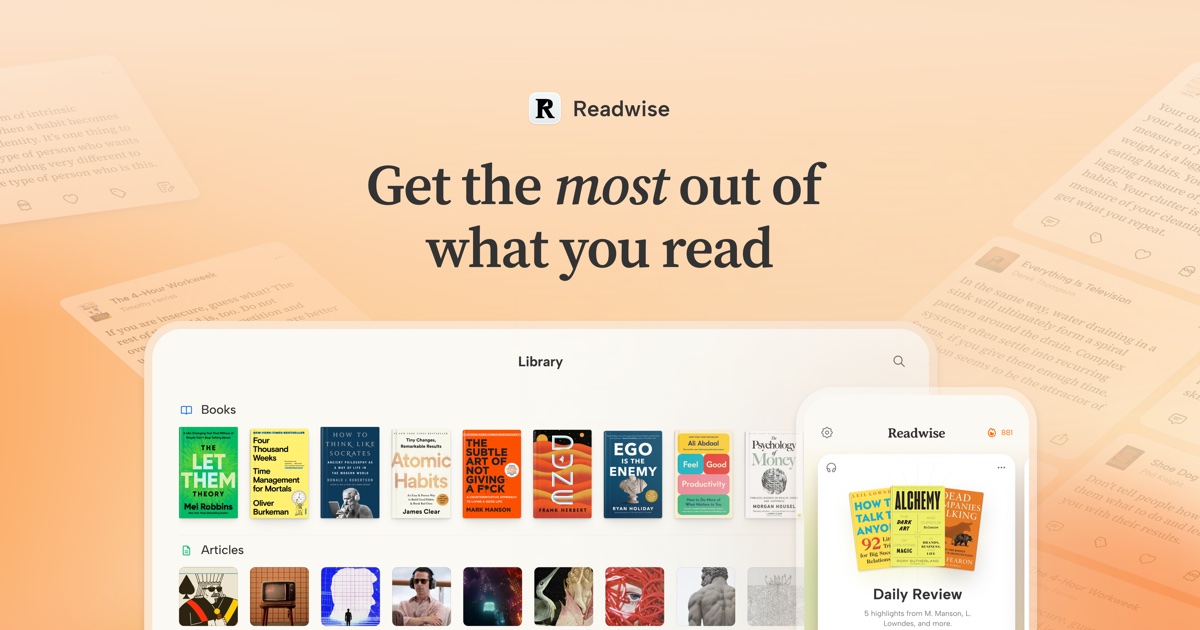
Easily revisit and learn from your highlights and annotations.
Readeck: Home
Save interesting articles, long read, pictures, videos. Read or revisit them later.

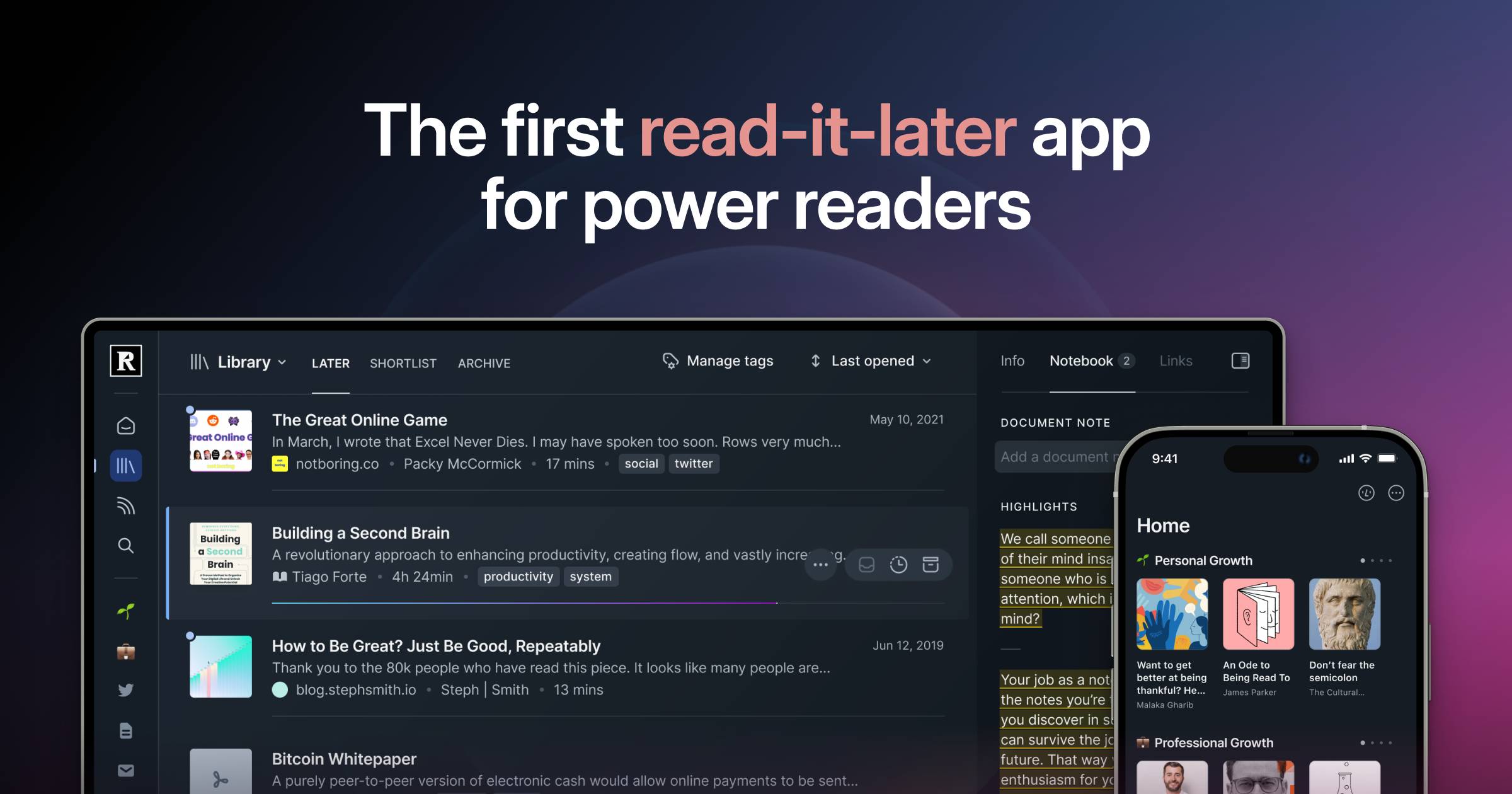
Readwise Reader: The first read-it-later app built for power readers.
Save everything to one place to overcome content overload, search instantly, and highlight like a pro.
Readwise on Twitter / X
🆕 We shipped an MCP server! You can new query your Readwise highlights inside of Claude, Cursor and more: pic.twitter.com/3HdIm4TRzJ— Readwise (@readwise) May 1, 2025

Creative Reading: Scaffolding Reading for Transformation
Reading augmentation systems increasingly help readers process text at scale. While these tools address real constraints of time and cognitive load, they often implicitly frame reading as...

Whitewind Reader
Your new favourite hyper-optimized way to gist your favorite articles. With dark mode.
Letting things build
This week I put together a reading list for my digital aura series. I recall starting to write around Thanksgiving — but when I looked back at my reading, I’d started reading for it months earlier. (No wonder it’s felt like such a big endeavor!)
Book Margin
Sync your book highlights and notes to your atproto account as Margin notes.
Curvenote Reader brings a better reading experience to half a million openRxiv preprints
Curvenote Reader is now live across half a million bioRxiv preprints - bringing inline citations, zoomable figures, and connected context directly into the reading flow. Find out how we modernized one of science's biggest preprint repositories without disrupting a single workflow.
Creative Reading: Scaffolding Reading for Transformation
However, recent work on augmenting reading largely focuses on making reading more efficient, especially in knowledge-intensive contexts where people must rapidly make sense of research papers and other complex documents (Lo et al., 2024). These systems often aim to help readers skim, summarize, and synthesize large volumes of information in order to reduce cognitive effort and accelerate document- and corpus-level sensemaking at scale (Gu et al., 2025; Lo et al., 2024; Fok et al., 2023). At one extreme, the form of reading implicitly envisioned by these systems may resemble what we call “reading to discard”: extracting the essential, actionable informational core of a document as quickly and efficiently as possible, so that the rest can be swiftly tossed aside—much like we often process inbound mail. This motivates us to ask what scaffolding approaches might resist “reading to discard,” what alternative forms of reading we might scaffold, and what alternative views and values of reading might guide the conversation.
Science should be machine-readable - Marginal REVOLUTION
One of the leading tasks of our time: We develop a machine-automated approach for extracting results from papers, which we assess via a comprehensive review of the entire eLife corpus. Our method facilitates a direct comparison of machine and peer review, and sheds light on key challenges that must be overcome in order to facilitate […]


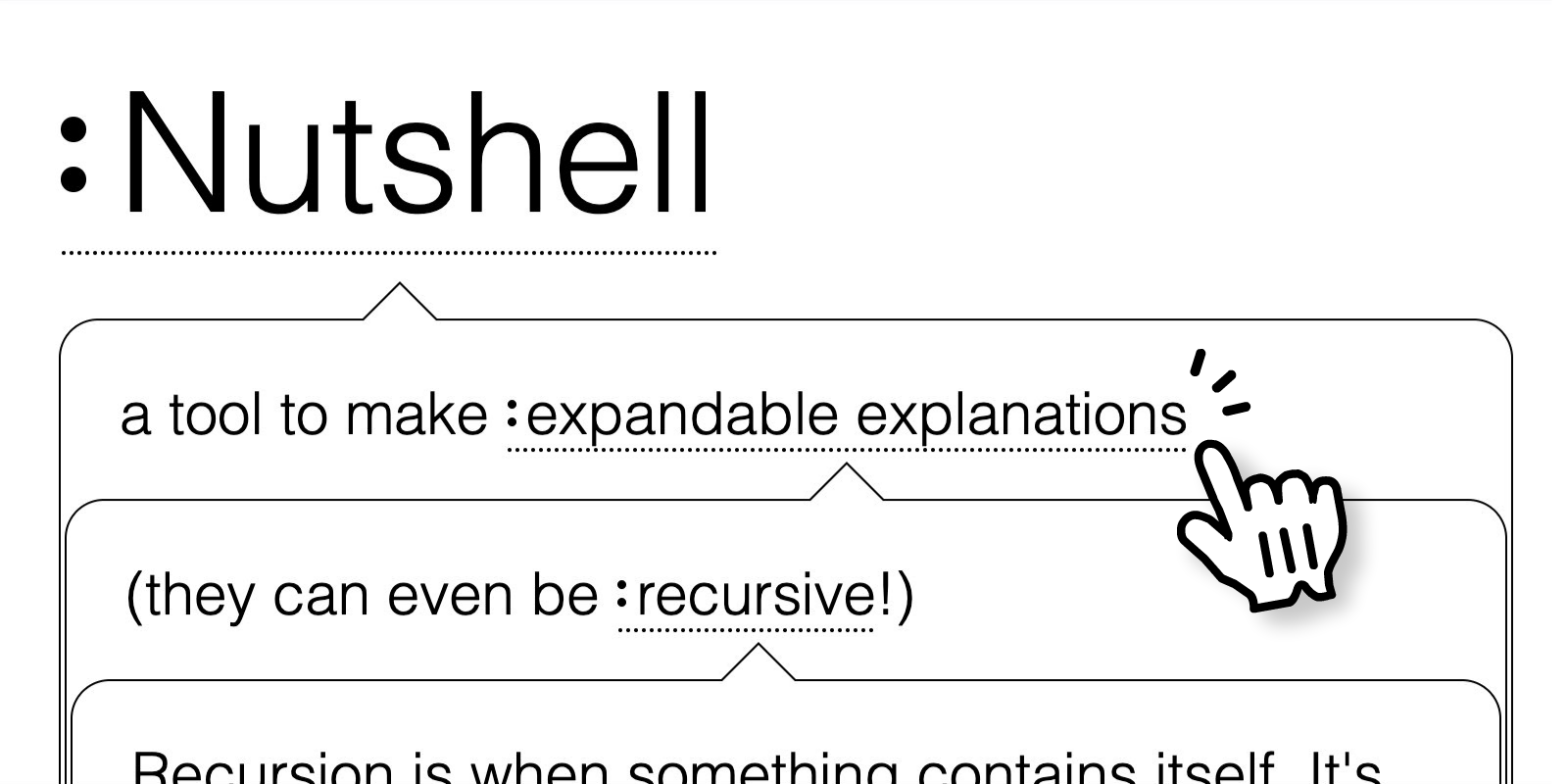
Nutshell: make expandable, embeddable explanations
a tool to let your readers dive into details
Reader guide · Standard Reader
How to use Standard Reader — following, reading, listening, and making it yours. No technical knowledge needed.
Is there a broadly used lexicon for *book* highlights yet? (eg. for your Xteink/KOReader, or highlighted.app, highlights) (I figure this could be handy for sense-making on @semble.so, and for everyone with their new fancy xteink devices…)
