

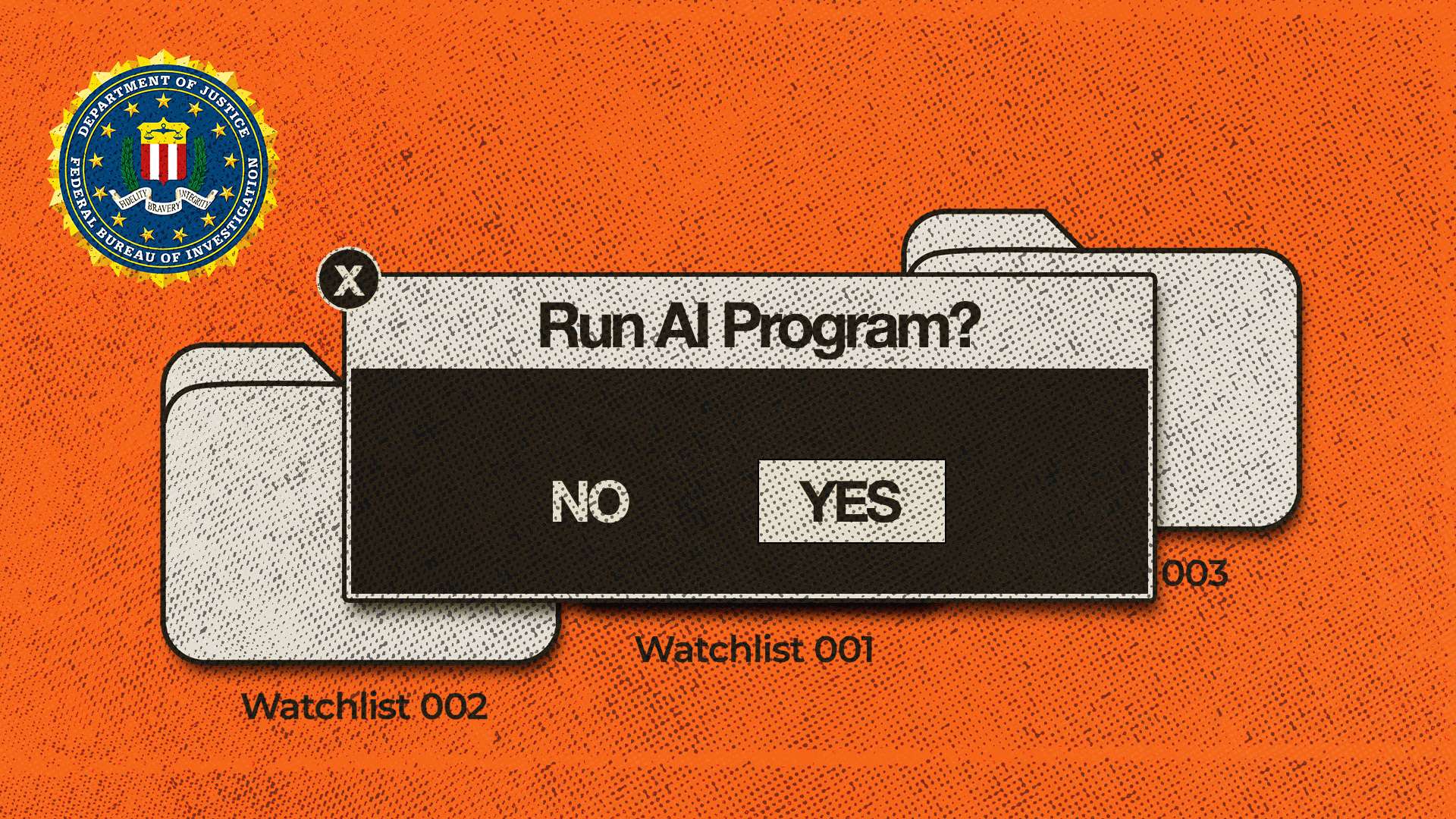
Documents show the FBI seeking AI tools to flag Americans before they act, as the terror watchlist's focus moves toward domestic dissent.
Board Calls for New Rules on Deceptive AI During Conflicts
In analyzing the spread of AI-generated content in armed conflicts in a case on the 2025 Israel-Iran war, the Oversight Board calls on Meta to do more to allow users to identify such output.

US Law Enforcement Warns of ‘Anti-Tech Extremism’ as AI Hatred Grows
As Americans stew over the looming risk of job-stealing AI and data centers in their back yards, the feds are raising the alarm about a new category of threat, documents obtained by WIRED show.

Exclusive: FBI’s New Political Pre-Crime Center
Are your views on the list of 'domestic terrorism' indicators?

Science flags paper that found AI chatbots help debunk conspiracy theories
Science has issued an expression of concern for a highly publicized study looking into whether conversations with AI chatbots could convince conspiracy theorists to abandon their beliefs. The move …

Exclusive: US military had close call after using AI for false intelligence report, sources say | CNN Politics
The episode shows the risks of using this new, relatively poorly understood technology in the middle of the Iran war

AI is now unpopular. That may not make a difference.
Where AI Regulation Stands Today
The White House has released a National Artificial Intelligence Legislative Framework and new executive orders aiming to establish a single, nationwide standard for AI regulation...

Evidence for Justice Lab - Justice and AI Tracker
Evidence for Justice Lab - Justice and AI Tracker
Evidence for Justice Lab - Justice and AI Tracker
Anthropic Is Building a Predictive Surveillance System to Monitor Activists
New hires and comments in interviews show that the AI giant is using its capabilities against dissenters.

Anthropic model takedown fuels warning of ‘ad hoc’ AI regulation
The Trump administration is coming under fire for a directive prompting Anthropic to pull its latest models, and artificial intelligence policy advocates warn the move signals the White House is ta…


AI use in American newspapers is widespread, uneven, and rarely disclosed
AI is rapidly transforming journalism, but the extent of its use in published newspaper articles remains unclear. We address this gap by auditing a large-scale dataset of 186K articles from online editions of 1.5K American newspapers published in the summer of 2025. Using Pangram, a state-of-the-art AI detector, we discover that approximately 9% of newly-published articles are either partially or fully AI-generated. This AI use is unevenly distributed, appearing more frequently in smaller, local outlets, in specific topics such as weather and technology, and within certain ownership groups. We also analyze 45K opinion pieces from Washington Post, New York Times, and Wall Street Journal, finding that they are 6.4 times more likely to contain AI-generated content than news articles from the same publications, with many AI-flagged op-eds authored by prominent public figures. Despite this prevalence, we find that AI use is rarely disclosed: a manual audit of 100 AI-flagged articles found only five disclosures of AI use. Overall, our audit highlights the immediate need for greater transparency and updated editorial standards regarding the use of AI in journalism to maintain public trust.

AI use in American newspapers is widespread, uneven, and rarely disclosed
AI is rapidly transforming journalism, but the extent of its use in published newspaper articles remains unclear. We address this gap by auditing a large-scale dataset of 186K articles from online editions of 1.5K American newspapers published in the summer of 2025. Using Pangram, a state-of-the-art AI detector, we discover that approximately 9% of newly-published articles are either partially or fully AI-generated. This AI use is unevenly distributed, appearing more frequently in smaller, local outlets, in specific topics such as weather and technology, and within certain ownership groups. We also analyze 45K opinion pieces from Washington Post, New York Times, and Wall Street Journal, finding that they are 6.4 times more likely to contain AI-generated content than news articles from the same publications, with many AI-flagged op-eds authored by prominent public figures. Despite this prevalence, we find that AI use is rarely disclosed: a manual audit of 100 AI-flagged articles found only five disclosures of AI use. Overall, our audit highlights the immediate need for greater transparency and updated editorial standards regarding the use of AI in journalism to maintain public trust.
As the Federal Government Rushes Toward AI, Here Are Three Cautionary Tales — ProPublica
We’ve been reporting on cybersecurity for years. As President Donald Trump and his Cabinet say artificial intelligence will transform the nation, the messaging isn’t new. It follows a familiar pattern.
