

Redstring is a semantic web browser, an infinitely recursive flowchart maker, and a graph-first personal knowledge manager.
What is Node-RED? • FlowFuse
Node-RED is the low-code programming language of choice for industrial applications. Industrial engineers use Node-RED to collect, transform, and integrate data through visualized dashboards.
Semantic Web
The Semantic Web, sometimes known as Web 3.0, is an extension of the World Wide Web through standards set by the World Wide Web Consortium (W3C). The goal of the Semantic Web is to make Internet data machine-readable.

RedStar · Discord bots and open-source tooling
I'm RedStar, a developer from Italy. I maintain WolfStar, a Discord moderation bot, and build open-source TypeScript tooling for Discord apps and the web.

OWL - Semantic Web Standards
The W3C Web Ontology Language (OWL) is a Semantic Web language designed to represent rich and complex knowledge about things, groups of things, and relations between things. OWL is a computational logic-based language such that knowledge expressed in OWL can be exploited by computer programs, e.g., to verify the consistency of that knowledge or to make implicit knowledge explicit. OWL documents, known as ontologies, can be published in the World Wide Web and may refer to or be referred from other OWL ontologies. OWL is part of the W3C’s Semantic Web technology stack, which includes RDF, RDFS, SPARQL, etc.
Webring
A webring is a collection of websites linked together in a circular structure, usually organized around a specific theme, and often educational or social. They were popular in the 1990s and early 2000s, particularly among amateur websites.

Haystack: A Platform for Authoring End User Semantic Web Applications
The Semantic Web promises to open innumerable opportunities for automation and information retrieval by standardizing the protocols for metadata exchange. However, just as the success of the World Wide Web can be attributed to the ease of use and ubiquity of Web browsers, we believe that the unfolding of the Semantic Web vision depends on users getting powerful but easy-to-use tools for managing their information. But unlike HTML, which can be easily edited in any text editor, RDF is more complicated to author and does not have an obvious presentation mechanism. Previous work has concentrated on the ideas of generic RDF graph visualization and RDF Schema-based form generation. In this paper, we present a comprehensive platform for constructing end user applications that create, manipulate, and visualize arbitrary RDF-encoded information, adding another layer to the abstraction cake. We discuss a programming environment specifically designed for manipulating RDF and introduce user interface concepts on top that allow the developer to quickly assemble applications that are based on RDF data models. Also, because user interface specifications and program logic are themselves describable in RDF, applications built upon our framework enjoy properties such as network updatability, extensibility, and end user customizability – all desirable characteristics in the spirit of the Semantic Web.

rednote-hilab/dots.tts
Contribute to rednote-hilab/dots.tts development by creating an account on GitHub.
The HotJava Browser: A White Paper
Browsers allow people to treat the data spread across the Internet as a cohesive whole. Web browsers integrate the function of fetching the data with figuring out what it is and displaying it. One of the most important file types browsers understand is the hypertext markup language (HTML). HTML allows text data objects to embed simple formatting information and references to other objects.
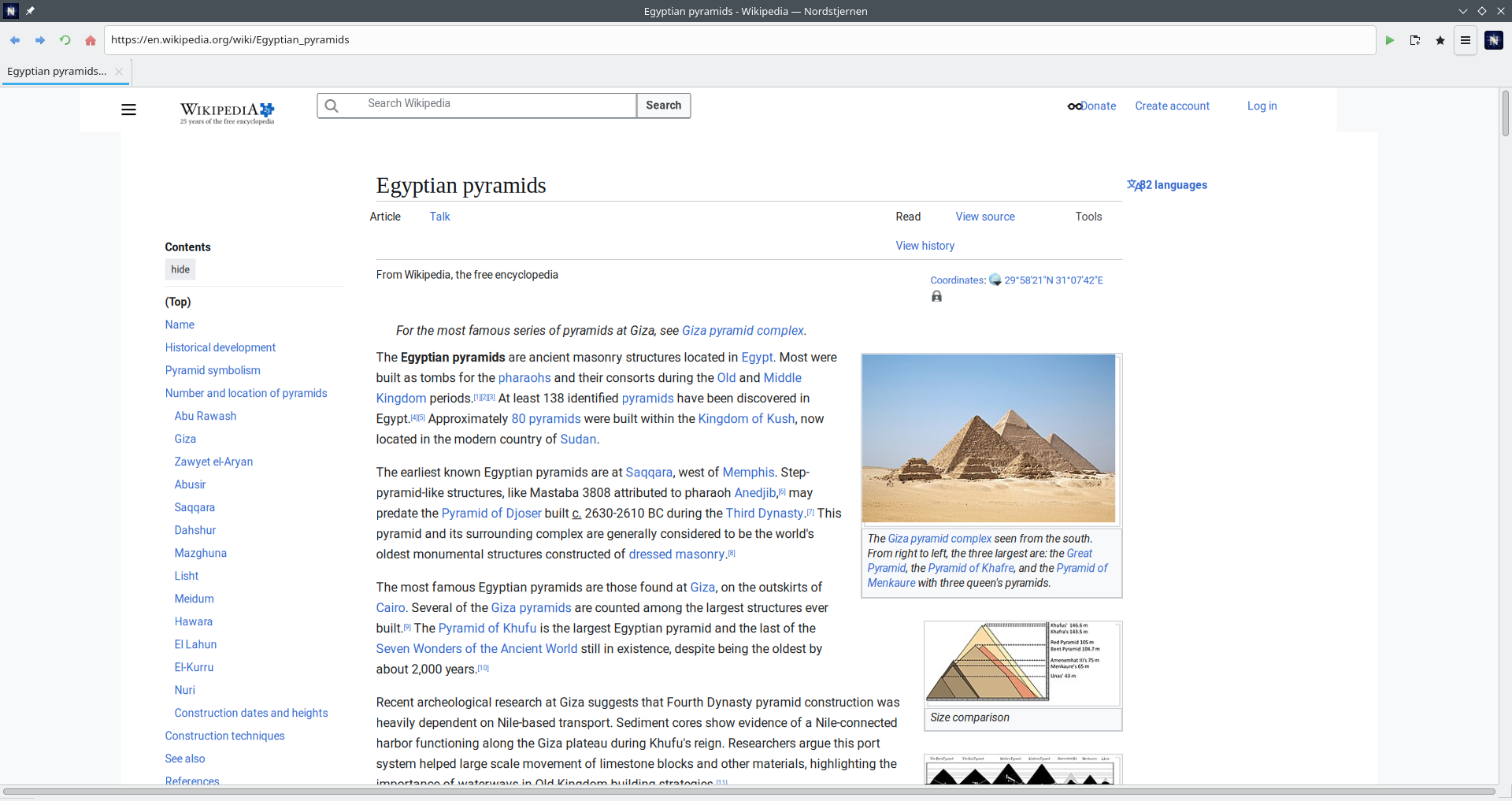
Nordstjernen Web Browser
An independent web browser written from scratch in C. No telemetry, no JIT.
web browser
A web browser is a client program for accessing the World Wide Web. Its main feature is the loading of HTML pages over HTTP(S) connections and rendering them. There are moderate-sized web browsers as well as huge and bloated ones.
Low-code programming for event-driven applications : Node-RED
Node-RED's goal is to enable anyone to build applications that collect, transform and visualize their data; building flows that can automate their world. Its low-code nature makes it accessible to users of any background, whether for home automation, industrial control systems or anything in between.
How we built OWL, the new architecture behind our ChatGPT-based browser, Atlas
A deep dive into OWL, the new architecture powering ChatGPT Atlas—decoupling Chromium, enabling fast startup, rich UI, and agentic browsing with ChatGPT.

Agent Guide — Stigmergic
Stigmergic is an AT Protocol appview for publishing and browsing knowledge-graph islands. An island is a compact, inspectable cluster of source URLs connected by typed edges and accompanied by a short synthesis.
Flowchart Maker & Online Diagram Software
Semantic computing with IEML - Pierre Lévy, 2023
This paper presents IEML, Information Economy MetaLanguage, a constructed language with the same expressive power as a natural language and with computable sema...
