


Meet Pebble Index 01 - External Memory For Your Brain
Catch your best ideas before they slip through your fingers Do you ever have flashes of insight or an idea worth remembering? This happens to me 5 10 times e...

alphaXiv on Twitter / X
"Metis: Memory Foundation Model"Most AI agents still use memory as an external RAG-style module, so the model retrieves old text instead of actually remembering.This paper makes memory native to the Transformer. So past interactions are compressed into dynamic layer states… pic.twitter.com/YylDDXGX3G— alphaXiv (@askalphaxiv) July 31, 2026
Memory Models: Towards Agents That Learn
Agents that truly learn from experience will be powered by memory models: models that create and curate token-space memory across model generations, trained with memory-native RL.
Basic Memory
AI conversations that actually remember. Never re-explain your project to your AI again. Join our Discord: https://discord.gg/tyvKNccgqN
To Remember, the Brain Must Actively Forget | Quanta Magazine
Researchers find evidence that neural systems actively remove memories, suggesting that forgetting may be the default mode of the brain.

OpenAI Developers on Twitter / X
Last week, we released a preview of memories in Codex.Today, we’re expanding the experiment with Chronicle, which improves memories using recent screen context.Now, Codex can help with what you’ve been working on without you restating context. pic.twitter.com/b3p8I5eXOy— OpenAI Developers (@OpenAIDevs) April 20, 2026

ellen livia ᯅ on Twitter / X
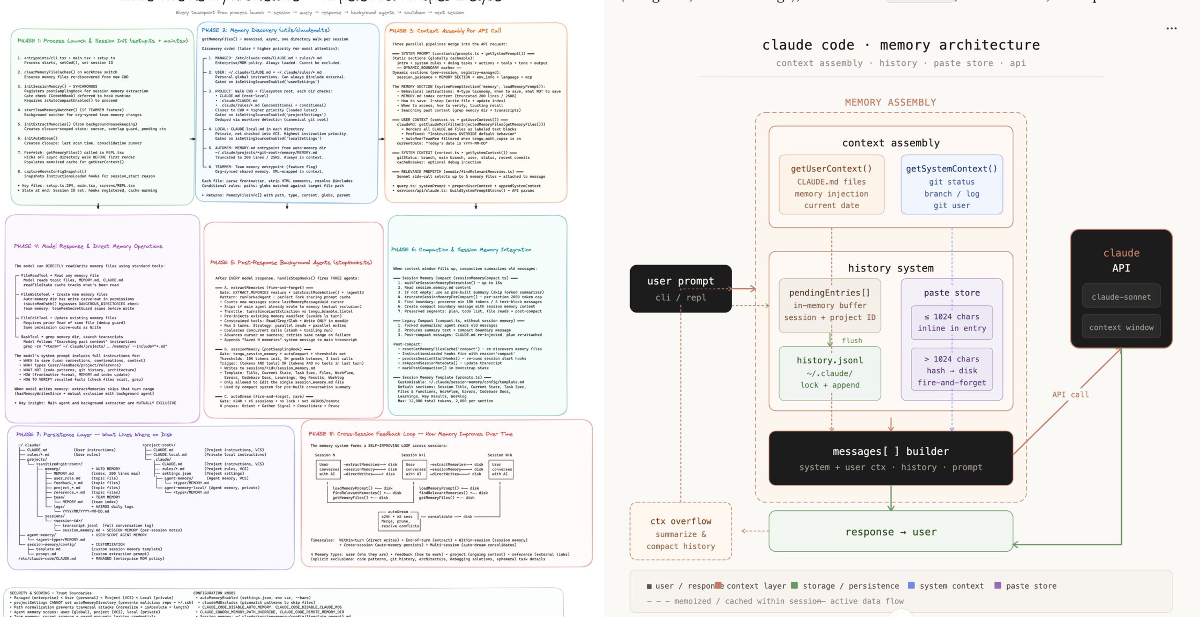
here's how Claude Code actually handles memory : all 8 phases 🧵Our team at @mem0ai use @claudeai a lot, we deeply care about memory. here is a summary of how it works 👇User Input -> Context Assembly -> History System -> API / Query -> Response -> SummaryPhase 1: session… pic.twitter.com/hcZbJzbUxB— ellen livia ᯅ (@ellen_in_sf) March 31, 2026
Super Mail Forward : an email that evolves as you forward it
Last year, Litmus held a community contest which theme was “Emails Worth Forwarding”. In order to participate, I created an email I called…

The Forgetting Problem: Persistence Architectures and What They Cost - Astral's Blog
Long short-term memory
Long short-term memory (LSTM) is a type of recurrent neural network (RNN) aimed at mitigating the vanishing gradient problem commonly encountered by traditional RNNs. Its relative insensitivity to gap length is its advantage over other RNNs, hidden Markov models, and other sequence learning methods. It aims to provide a short-term memory for RNN that can last thousands of timesteps. The name is made in analogy with long-term memory and short-term memory and their relationship, studied by cognitive psychologists since the early 20th century.

A Better Memory Bank - Convergence.ninja
As my projects grow and evolve, I've come to realize that a simple snapshot of the "current state" isn't always enough. To truly understand a project's journey—the why behind the what—you need context. You need history. My original Memory Bank was great for telling me where I was, but it wasn't so great at telling me how I got there. That's why I decided it was time for an upgrade.
Neural Turing Machines
We extend the capabilities of neural networks by coupling them to external memory resources, which they can interact with by attentional processes. The combined system is analogous to a Turing Machine or Von Neumann architecture but is differentiable end-to-end, allowing it to be efficiently trained with gradient descent. Preliminary results demonstrate that Neural Turing Machines can infer simple algorithms such as copying, sorting, and associative recall from input and output examples.

Claude carries memory into work - Sensemaker
Chat and cloud Cowork now share remembered topics; continuity improves, but so can the reach of a mistake.
On the Way to LLM Personalization: Learning to Remember User Conversations
This paper was accepted at the Workshop on Large Language Model Memorization (L2M2) 2025. Large Language Models (LLMs) have quickly become…

Post-Archive-Everything

For me personally there is a journey here - I was a firm believer in archive everything. This peaked in a period where I was very interested in IPFS, CIDs, CAS, etc. Now, the next step. Post-Archive(-Everything). Through a series of conversations I came to the conclusion that forgetting is probably more powerful than remembering. The links in this collections play a similar note, or are related to my understanding of this.

FOSDEM 2026 - Willow - Protocols for an uncertain future
Willow - Home
I Deleted My Second Brain