

The recent revival of political interest in antitrust has resurfaced a longstanding debate about the role of industrial concentration and monopoly in enabling Hitler’s rise to power and the Third Reich’s wars of aggression. Proponents of stronger antitrust enforcement argue that monopolies and cartels brought the Nazis to power and warn that rising concentration in the American economy could similarly threaten democracy. Skeptics demur, observing that German big business largely opposed Hitler during the crucial years of his ascent. Drawing on business histories and archival material from the U.S. Office of Military Government’s Decartelization Branch, this Article assesses the historical record on the role of industrial concentration in facilitating Nazism. It finds compelling evidence that, while German big business principally did not support Hitler before he won the chancellorship in 1933, the extreme concentration of market power during the Weimar period enabled Hitler to seize and consolidate totalitarian power through a variety of mechanisms. Hence, the German experience with Nazism lends support to the idea that extreme concentration of economic power enables extreme concentration of political power. However, most of the conduct that created the radical economic concentration of the Weimar period would be unlawful under contemporary antitrust principles, which casts doubt on claims that a significant shift in antitrust enforcement is necessary to forestall antidemocratic forces.
Corporations and the Nazi regime
It is apparent, 90 years after the beginnings of the Nazi period, that large corporations played an important and lamentable role in Nazi power and administration, and the implementation of the atr…
Opinion | Be Afraid of Economic ‘Bigness.’ Be Very Afraid. (Published 2018)
In the 1930s it contributed to the rise of fascism. Alarmingly, we are experimenting again with a monopolized economy.

Q&A: Robert Reich on the ‘Vicious Cycle of Wealth and Power’ He Says Threatens Capitalism
Former Labor Secretary Robert Reich's new book argues "the increasing concentration of political power in a corporate and financial elite " helps drive inequality.

The Antitrust Revolution, by Barry C. Lynn
Liberal democracy’s last stand against Big Tech

Anti-Fascist Economics by Isabella Weber: 9798217154432 | PenguinRandomHouse.com: Books
As inequality, inflation, and overwhelming corporate power threaten democracy, a rising-star economist asks what it would mean to create an anti-fascist economics that guarantees dignity for all....
Imperialism, the Highest Stage of Capitalism
[1] Written in Zurich in January-June 1916. Lenin began to take note of new developments in capitalism long before the outbreak of the First World War. In several of his writings from 1895 to 1913—”Draft and Explanation of a Programme for the Social-Democratic Party” (1895-96); “The War in China” (1900); “The Lessons of the Crisis” (1901), “Review of Home Affairs” (1901); “Concentration of Production in Russia” (1912); “The Growth of Capitalist Wealth” (1913) “Backward Europe and Advanced Asia” (1913); “The Historical Destiny of the Doctrine of Karl Marx” (1913); “Concerning Certain Speeches by Workers’ Deputies” (1912), and others—Lenin pointed out and analysed some characteristic aspects of the imperialist epoch— the concentration of production and the growth of monopoly; the export of capital; the struggle for new markets and spheres of influence; the internationalisation of economic relations; the parasitism and decay of capitalism; the growth of contradictions between labour and capital and the sharpening of the class struggle; and the creation of the material conditions for the transition to socialism. He devoted special attention to exposing predatory colonial policy, the fight for a division and redivision of the world, and the preparation of imperialist wars of aggrandisement. In his article, “Marxism and Revisionism”, written in 1908, he came out against the attempts to revise Marxism and undermine it from inside under the pretext of amending and correcting the theory in particular, Marx’s theory of crises. Lenin wrote: ‘The forms, the sequence, the picture of particular crises changed, but crises remained an inevitable component of the capitalist system. While uniting production, the cartels and trusts at the same time and in a way that was obvious to all, aggravated the anarchy of production, the insecurity of existence of the proletariat and the oppression of capital, thereby intensifying class antagonisms to an unprecedented degree. That capitalism is heading for a breakdown—in the sense both of individual political and economic crises and of the complete collapse of the entire capitalist system— has been made particularly clear, and on a particularly large scale, precisely by the new giant trusts” (see present edition, Vol. 15, pp. 35-36). Lenin kept abreast of all the latest writings on capitalism, as will be seen from his review of Hobson’s The Evolution of Modern Capitalism. In August 1904, Lenin began a translation of Hobson’s Imperialism, the manuscript of which has not yet been found. It was on the outbreak of the First World War that Lenin undertook a comprehensive study of the monopoly stage of capitalist development This was required by the working-class revolutionary struggle in Russia and other capitalist countries. In order to provide correct leadership for the revolutionary movement and combat the ideology of imperialist reaction and the reformist policy of conciliation with imperialists, it was necessary to see one’s way in the key economic question without a study of which there was no understanding of the assessment of modern war or modern politics, namely: the economic essence of imperialism”. Lenin must have started his close study of the writings on imperialism in mid-1915, when he was in Berne, for his first indexes of literature, plans, extracts, notes and summaries date to that period. The preparatory materials for Imperialism, the Highest Stage of Capitalism (Notebooks on Imperialism) make up about 800 printed pages. They contain extracts from 148 books (including 106 in German, 23 in French, 17 in English, and 2 translations into Russian), and 232 articles (of them 206 in German, 13 in French, and 3 in English) from 49 periodicals (34 German, 7 French and 8 English). In early January 1916, Lenin accepted an order for a book on imperialism from the legal Parus Publishers, founded in Petrograd in December 1915. Lenin wrote to Maxim Gorky on December 29, 1915 (January 11, 1916): “I am getting down to the writing of a pamphlet on imperialism” (see present edition, Vol. 35). In the early part of February 1916, he left Berne for Zurich, where he continued to collect and work on materials on imperialism. He worked at the Zurich Cantonal Library and ordered books from other towns. On June 19 (July 2), 1916 Lenin wrote to M. N. Pokrovsky, who was then living in France and editing for Parus a series of pamphlets about West-European countries during the First World War: “Today, I sent you a manuscript by registered mail” (see present edition, Vol. 35). The manuscript, which was mailed with the letter, did not reach Pokrovsky, and another copy had to be sent. Besides, the publishers suggested that the finished manuscript should be shortened from eighty to fifty pages, but Lenin objected because “it is absolutely impossible to cut it down once again and squeeze it into fifty pages” (ibid.). When the book reached the publishers, Menshevik elements among the management deleted from the book parts sharply criticising Kautsky and Martov, and made corrections in the text which not only distorted Lenin’s style but also his ideas. Thus, Lenin’s terms pererastaniye (capitalism growing into imperialism) was altered to prevrashcheniye (transformation); reaktstonny kharakter (reactionary nature of the theory of ultra-imperialism) to otstaly kharakter (backward character), etc. In mid-1917, the book was published under the title Imperialism, the Latest Stage of Capitalism(A Popular Outline) with a preface by Lenin, dated April 26, 1917.
The Authoritarian Personality
This hugely influential study on the psychology of authoritarianism was written in answer to Hitler’s Germany—and now rings more relevant than ever as fascism and anti-Semitism sweep across America.What makes a fascist? Are there character traits that make someone more likely to vote for the far right? The Authoritarian Personality is not only one of the most significant works of social psychology ever written, it also marks a milestone in the development of Adorno’s thought, showing him grappling with the problem of fascism and the reasons for Europe’s turn to reaction. Over half a century later, and with the rise of right-wing populism and the reemergence of the far-right in recent years, this hugely influential study remains as insightful and relevant as ever.This new edition includes an introduction by Frankfurt School scholar Peter E. Gordon and contains the first-ever publication of Adorno’s subsequent critical notes on the project.“Adorno and his colleagues could easily have been describing Alex Jones’s paranoid InfoWars rants or the racist views expressed by many Trump supporters.” —New York Times
Naomi Klein’s new book calls out end times fascism. What is this – and what’s the role of big tech?
Two new books, End Times Fascism and Nerd Reich, take a hard look at fascism today – and its intersections with big tech.
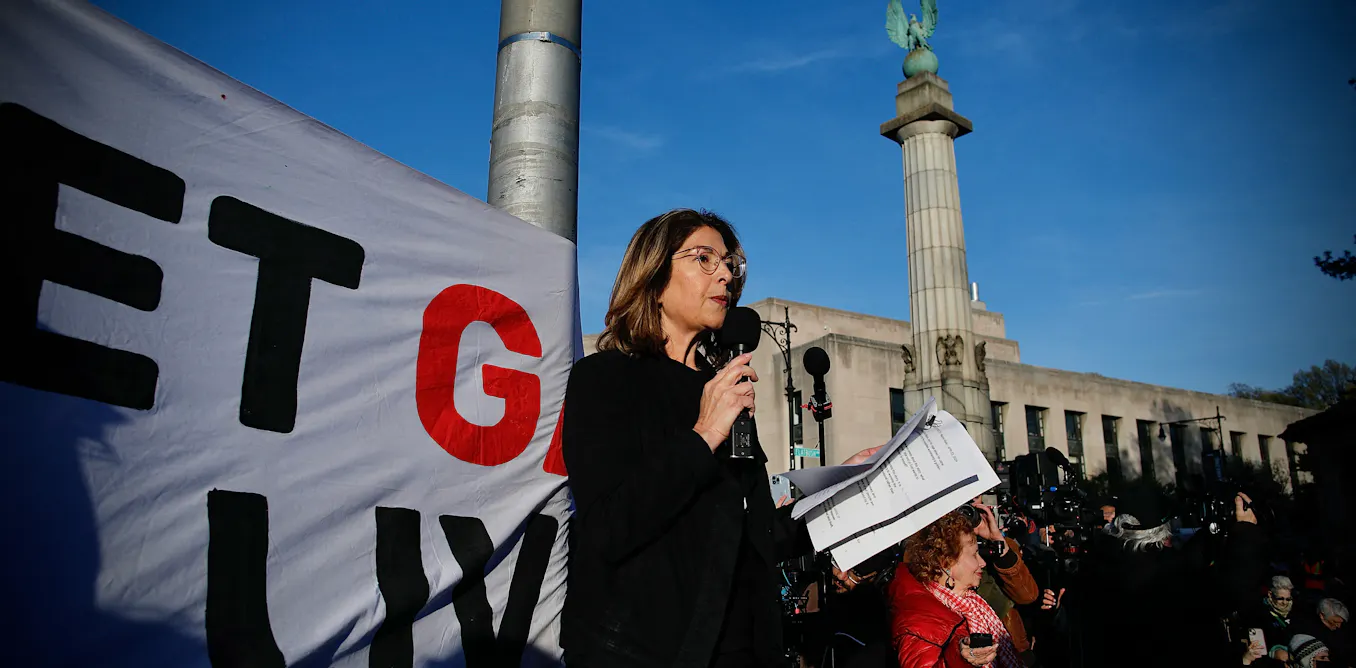
Naomi Klein’s new book calls out end times fascism. What is this – and what’s the role of big tech?
Two new books, End Times Fascism and Nerd Reich, take a hard look at fascism today – and its intersections with big tech.
The Triumph of Broken Promises — Harvard University Press
A powerful case that the economic shocks of the 1970s hastened both the end of the Cold War and the rise of neoliberalism by forcing governments to impose austerity on their own people.Why did the Cold War come to a peaceful end? And why did neoliberal economics sweep across the world in the late twentieth century? In this pathbreaking study, Fritz Bartel argues that the answer to these questions is one and the same. The Cold War began as a competition between capitalist and communist governments to expand their social contracts as they raced to deliver their people a better life. But the economic shocks of the 1970s made promises of better living untenable on both sides of the Iron Curtain. Energy and financial markets placed immense pressure on governments to discipline their social contracts. Rather than make promises, political leaders were forced to break them.In a sweeping narrative, The Triumph of Broken Promises tells the story of how the pressure to break promises spurred the end of the Cold War. In the West, neoliberalism provided Western leaders like Ronald Reagan and Margaret Thatcher with the political and ideological tools to shut down industries, impose austerity, and favor the interests of capital over labor. But in Eastern Europe, revolutionaries like Lech Walesa in Poland resisted any attempt at imposing market discipline. Mikhail Gorbachev tried in vain to reform the Soviet system, but the necessary changes ultimately presented too great a challenge.Faced with imposing economic discipline antithetical to communist ideals, Soviet-style governments found their legitimacy irreparably damaged. But in the West, politicians could promote austerity as an antidote to the excesses of ideological opponents, setting the stage for the rise of the neoliberal global economy.
Anti-trust
Technology markets, and others that share their strong economies of scale , naturally tend to evolve into oligopolies, if not outright monop...

Super Imperialism: The Economic Strategy of American Empire | Michael Hudson
Super Imperialism. The Economic Strategy of Americ .... Hudson, Michael Buy Now (Wrapping 1972) “THE MOST IMPORTANT WORK ON IMPERIALISM SINCE LENIN” -TERENCE McCARTHY Michael Hudson Holt, Rinehart, Winston Backside: Super Imperialism "Never before has a bankrupt nation dared insist that its bankruptcy become the foundation of world economic policy; that, because of its bankruptcy,
L’antisémitisme et la réforme de la Bourse de Paris (1893-1898)
Les réformes de la Bourse de Paris entre 1893 et 1898 sont l’occasion de manifestations d’antisémitisme qui peuvent ne guère surprendre dans le contexte de l’époque. Les partisans du monopole des agents de change traitent de juifs les membres du marché libre (les coulissiers) qui le remettent en cause. Au-delà de la défense conservatrice d’une corporation privilégiée et de sa contestation libérale, cet épisode permet de mieux comprendre que ce sont deux conceptions du marché financier toujours actuelles qui sont en cause. Les coulissiers privilégient la liquidité, la rapidité d’exécution, les financiers professionnels et les échanges internationaux, au prix éventuellement d’une moindre sécurité et d’une moindre égalité dans l’échange, au détriment sans doute des petits boursicoteurs et de la stabilité du marché. Les agents de change avaient des priorités inverses. Le débat s’enrichit de l’émergence d’une tierce position socialiste qui renvoie dos à dos libéraux et conservateurs pour proposer une Bourse service public privilégiant transparence et sécurité sans que ce soit au profit d’un groupe privilégié, position qui, sans prévaloir, annonce de nouvelles conceptions de l’économie de marché., The reforms of the Paris Stock Exchange between 1893 and 1898 gave rise to manifestations of antisemitism that were very much of their time. Supporters of the stockbrokers’ monopoly branded their opponents who participated in the free market (known as coulissiers) as Jews. Beyond the conservative defense of a privileged guild and its liberal contestation, this episode illuminates two conceptions of the financial market that are still current today. The coulissiers favored liquidity and speed of execution, professional financiers, and international exchanges, potentially at the cost of trading security and equality, and to the detriment of small traders and market stability. The official brokers (agents de change) had opposite priorities. The debate was complexified by the emergence of a third, socialist position that rejected both liberal and conservative visions, proposing a public-service stock exchange that would favor transparency and security without benefiting a privileged group. Although this position did not win out, it nevertheless heralded new conceptions of the market economy.

Opinion | The Monopolization of America (Published 2018)
In one industry after another, big companies have become more dominant over the past 15 years, new data show.

if there's one conclusion that the study of both labor history and imperialism converge on, it is that the richest people in the world are happy to burn money on control, power, impunity. and the "everything is about profit" version of anti-capitalism does not survive serious contact with either

Leonard Pierce
Adding to this thread: it’s a common mistake (I’ve made it myself, many times) to think of the motivations of the capitalist elites as essentially mercantilist: that is, that they are largely still motivated *entirely* by profit and loss, selling product, etc. This has not been true for a while.
