Our teams advance the state of the art through research, systems engineering, and collaboration across Google.
Google’s broken link to the web
With AI search results coming to the masses, the human-powered web recedes further into the background

Why Google’s New AI-Saturated Search Page Will Be A Disaster
Google didn’t invent full-text search of the Internet – that honor belongs to early pioneers such as WebCrawler, Lycos and AltaVista. But for the last 25 years or so, Google has…

atproto-aware concept search engine
a mockup of a webpage search engine that only indexes webpages that are referenced in atproto records. Surfaces related links based on social and community context.
The Age of PageRank is Over
When Sergey Brin and Larry Page came up with the concept of PageRank in their seminal paper The Anatomy of a Large-Scale Hypertextual Web Search Engine (Sergey Brin and Lawrence Page, Stanford University, 1998) they profoundly...

Fixing Search
Search on the web, for most people, has become a deplorable experience. It is such a key function that it can feel unfixable, but by treating search as an architectural component of the web (which it effectively is) and working our way through the issues it creates, we can define an alternative that is both realistic and superior.

Less than Half of Google Searches Now Result in a Click - SparkToro
We've passed a milestone in Google's evolution from search engine to walled-garden. In June of 2019, for the first time, a majority of all browser-based

The State of the Web at Google I/O 2018
The web is a global treasure, and has many strengths we all enjoy. It is a distribution platform like no other, providing people around the ...

Introduction
A complete search engine and RAG pipeline in your browser, server or edge network with support for full-text, vector, and hybrid search in less than 2kb.

IndieSearch
I built a prototype for client-side, fully distributed search for the IndieWeb — check out the demo & a little explainer.
Google Search Is Dying. What Comes Next Is Worse | The Walrus
As AI eats the web, the internet’s collective memory is disappearing

Deep-Research Agents Can Be Poisoned via User-Generated Content
Deep-research agents, i.e., systems that rely on multi-agent pipelines to iteratively retrieve, synthesize, and cite Web content in order to produce structured reports, are rapidly replacing traditional search for both routine and complex information needs. These agents issue many related queries during a single research session. We show that for many common search topics, they repeatedly retrieve the same user-generated content (UGC) pages from platforms such as Reddit and Wikipedia. Next, we argue that this retrieval overlap creates a concentrated attack surface: an adversary who appends a short, crafted text to a single, frequently retrieved UGC page can cause the agent to cite attacker-chosen content and promote attacker-chosen entities across many related queries. We evaluate this attack on three representative deep-research systems (STORM, Co-STORM, and OmniThink) across multiple query clusters. We also study defenses at different stages of the pipeline, including source-level filtering and output-based detection. Our findings highlight a fundamental vulnerability in how deep-research agents retrieve and integrate web content.

Keynote: The Death of the Browser - Rachel-Lee Nabors, AgentQL
Freeing the Web from the Browser | reinterpretcast.com
The Web is, without a doubt, the most powerful research tool currently available to man. No longer must researchers comb through endless indices and catalogues to find what they are looking for. Instead, hyperlinks allow users to associatively explore rich interconnected structures of information with ease. In just a few clicks, it is possible to navigate through a vast global space of information comprising documents on virtually any subject.
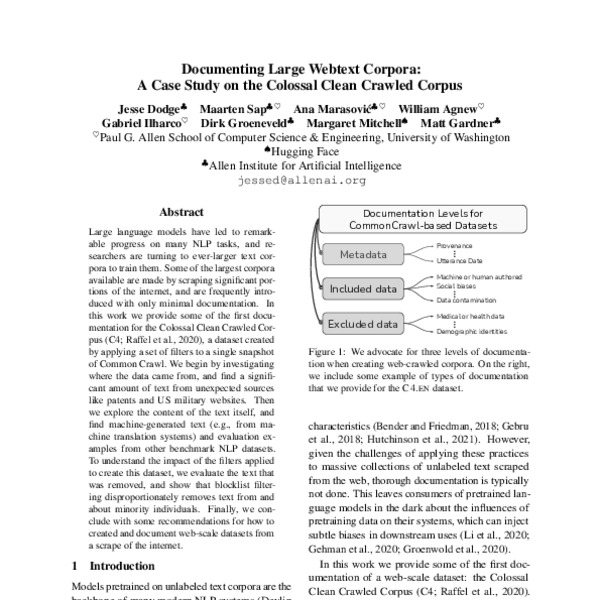
Documenting Large Webtext Corpora: A Case Study on the Colossal Clean Crawled Corpus
Large language models have led to remarkable progress on many NLP tasks, and researchers are turning to ever-larger text corpora to train them. Some of the largest corpora available are made by scraping significant portions of the internet, and are frequently introduced with only minimal documentation. In this work we provide some of the first documentation for the Colossal Clean Crawled Corpus (C4; Raffel et al., 2020), a dataset created by applying a set of filters to a single snapshot of Common Crawl. We begin by investigating where the data came from, and find a significant amount of text from unexpected sources like patents and US military websites. Then we explore the content of the text itself, and find machine-generated text (e.g., from machine translation systems) and evaluation examples from other benchmark NLP datasets. To understand the impact of the filters applied to create this dataset, we evaluate the text that was removed, and show that blocklist filtering disproportionately removes text from and about minority individuals. Finally, we conclude with some recommendations for how to created and document web-scale datasets from a scrape of the internet.
Designing with Hypertextual Friction in the Algorithmic Web – Sophia Liu | ACM Hypertext '25
Exclusive: New York Times tests out AI-generated search summaries
In recent weeks, the paper has quietly rolled out a new AI-powered search page for a small subset of visitors.