


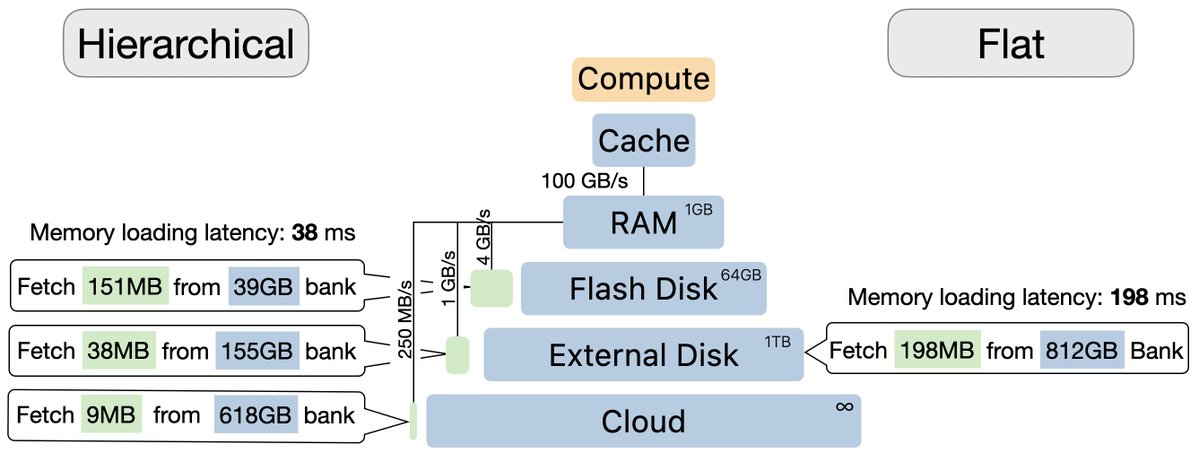
Generative AI models struggle to handle long context, but memory augmentation can reduce their memory footprint, making them more accurate and lightweight
Awni Hannun on Twitter / X
I love this line of research from my colleagues at Apple:Augmenting a language model with a hierarchical memory makes perfect sense for several reasons:- Intuitively the memory parameters should be accessed much less frequently than the weights responsible for reasoning. You… https://t.co/q7HQnYmdR4 pic.twitter.com/38b9q7YKCe— Awni Hannun (@awnihannun) October 6, 2025
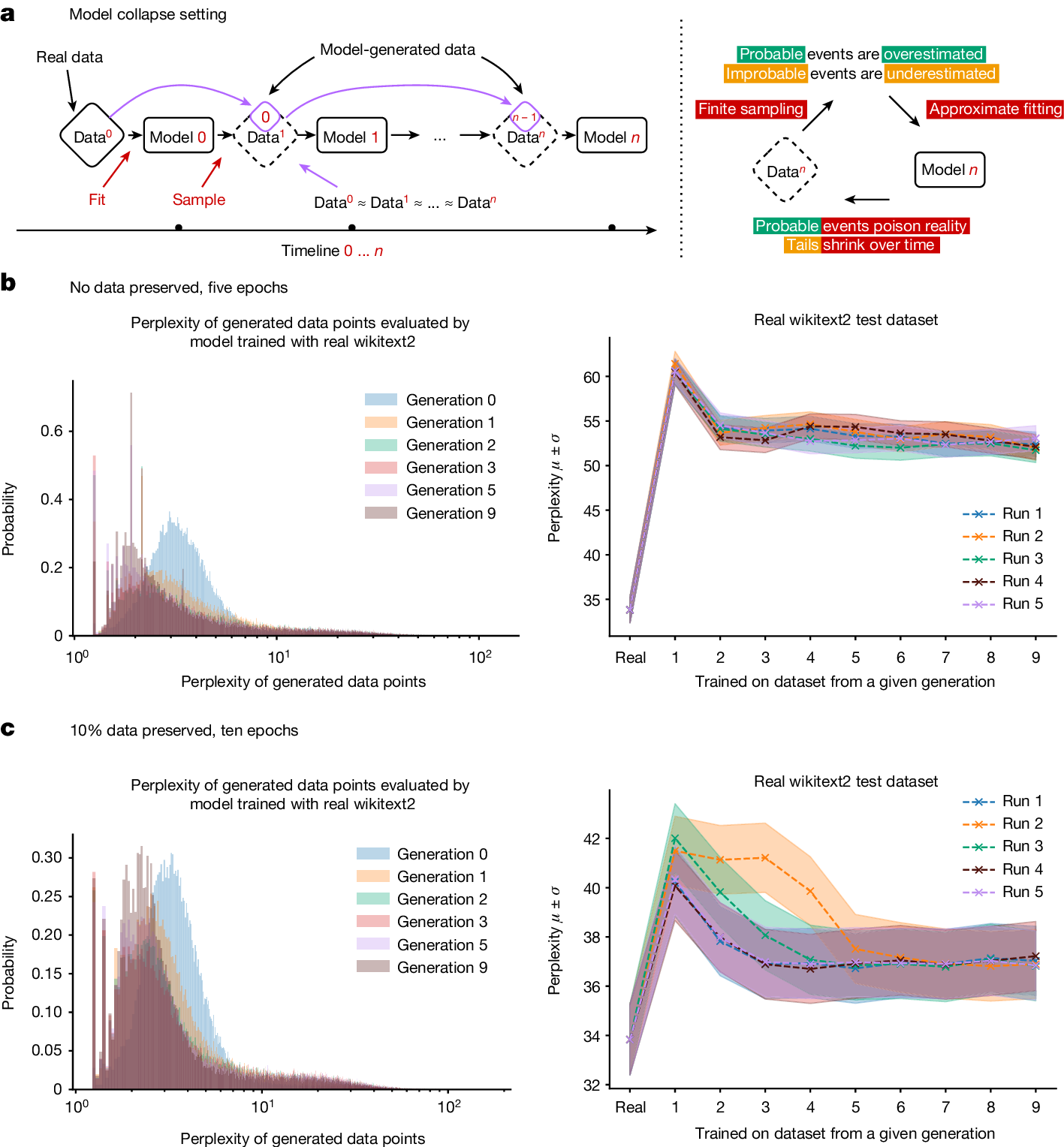
AI models collapse when trained on recursively generated data
Stable diffusion revolutionized image creation from descriptive text. GPT-2 (ref. 1), GPT-3(.5) (ref. 2) and GPT-4 (ref. 3) demonstrated high performance across a variety of language tasks. ChatGPT introduced such language models to the public. It is now clear that generative artificial intelligence (AI) such as large language models (LLMs) is here to stay and will substantially change the ecosystem of online text and images. Here we consider what may happen to GPT-{n} once LLMs contribute much of the text found online. We find that indiscriminate use of model-generated content in training causes irreversible defects in the resulting models, in which tails of the original content distribution disappear. We refer to this effect as ‘model collapse’ and show that it can occur in LLMs as well as in variational autoencoders (VAEs) and Gaussian mixture models (GMMs). We build theoretical intuition behind the phenomenon and portray its ubiquity among all learned generative models. We demonstrate that it must be taken seriously if we are to sustain the benefits of training from large-scale data scraped from the web. Indeed, the value of data collected about genuine human interactions with systems will be increasingly valuable in the presence of LLM-generated content in data crawled from the Internet.
AI models collapse when trained on recursively generated data
Stable diffusion revolutionized image creation from descriptive text. GPT-2 (ref. 1), GPT-3(.5) (ref. 2) and GPT-4 (ref. 3) demonstrated high performance across a variety of language tasks. ChatGPT introduced such language models to the public. It is now clear that generative artificial intelligence (AI) such as large language models (LLMs) is here to stay and will substantially change the ecosystem of online text and images. Here we consider what may happen to GPT-{n} once LLMs contribute much of the text found online. We find that indiscriminate use of model-generated content in training causes irreversible defects in the resulting models, in which tails of the original content distribution disappear. We refer to this effect as ‘model collapse’ and show that it can occur in LLMs as well as in variational autoencoders (VAEs) and Gaussian mixture models (GMMs). We build theoretical intuition behind the phenomenon and portray its ubiquity among all learned generative models. We demonstrate that it must be taken seriously if we are to sustain the benefits of training from large-scale data scraped from the web. Indeed, the value of data collected about genuine human interactions with systems will be increasingly valuable in the presence of LLM-generated content in data crawled from the Internet.
Mem0: Building Production-Ready AI Agents with Scalable Long-Term Memory
Large Language Models (LLMs) have demonstrated remarkable prowess in generating contextually coherent responses, yet their fixed context windows pose fundamental challenges for maintaining consistency over prolonged multi-session dialogues. We introduce Mem0, a scalable memory-centric architecture that addresses this issue by dynamically extracting, consolidating, and retrieving salient information from ongoing conversations. Building on this foundation, we further propose an enhanced variant that leverages graph-based memory representations to capture complex relational structures among conversational elements. Through comprehensive evaluations on LOCOMO benchmark, we systematically compare our approaches against six baseline categories: (i) established memory-augmented systems, (ii) retrieval-augmented generation (RAG) with varying chunk sizes and k-values, (iii) a full-context approach that processes the entire conversation history, (iv) an open-source memory solution, (v) a proprietary model system, and (vi) a dedicated memory management platform. Empirical results show that our methods consistently outperform all existing memory systems across four question categories: single-hop, temporal, multi-hop, and open-domain. Notably, Mem0 achieves 26% relative improvements in the LLM-as-a-Judge metric over OpenAI, while Mem0 with graph memory achieves around 2% higher overall score than the base configuration. Beyond accuracy gains, we also markedly reduce computational overhead compared to full-context method. In particular, Mem0 attains a 91% lower p95 latency and saves more than 90% token cost, offering a compelling balance between advanced reasoning capabilities and practical deployment constraints. Our findings highlight critical role of structured, persistent memory mechanisms for long-term conversational coherence, paving the way for more reliable and efficient LLM-driven AI agents.

LLM in a Flash: Efficient Large Language Model Inference with Limited Memory
Large language models (LLMs) are central to modern natural language processing, delivering exceptional performance in various tasks…
Language models struggle with compartmentalization
In the training data used by large language models (LLMs), the same latent concept is often presented in multiple distinct ways: the same facts appear in English and Swahili; many functions can be expressed in both Python and Haskell; we can express propositions in both formal and natural language. We show that LLMs can exhibit compartmentalization, where they fail to identify and share statistical strength between distinct presentations of unified concepts. In the worst case, LLMs simply learn parallel internal representations of each presentation of the concept, saturating model capacity with redundancies and decreasing sample efficiency with the number of such presentations. We also demonstrate that synthetic parallel data can fail to improve this despite being easily learned itself. Under this framework, we find that, for small models, early multilingual learning is nearly entirely compartmentalized. Finally, all interventions that we study exhibit a phase transition in which their effectiveness depends on the number of distinct presentations, suggesting that the language modeling objective may only inconsistently unify representations.
MemOS: An Operating System for Memory-Augmented Generation (MAG) in Large Language Models
Large Language Models (LLMs) have emerged as foundational infrastructure in the pursuit of Artificial General Intelligence (AGI). Despite their remarkable capabilities in language perception and generation, current LLMs fundamentally lack a unified and structured architecture for handling memory. They primarily rely on parametric memory (knowledge encoded in model weights) and ephemeral activation memory (context-limited runtime states). While emerging methods like Retrieval-Augmented Generation (RAG) incorporate plaintext memory, they lack lifecycle management and multi-modal integration, limiting their capacity for long-term knowledge evolution. To address this, we introduce MemOS, a memory operating system designed for LLMs that, for the first time, elevates memory to a first-class operational resource. It builds unified mechanisms for representation, organization, and governance across three core memory types: parametric, activation, and plaintext. At its core is the MemCube, a standardized memory abstraction that enables tracking, fusion, and migration of heterogeneous memory, while offering structured, traceable access across tasks and contexts. MemOS establishes a memory-centric execution framework with strong controllability, adaptability, and evolvability. It fills a critical gap in current LLM infrastructure and lays the groundwork for continual adaptation, personalized intelligence, and cross-platform coordination in next-generation intelligent systems.
GLaM: Efficient Scaling of Language Models with Mixture-of-Experts
Scaling language models with more data, compute and parameters has driven significant progress in natural language processing. For example, thanks to scaling, GPT-3 was able to achieve strong results on in-context learning tasks. However, training these large dense models requires significant amounts of computing resources. In this paper, we propose and develop a family of language models named GLaM (Generalist Language Model), which uses a sparsely activated mixture-of-experts architecture to scale the model capacity while also incurring substantially less training cost compared to dense variants. The largest GLaM has 1.2 trillion parameters, which is approximately 7x larger than GPT-3. It consumes only 1/3 of the energy used to train GPT-3 and requires half of the computation flops for inference, while still achieving better overall zero-shot and one-shot performance across 29 NLP tasks.
On the Way to LLM Personalization: Learning to Remember User Conversations
Large Language Models (LLMs) have quickly become an invaluable assistant for a variety of tasks. However, their effectiveness is constrained by their ability to tailor responses to human preferences and behaviors via personalization. Prior work in LLM personalization has largely focused on style transfer or incorporating small factoids about the user, as knowledge injection remains an open challenge. In this paper, we explore injecting knowledge of prior conversations into LLMs to enable future work on less redundant, personalized conversations. We identify two real-world constraints: (1) conversations are sequential in time and must be treated as such during training, and (2) per-user personalization is only viable in parameter-efficient settings. To this aim, we propose PLUM, a pipeline performing data augmentation for up-sampling conversations as question-answer pairs, that are then used to finetune a low-rank adaptation adapter with a weighted cross entropy loss. Even in this first exploration of the problem, we perform competitively with baselines such as RAG, attaining an accuracy of 81.5% across 100 conversations.
Agentic Context Engineering: Evolving Contexts for Self-Improving Language Models
Large language model (LLM) applications such as agents and domain-specific reasoning increasingly rely on context adaptation: modifying inputs with instructions, strategies, or evidence, rather than weight updates. Prior approaches improve usability but often suffer from brevity bias, which drops domain insights for concise summaries, and from context collapse, where iterative rewriting erodes details over time. We introduce ACE (Agentic Context Engineering), a framework that treats contexts as evolving playbooks that accumulate, refine, and organize strategies through a modular process of generation, reflection, and curation. ACE prevents collapse with structured, incremental updates that preserve detailed knowledge and scale with long-context models. Across agent and domain-specific benchmarks, ACE optimizes contexts both offline (e.g., system prompts) and online (e.g., agent memory), consistently outperforming strong baselines: +10.6% on agents and +8.6% on finance, while significantly reducing adaptation latency and rollout cost. Notably, ACE could adapt effectively without labeled supervision and instead by leveraging natural execution feedback. On the AppWorld leaderboard, ACE matches the top-ranked production-level agent on the overall average and surpasses it on the harder test-challenge split, despite using a smaller open-source model. These results show that comprehensive, evolving contexts enable scalable, efficient, and self-improving LLM systems with low overhead.
Reality Monitoring in Large Language Models: Self-Knowledge That Transforms with Conversation Memory
A conversational AI that cannot tell its own output from what a user said will treat its own mistakes as user-provided facts. In humans, this capacity is called reality monitoring, and its failures are linked to hallucinations, delusions, and confabulation, yet whether LLMs possess it remains untested. Here we show, across two experiments and six LLMs, that source attribution depends on how conversational memory is structured: ceiling accuracy for self-generated content under minimal memory demands reverses to a fragile external-item advantage once episodic delay removes that shortcut. Feedback exposes two failures: in some models, internal and external judgments swap; in others, accuracy improves while confidence decouples from correctness, dissociations invisible to existing benchmarks. Across models, this pattern implicates active, not aggregate, parameter count. This suggests that as AI systems take on autonomous, multi-turn roles, evaluating what they know is not enough: tracking where that knowledge came from may matter equally.
Is Model Collapse Inevitable? Breaking the Curse of Recursion by Accumulating Real and Synthetic Data
The proliferation of generative models, combined with pretraining on web-scale data, raises a timely question: what happens when these models are trained on their own generated outputs? Recent investigations into model-data feedback loops proposed that such loops would lead to a phenomenon termed model collapse, under which performance progressively degrades with each model-data feedback iteration until fitted models become useless. However, those studies largely assumed that new data replace old data over time, where an arguably more realistic assumption is that data accumulate over time. In this paper, we ask: what effect does accumulating data have on model collapse? We empirically study this question by pretraining sequences of language models on text corpora. We confirm that replacing the original real data by each generation's synthetic data does indeed tend towards model collapse, then demonstrate that accumulating the successive generations of synthetic data alongside the original real data avoids model collapse; these results hold across a range of model sizes, architectures, and hyperparameters. We obtain similar results for deep generative models on other types of real data: diffusion models for molecule conformation generation and variational autoencoders for image generation. To understand why accumulating data can avoid model collapse, we use an analytically tractable framework introduced by prior work in which a sequence of linear models are fit to the previous models' outputs. Previous work used this framework to show that if data are replaced, the test error increases with the number of model-fitting iterations; we extend this argument to prove that if data instead accumulate, the test error has a finite upper bound independent of the number of iterations, meaning model collapse no longer occurs.
Is Model Collapse Inevitable? Breaking the Curse of Recursion by Accumulating Real and Synthetic Data
The proliferation of generative models, combined with pretraining on web-scale data, raises a timely question: what happens when these models are trained on their own generated outputs? Recent investigations into model-data feedback loops proposed that such loops would lead to a phenomenon termed model collapse, under which performance progressively degrades with each model-data feedback iteration until fitted models become useless. However, those studies largely assumed that new data replace old data over time, where an arguably more realistic assumption is that data accumulate over time. In this paper, we ask: what effect does accumulating data have on model collapse? We empirically study this question by pretraining sequences of language models on text corpora. We confirm that replacing the original real data by each generation's synthetic data does indeed tend towards model collapse, then demonstrate that accumulating the successive generations of synthetic data alongside the original real data avoids model collapse; these results hold across a range of model sizes, architectures, and hyperparameters. We obtain similar results for deep generative models on other types of real data: diffusion models for molecule conformation generation and variational autoencoders for image generation. To understand why accumulating data can avoid model collapse, we use an analytically tractable framework introduced by prior work in which a sequence of linear models are fit to the previous models' outputs. Previous work used this framework to show that if data are replaced, the test error increases with the number of model-fitting iterations; we extend this argument to prove that if data instead accumulate, the test error has a finite upper bound independent of the number of iterations, meaning model collapse no longer occurs.
Attention Is All You Need
The dominant sequence transduction models are based on complex recurrent or convolutional neural networks in an encoder-decoder configuration. The best performing models also connect the encoder and decoder through an attention mechanism. We propose a new simple network architecture, the Transformer, based solely on attention mechanisms, dispensing with recurrence and convolutions entirely. Experiments on two machine translation tasks show these models to be superior in quality while being more parallelizable and requiring significantly less time to train. Our model achieves 28.4 BLEU on the WMT 2014 English-to-German translation task, improving over the existing best results, including ensembles by over 2 BLEU. On the WMT 2014 English-to-French translation task, our model establishes a new single-model state-of-the-art BLEU score of 41.8 after training for 3.5 days on eight GPUs, a small fraction of the training costs of the best models from the literature. We show that the Transformer generalizes well to other tasks by applying it successfully to English constituency parsing both with large and limited training data.
Mixture-of-Experts Meets Instruction Tuning:A Winning Combination for Large Language Models
Sparse Mixture-of-Experts (MoE) is a neural architecture design that can be utilized to add learnable parameters to Large Language Models (LLMs) without increasing inference cost. Instruction tuning is a technique for training LLMs to follow instructions. We advocate combining these two approaches, as we find that MoE models benefit more from instruction tuning than dense models. In particular, we conduct empirical studies across three experimental setups: (i) Direct finetuning on individual downstream tasks devoid of instruction tuning; (ii) Instructiontuning followed by in-context few-shot or zero-shot generalization on downstream tasks; and (iii) Instruction tuning supplemented by further finetuning on individual downstream tasks. In the first scenario, MoE models overall underperform dense models of identical computational capacity. This narrative, however, dramatically changes with the introduction of instruction tuning (second and third scenario), used independently or in conjunction with task-specific finetuning. Our most powerful model, FLAN-MOE-32B, surpasses the performance of FLAN-PALM-62B on four benchmark tasks, while using only a third of the FLOPs. The advancements embodied byFLAN-MOE inspire a reevaluation of the design principles of large-scale, high-performance language models in the framework of task-agnostic learning.
Natural Language Autoencoders Produce Unsupervised Explanations of LLM Activations
We introduce Natural Language Autoencoders (NLAs), an unsupervised method for generating natural language explanations of LLM activations. An NLA consists of two LLM modules: an activation verbalizer (AV) that maps an activation to a text description and an activation reconstructor (AR) that maps the description back to an activation. We jointly train the AV and AR with reinforcement learning to reconstruct residual stream activations. Although we optimize for activation reconstruction, the resulting NLA explanations read as plausible interpretations of model internals that, according to our quantitative evaluations, grow more informative over training.