


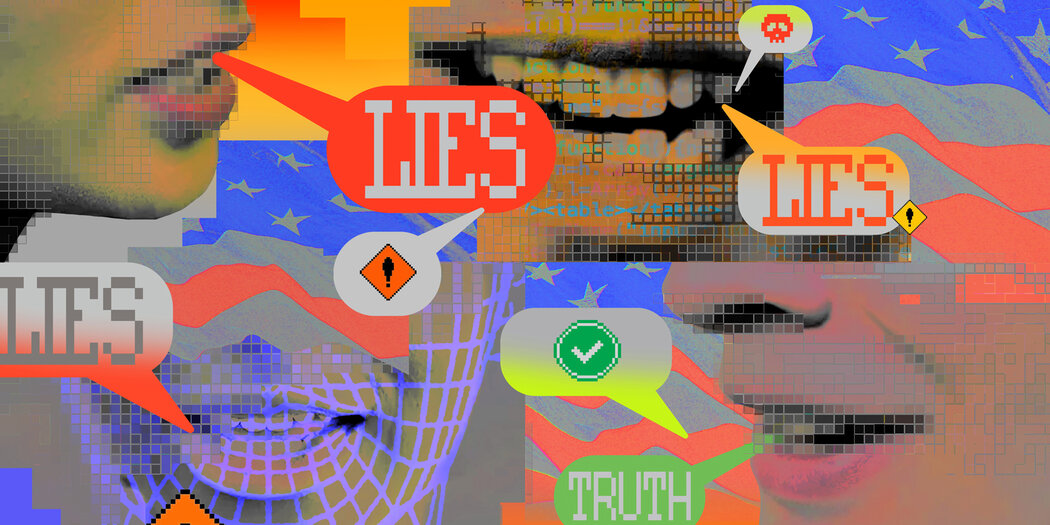
Deepfake experts noted that AI can be used as a cover by politicians when embarrassing audio and video clips of them emerge.
Deepfakes, Elections, and Shrinking the Liar’s Dividend
Heightened public awareness of the power of generative AI could give politicians an incentive to lie about the authenticity of real content.
The Tokenpocalypse Is Here: Companies Are Scrambling To Stop Spending So Much on AI
Leaked audio from Accenture says a big source of AI token ‘chewing’ is people just converting PDFs to presentation slides.

Detection of Deepfake Videos and Audios on Social Media Platforms
Deepfake technology, a rapidly evolving application of artificial intelligence, has enabled the creation of highly realistic yet synthetic multimedia content. While this innovation offers potential benefits in areas such as entertainment and education, its misuse has raised significant ethical and security concerns, including misinformation and financial fraud. This study evaluates the effectiveness of current deepfake detection methods, focusing on the Xception model for video detection and the LCNN model for audio detection, using a dataset composed of real-life and deepfake content. The dataset includes deepfakes generated by tools such as the Deepfake Offensive Toolkit and Haotian AI, a cutting-edge provider known for its high-quality outputs. Our findings reveal that the Xception model, while achieving 89.1% accuracy on control datasets, struggled to detect Haotian AI-generated deepfakes, misclassifying nearly all samples as authentic. This performance gap highlights the need for more diverse training datasets and advanced detection frameworks capable of addressing the nuances of emerging deepfake tools. Additionally, metadata changes caused by uploading and downloading content on social media platforms were found to have minimal impact on detection accuracy, challenging the feasibility of metadata-based detection approaches. This research underscores the limitations of current deepfake detection models and emphasizes the necessity for multimodal approaches and broader datasets to enhance robustness. The study’s implications call for continued advancements in detection methods to keep pace with the growing sophistication of deepfake technologies.
Deep Fakes: A Looming Challenge for Privacy, Democracy, and National Security — California Law Review
Harmful lies are nothing new. But the ability to distort reality has taken an exponential leap forward with “deep fake” technology. This capability makes it possible to create audio and video of real people saying and doing things they never said or did. Machine learning techniques are escalating th

People are trying to claim real videos are deepfakes. The courts are not amused
The unleashing of powerful, generative AI on the public is raising concerns that as the technology becomes more prevalent, it will become easier to claim that anything is fake.
A Compilation of Students Booing AI Graduation Speeches
Oh no, Google is turning everything into a podcast
Deep Fakes: A Looming Challenge for Privacy
<p>Harmful lies are nothing new. But the ability to distort reality has taken an exponential leap forward with “deep fake” technology. This capability makes it possible to create audio and video of real people saying and doing things they never said or did. Machine learning techniques are escalating the technology’s sophistication, making deep fakes ever more realistic and increasingly resistant to detection. Deep-fake technology has characteristics that enable rapid and widespread diffusion, putting it into the hands of both sophisticated and unsophisticated actors.</p><p>While deep-fake technology will bring certain benefits, it also will introduce many harms. The marketplace of ideas already suffers from truth decay as our networked information environment interacts in toxic ways with our cognitive biases. Deep fakes will exacerbate this problem significantly. Individuals and businesses will face novel forms of exploitation, intimidation, and personal sabotage. The risks to our democracy and to national security are profound as well.</p><p>Our aim is to provide the first in-depth assessment of the causes and consequences of this disruptive technological change, and to explore the existing and potential tools for responding to it. We survey a broad array of responses, including: the role of technological solutions; criminal penalties, civil liability, and regulatory action; military and covert-action responses; economic sanctions; and market developments. We cover the waterfront from immunities to immutable authentication trails, offering recommendations to improve law and policy and anticipating the pitfalls embedded in various solutions.</p>
Deep Fakes: A Looming Challenge for Privacy
<p>Harmful lies are nothing new. But the ability to distort reality has taken an exponential leap forward with “deep fake” technology. This capability makes it possible to create audio and video of real people saying and doing things they never said or did. Machine learning techniques are escalating the technology’s sophistication, making deep fakes ever more realistic and increasingly resistant to detection. Deep-fake technology has characteristics that enable rapid and widespread diffusion, putting it into the hands of both sophisticated and unsophisticated actors.</p><p>While deep-fake technology will bring certain benefits, it also will introduce many harms. The marketplace of ideas already suffers from truth decay as our networked information environment interacts in toxic ways with our cognitive biases. Deep fakes will exacerbate this problem significantly. Individuals and businesses will face novel forms of exploitation, intimidation, and personal sabotage. The risks to our democracy and to national security are profound as well.</p><p>Our aim is to provide the first in-depth assessment of the causes and consequences of this disruptive technological change, and to explore the existing and potential tools for responding to it. We survey a broad array of responses, including: the role of technological solutions; criminal penalties, civil liability, and regulatory action; military and covert-action responses; economic sanctions; and market developments. We cover the waterfront from immunities to immutable authentication trails, offering recommendations to improve law and policy and anticipating the pitfalls embedded in various solutions.</p>
‘This Is Not Me’: Inside the AI Scams Driving Musicians Crazy
Indie artists are constantly finding AI-generated slop and direct impersonations on their streaming pages, and it's only getting worse.

55 AI-Generated Video Statistics: Disclosure, Detection, and Trust
AI-generated video is projected to account for 10% of all digital video content in 2026

Scientists Asked AI to Impersonate 112 Public Figures. What Happened Next Is a ‘Dire’ Warning
Researchers discovered that people found AI impersonators to be more authentic, coherent, and relevant than the real politicians, raising alarm bells around the potential for public deception.
Copy of Digital Masquerade
The Digital Masquerade: Unmasking AI’s Phantom Journalists By Tony Eastin and Sandeep Abraham, CAMS

AI video is moving beyond clip slop
AI companies don’t just want Hollywood using AI for video, but for everything.

Google is embedding inaudible watermarks right into its AI generated music
SynthID comes to audio.

Amazing site here via @timnitgebru.bsky.social - a map of big tech influence on media and media companies. imo this goes a decent way to explaining why coverage of AI specifically has been so shockingly bad recently. Very useful resource!! nananwachukwu.github.io/media-capture-watch/
