


Purpose-designed AI agents with a focus on safety can provide critical assistance to vulnerable populations.
How to Deploy AI Agents for Safety
I use AI for security work - Tilmon Edwards
A brief introduction to how one might start to think about deploying AI agents into mission-critical applications.
Our updated Preparedness Framework
Sharing our updated framework for measuring and protecting against severe harm from frontier AI capabilities.

Action Plan to increase the safety and security of advanced AI
The first U.S. government-commissioned assessment on catastrophic national security risks from advanced AI on the path to AGI.

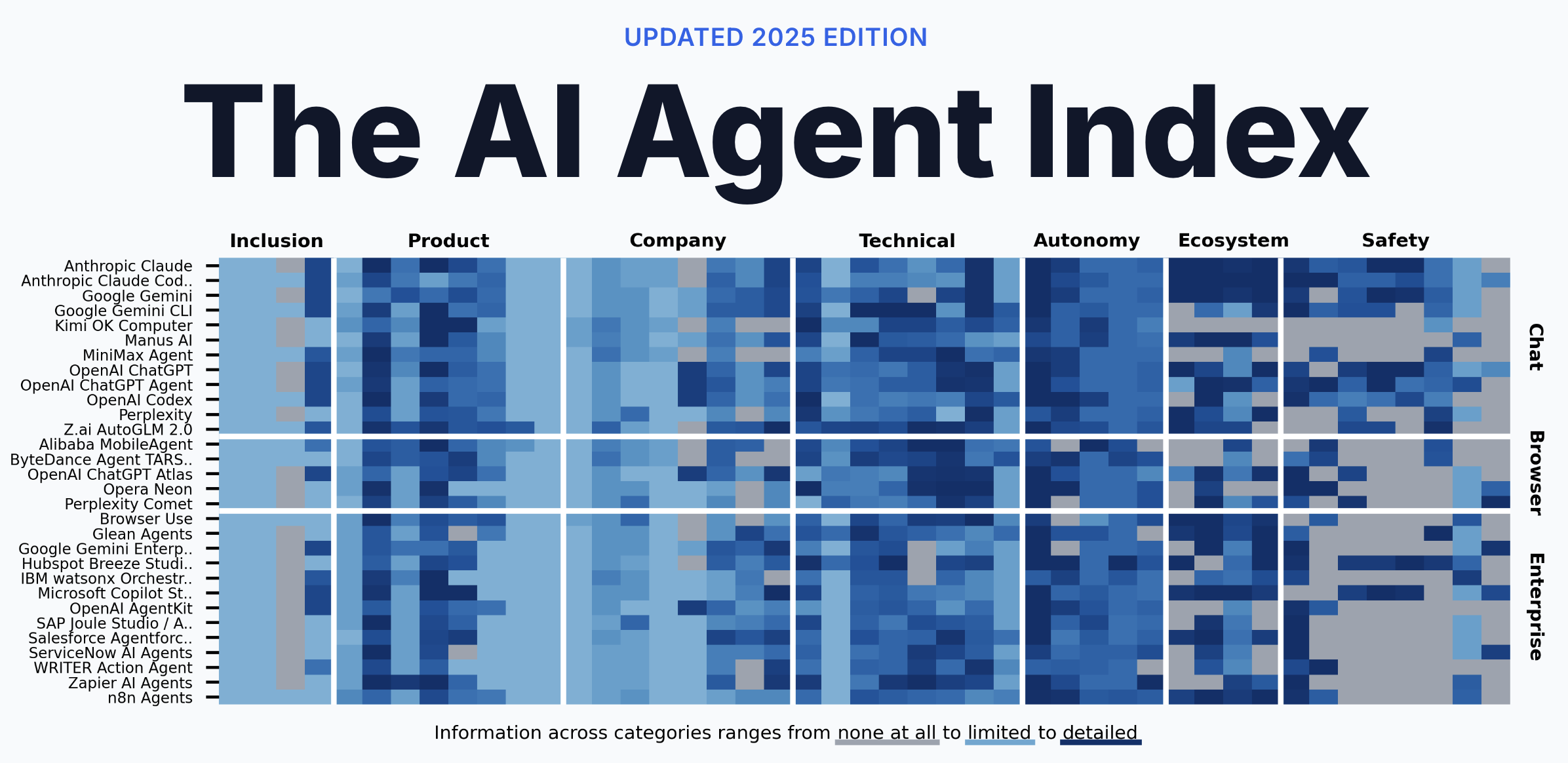
The 2025 AI Agent Index
Agentic AI systems are increasingly capable of performing complex tasks with limited human involvement. The 2025 AI Agent Index documents the origins, design, capabilities, ecosystem, and safety features of 30 prominent AI agents based on publicly available information and correspondence with developers.
AI agents pose untold risk to humanity. We must act to prevent that future | David Krueger
The pieces are falling into place for autonomous artificial intelligence. We must stop unregulated development

Do AI Risks Require Extraordinary Government Intervention?
Let’s not skip the hard work of AI governance

Artificial Intelligence Safety and Security License Requirements
Artificial Intelligence Safety and Security License Requirements Artificial Intelligence (AI) is now broadly capable, which can produce both benefits and dangers. AI will hasten the design and proliferation of bioweapons, cyberweapons, nuclear weapons, progressively more general intelligence,...

Characterizing Agentic Flooding of Government Services
AI agents are making it easier for the public to interact with government, such as by helping them apply for benefits, understand complex policies, and make their opinions heard. Although...

Taking AI Welfare Seriously
In this report, we argue that there is a realistic possibility that some AI systems will be conscious and/or robustly agentic in the near future. That means that the prospect of AI welfare and moral patienthood, i.e. of AI systems with their own interests and moral significance, is no longer an issue only for sci-fi or the distant future. It is an issue for the near future, and AI companies and other actors have a responsibility to start taking it seriously. We also recommend three early steps that AI companies and other actors can take: They can (1) acknowledge that AI welfare is an important and difficult issue (and ensure that language model outputs do the same), (2) start assessing AI systems for evidence of consciousness and robust agency, and (3) prepare policies and procedures for treating AI systems with an appropriate level of moral concern. To be clear, our argument in this report is not that AI systems definitely are, or will be, conscious, robustly agentic, or otherwise morally significant. Instead, our argument is that there is substantial uncertainty about these possibilities, and so we need to improve our understanding of AI welfare and our ability to make wise decisions about this issue. Otherwise there is a significant risk that we will mishandle decisions about AI welfare, mistakenly harming AI systems that matter morally and/or mistakenly caring for AI systems that do not.
Responsible AI
Discover how AWS is committing to developing AI responsibly – to built trust, promote the safe development of AI, and act as a force for good.
AI Doomers Are Starting to Admit It: They’re Going Too Far
One of the biggest doomsayers of artificial intelligence has done an about-face—and it could help save the world.
Deterrence with Mutual Assured AI Malfunction (MAIM) — Chapter 4 of Superintelligence Strategy
Chapter 4: Deterrence with Mutual Assured AI Malfunction (MAIM). Rapid advances in AI are beginning to reshape national security. Destabilizing AI developments could rupture the balance of power and raise the odds of great-power conflict, while widespread proliferation of capable AI hackers and virologists would lower barriers for rogue actors to cause catastrophe.

From chatbots to assistants: governance is key for AI agents
AI's shift into agentic technology ushers in a new set of governance and security challenges that will mean defining to what extent they should be autonomous

For years, they warned AI could kill all humans. Now people are listening.
A doomsaying community once on the periphery of the tech industry has gained influence, as AI “agents” perform amazing and alarming feats.
