

Reporting percentage is calculated based on Voting Area/Locations activity. A Voting Area/Location is considered "reported" once at least one question for that Voting Area/Location has been submitted. A 100% completion rate indicates that every Voting Area/Location has started, but does not necessarily mean every individual question for those Voting Area/Locations has been completed.
The Alberta referendum by the numbers
While final results are still pending, preliminary tallies already reveal how voters have responded to the questions posed by the government

Alberta Referendum Results: No referendum but Albertans want more control over immigration
From Results Updated at 7:30 AM, October 20 Summary 10,174,858 Valid Votes Cast Across 10 Questions Voting Areas/Locations Reporting 80% 4,477 Reported 1,109 Not Reported 5,586 Total Vote Co…

FiftyPlusOne - Latest Political Polls and Averages
A comprehensive list of polls and polling averages for elections and politician approval.

FiftyPlusOne - Latest Political Polls and Averages
A comprehensive list of polls and polling averages for elections and politician approval.
Victorian election polls 2026 — average and ledger — Australian Election Tracker
Victorian state election 2026 polls: sourced statewide primary votes and a transparent weighted average with uncertainty bands. Latest tracker average (as of 2026-10-10): Labor 24.5%, Coalition 29.1%, One Nation 22.6%, Greens 14.9%, Others 8.9%. Not a forecast.

The Performance of the Polls in the 2019 General Election - British Polling Council
The Performance of the Polls in the 2019 General Election
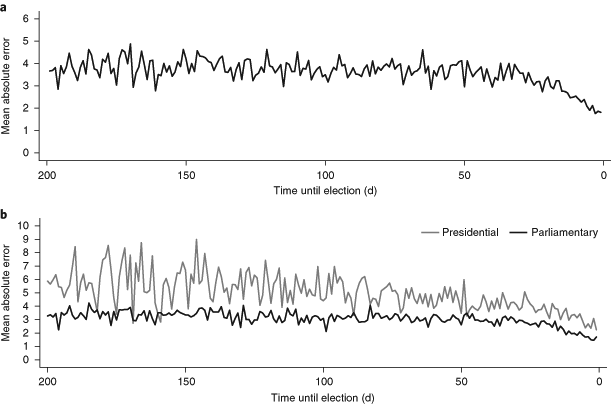
Election polling errors across time and space
Are election polling misses becoming more prevalent? Are they more likely in some contexts than others? Here we undertake an over-time and cross-national assessment of prediction errors in pre-election polls. Our analysis draws on more than 30,000 national polls from 351 general elections in 45 countries between 1942 and 2017. We proceed in the following way. First, building on previous studies, we show how errors in national polls evolve in a structured way over the election timeline. Second, we examine errors in polls in the final week of the election campaign to assess performance across election years. Third, we undertake a pooled analysis of polling errors—controlling for a number of institutional and party features—that enables us to test whether poll errors have increased or decreased over time. We find that, contrary to conventional wisdom, the recent performance of polls has not been outside the ordinary. However, the performance of polls does vary across political contexts and in understandable ways.
The Twilight of the Polls? A Review of Trends in Polling Accuracy and the Causes of Polling Misses
Polls have had a number of high-profile misses in recent elections. We review the current polling environment, the performance of polls in a historical context, the mechanisms of polling error, and the causes of several recent misses in Britain and the US. Contrary to conventional wisdom, polling errors have been constant over time, although the level of error has always been substantially beyond that implied by stated margins of error. Generally, there is little evidence that voters lying about their vote intention (so-called ‘shy’ voters) is a substantial cause of polling error. Instead, polling errors have most commonly resulted from problems with representative samples and weighting, undecided voters breaking in one direction, and to a lesser extent late swings and turnout models. We conclude with a discussion of future directions for polling both in terms of fixing the problems identified and new approaches to understanding public opinion.

What is Approval Voting? | Center for Election Science
What is Approval Voting?

Permissioned Data Shapes: Polls - Nick's Blog
A poll is a space, a ballot is an address, and read_self is the ballot screen: voters cast and change their own votes while no voter's client can read anyone else's.
Thirty-ninth General Election 2006: Official Voting Results (raw data)
Official Voting Results published by Elections Canada.

Victorian State Voting Intention: One Nation (26.5%) now ahead of ALP (25.5%) and L-NP Coalition (21.5%) on primary vote nine months before Victorian State Election - Roy Morgan Research
Only nine months before a State Election, Victorian electors are split with One Nation (26.5%) now ahead of the governing ALP (25.5%), and the official Opposition L-NP Coalition (21.5%). In addition, 13.5% support the Greens and a further 13% support other minor parties and Independents according to the special SMS Roy Morgan survey conducted from February 13-16, 2026, with a representative Victoria-wide cross-section of 2,462 electors.

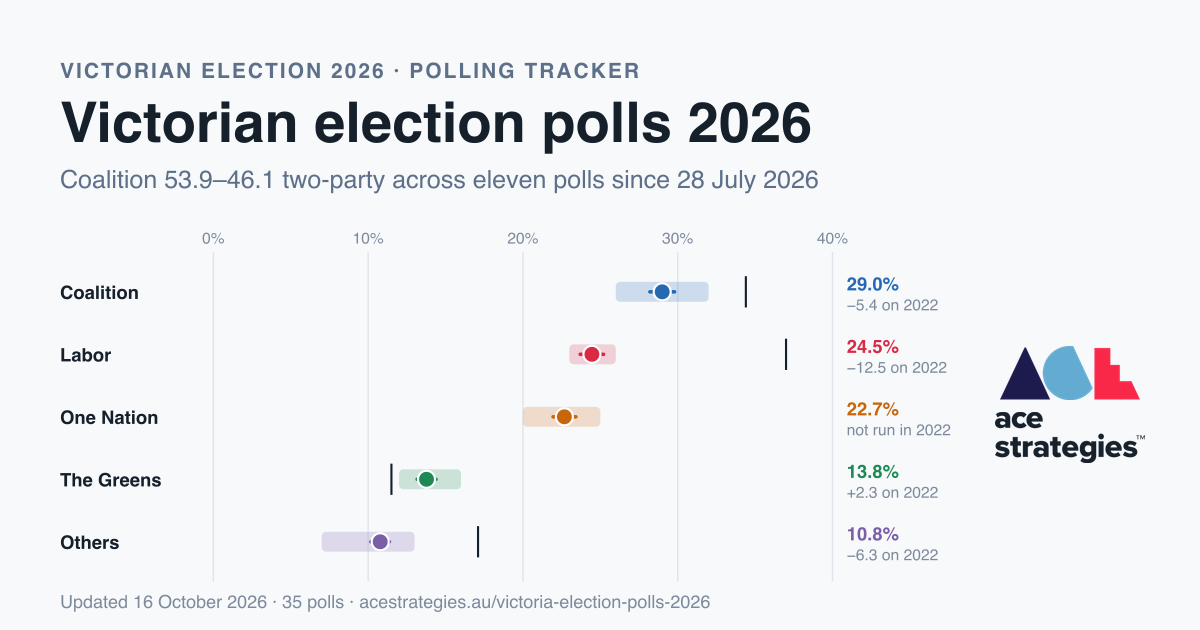
Victorian Election Polls 2026: The Third Corner
Updated 16 October 2026: the Coalition leads 53.9–46.1 across the eleven Victorian polls since the change of Premier, with One Nation on 22.7 per cent.
How Approval Voting and Ranked Choice Voting Are Different | Center for Election Science
How Approval Voting and Ranked Choice Voting Are Different

Why does every poll seem to show a tossup now?
Campaigns see internal polls as tools for fundraising
Election Maps UK (@electionmaps.uk)
Current Nowcast Projection for Clacton: ➡️ RFM: 48.5% (+2.3) 🌳 CON: 19.2% (-8.7) ◼️ RES: 12.0% (New) 🌍 GRN: 8.2% (+4.0) 🌹 LAB: 6.2% (-10.0) 🔶 LDM: 4.6% (+0.2) electionmaps.uk/nowcast
