


As the publishing community debates the merits of naming sleuths in retraction or correction notices, one journal did so without the sleuth’s permission — by publishing an email from the authors na…
Scientific sleuths come in from the cold
Research integrity investigators are starting to organize, but the field, and the people, remain idiosyncratic

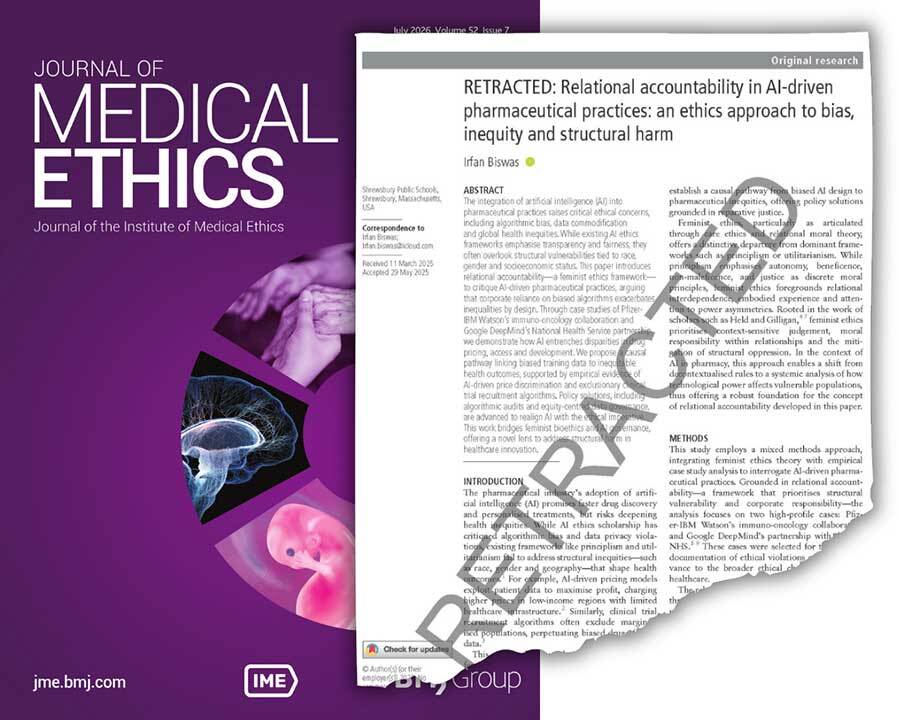
Ethics journal retracts paper by high school student for AI, peer review manipulation
The Journal of Medical Ethics has retracted a paper on the use of AI in the pharmaceutical industry for containing references that don’t exist. The article’s sole author: a high school student.&nbs…
Why the Stockholm Declaration will never work
Abstract The Stockholm Declaration calls for a moral reformation of scientific publishing—replacing commercial publishers with scholar-led journals, rewarding quality over quantity and instituting independent oversight. While noble in spirit, it fundamentally misdiagnoses the disease. The crisis of science stems not from paper mills or profit motives but from systemic incentives that reward volume, novelty and prestige over validity and reliability. Non-profit ownership will not neutralize the prestige economy, sleuth-led policing cannot scale, and ‘integrity registries’ would merely replace metrics with surveillance. True reform requires rebuilding the publishing infrastructure as a public utility: publicly funded, free to publish and read, and stripped of hierarchy and financial incentives.

Salami publication: definitions and examples
Salami publication or segmented publication is a distinct form of redundant publication which is usually characterized by similarity of hypothesis, methodology or results but not text similarity. These aspects of publications are not objectively detected by software applications and therefore present a serious threat to publication ethics. This article presents a practical approach for dealing with manuscripts suspected of salami publication during the submission process and after article publication in Biochemia Medica.

So maybe now we can agree that having an unchecked research integrity militia who unfortunately has the ear of the press and increasingly that of the the publishers, but who fiercely rejects any… | Ioana A. Cristea
So maybe now we can agree that having an unchecked research integrity militia who unfortunately has the ear of the press and increasingly that of the the publishers, but who fiercely rejects any minimal ethics or code of conduct, is a (growing) problem? Also, that 1. problems have to be investigated before deciding they are are legitimate and serious; 2. this investigation is not social media, blogs and the press; 3. this investigation should not be on the front page of journals and Retraction Watch; 4. there are degrees of seriousness and some things can just be corrected or are simply not very consequential (no, it's not a house of bricks where we have to check every brick, that's a dumb analogy), so being absolutely hysterical and overdramatic about any lie, inaccuracy or mistake is purposeful at worse and should be ignored at best and 5. it is not only unnecessary, but harmful, to also go into other, non-academic things the person did or does to complete "investigations" that you (press, sleuth, blogger, etc) do not have the tools and information to do completely and accurately (this fixation would be called harassment in the before times). Others will justly write about what the institutions did or did not do, but what I want to say is that we really should end it with the blank credit we give to any and all allegations that come from the establish research integrity truth fighters.

Wired and Business Insider remove articles by AI-generated ‘freelancer’
At least six publications have taken down articles under the name Margaux Blanchard that were AI-generated

Review and ethics guidelines
We report independently THE DECODER operates as an independent editorial team. Our reporting is not influenced by the interests of any party, company,

A response to: Should universities investigate questionable papers students and faculty wrote elsewhere?
Editor’s note: We recently published a guest post on universities’ responsibility for investigating misconduct allegations related to work by staff and students conducted and/or published while the…

This is a FRAUDULENT paper, AI-generated. My name was used as an author and I had nothing to do with it, never saw it until today e-pubmed.co.uk/journals/digital-health-imple… The "Editors" Angelo Rossi Mori, David Mensah, and Zarnie Khadjesari and this "Journal" should be reported.
Lots of scepticism about codes of ethics in this piece but surely the work of sleuthing needs to be grounded in some kind of observable, ethical process. Otherwise it's just as opaque and unscientific as the stuff it's investigating.

Dalmeet Singh Chawla
Research sleuths are starting to organize, but the field, and the people, remain idiosyncratic — my latest for @cenmag.bsky.social: cen.acs.org/research-integrity/scientific… @mcintold.bsky.social, @reeserichardson.bsky.social, @elisabethbik.bsky.social, @sholtodavid.bsky.social, @eugenie-reich.bsky.social
This is a FRAUDULENT paper, AI-generated. My name was used as an author and I had nothing to do with it, never saw it until today e-pubmed.co.uk/journals/digital-health-imple… The "Editors" Angelo Rossi Mori, David Mensah, and Zarnie Khadjesari and this "Journal" should be reported.
I don't see the point in giving sleuths credit for retractions. It doesn't seem like a good way of valuing labour and also further turns retractions into a kind of weird moral economy.

Noticed: Sleuths are starting to get credit for retractions
retractionwatch.comWhen should a paper be corrected? Last December, @elisabethbik.bsky.social and other sleuths began flagging papers by a prominent bioengineer, Ali Khademhosseini. They found over 80 with image issues. Khademhosseini and his colleagues have issued over 40 corrections, but avoided retractions.

Science sleuths raise concerns about scores of bioengineering papers
www.nature.comAnd for context, here are the sleuths' profiles in other outlets: thetransmitter.org/publishing/retraction-she-wro… zmescience.com/science/the-rise-of-the-scien… These people are pros.

Retraction, She Wrote: Dorothy Bishop’s life after research
www.thetransmitter.orgArticle now retracted. Retraction notice focuses on data sharing, but doesn't mention - the ethics review body is the author's own company - the tech used to to collect the data by intercepting users' LLM prompts does not exist ht @grinschglsandra.bsky.social psycnet.apa.org/fulltext/2027-53135-001.html
APA PsycNet
psycnet.apa.org
Ian Hussey
Retractionwatch coverage of this article retractionwatch.com/2026/06/16/technology-mind-be… @grinschglsandra.bsky.social @malte.the100.ci @jamiecummins.bsky.social


