

via CDC We’ve been tracking retractions of papers about COVID-19 as part of our database. Here’s a running list, which will be updated as needed. (For some context on these figures, see…
BMJ Group retracts paper on COVID-19 vaccines and mortality featured in Senate hearing
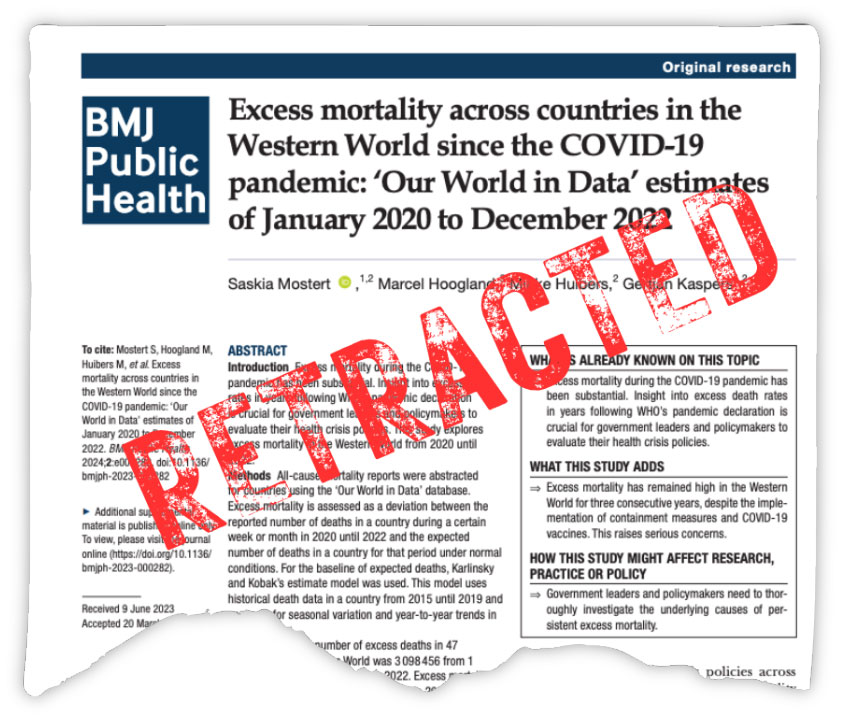
BMJ Public Health has retracted a paper some — including a witness at a recent U.S. Senate subcommittee hearing — have used to link COVID-19 vaccines to deaths. The action comes more than two years…
More than 10,000 research papers were retracted in 2023 — a new record
The number of articles being retracted rose sharply this year. Integrity experts say that this is only the tip of the iceberg.
More than 10,000 research papers were retracted in 2023 — a new record
The number of articles being retracted rose sharply this year. Integrity experts say that this is only the tip of the iceberg.
Archive: New COVID-19 ‘Citizen Science’ Initiative Lets Any Adult with a Smartphone Help to Fight Coronavirus
The online study would try to help researchers gain insight into how the virus is spreading and identify ways to predict and reduce the number of new infections.

Correction of scientific literature: Too little, too late!
The Coronavirus Disease 2019 (COVID-19) pandemic has highlighted the limitations of the current scientific publication system, in which serious post-publication concerns are often addressed too slowly to be effective. In this Perspective, we offer suggestions to improve academia’s willingness and ability to correct errors in an appropriate time frame.
The State of Papers, Retractions, and Preprints: Evidence from the CrossRef Database (2004-2024)
A 20-year analysis of CrossRef metadata demonstrates that global scholarly output -- encompassing publications, retractions, and preprints -- exhibits strikingly inertial growth, well-described by exponential, quadratic, and logistic models with nearly indistinguishable goodness-of-fit. Retraction dynamics, in particular, remain stable and minimally affected by the COVID-19 shock, which contributed less than 1% to total notices. Since 2004, publications doubled every 9.8 years, retractions every 11.4 years, and preprints at the fastest rate, every 5.6 years. The findings underscore a system primed for ongoing stress at unchanged structural bottlenecks. Although model forecasts diverge beyond 2024, the evidence suggests that the future trajectory of scholarly communication will be determined by persistent systemic inertia rather than episodic disruptions -- unless intentionally redirected by policy or AI-driven reform.

Researchers link Long COVID to another virus | NHK WORLD-JAPAN News
Researchers in Japan have released findings showing that COVID-19 after effects, including fatigue, occur when a coronavirus infection activates another virus already inside the body.

COVID-19 Vaccine Effectiveness and Safety for the 2026-2027 Respiratory Season
This Special Communication aims to identify and summarize the most recently published evidence evaluating the effectiveness and safety of US-licensed COVID-19 vaccines and report on the epidemiology of SARS-CoV-2 in the US.

outbreak.info SARS-CoV-2 data explorer
Meta to roll back Covid-19 misinformation measures
Meta is revising its policies to take a regional approach towards countries that still have public health emergency declarations.

How Ten Publishers Retract Research
Retractions are the primary mechanism for correcting the scholarly record, yet publishers differ markedly in how they use them. We present a bibliometric analysis of 46,087 retractions across 10 major publishers using data from the Retraction Watch database (1997-2026), examining retraction rates, reasons, temporal trends, and geographic distributions, among other dimensions. Normalized retraction rates vary by two orders of magnitude, from Elsevier's 3.97 per 10,000 publications to Hindawi's 320.02. China-affiliated authors account for the largest share of retractions at every publisher. Retraction lags and reason profiles also vary widely across publishers. Among the ten publishers, ACM is an outlier in its retraction profile. ACM's normalized rate is mid-range (5.65), yet 98.3% of its 354 retractions are related to one incident. Seven of the ten most common global retraction reasons (including misconduct, plagiarism, and data concerns) are entirely absent from ACM's record. ACM's first retraction dates to 2020, despite a catalog dating to 1997. ACM self-describes its retraction threshold as "extremely high." We discuss this threshold in relation to the COPE retraction guidelines and the implications of ACM's non-public dark archive of removed works.
Article now retracted. Retraction notice focuses on data sharing, but doesn't mention - the ethics review body is the author's own company - the tech used to to collect the data by intercepting users' LLM prompts does not exist ht @grinschglsandra.bsky.social psycnet.apa.org/fulltext/2027-53135-001.html
APA PsycNet
psycnet.apa.org
Ian Hussey
Retractionwatch coverage of this article retractionwatch.com/2026/06/16/technology-mind-be… @grinschglsandra.bsky.social @malte.the100.ci @jamiecummins.bsky.social
Just checked, and yes, my retracted paper is in the #retractionwatch database, as it should be. However, I wish the reason didn't include that it was an investigation by the journal/publisher, it was me who sweated and wrote a new paper with a solid theorem explaining why our old paper was […]
Original post on mathstodon.xyz
mathstodon.xyzAn article about data visualization was retracted 1.5 years after I pointed out errors. The notice says that "concerns were raised". I spend dozens of hours contacting authors and editors, reproducing analyses, and following up on ignored emails. But I'm not mentioned in the retraction notice.

RETRACTED: A Perception Study for Unit Charts in the Context of Large-Magnitude Data Representation
www.mdpi.comCOVID-19 vaccines

Primarily information in the US and Japan
COVID-19 Vaccine Effectiveness and Safety for the 2026-2027 Respiratory Season
BMJ Group retracts paper on COVID-19 vaccines and mortality featured in Senate hearing

What to Know About New Covid Vaccines for Fall 2026
Underlying Conditions and the Higher Risk for Severe COVID-19

