


As the world changes at accelerating speed, news media report and update on these events around the clock, jostling for a share of the four to five hours each day that people devote to their smartphones. For some, this means new opportunities to stay close to news stories as they unfold; for others, it risks creating a sense of overload.
The future of news is happening where no one is looking
"In 2026, more news organizations will understand that people don’t always want an article. Sometimes they just want clarity."

The Curious About Everything Newsletter #60
The many interesting things I read in February 2026

The Curious About Everything Newsletter #63
The many interesting things I read in May 2026

Press Release
The world's online population grew by more than 240 million people in 2025, according to Facts and Figures 2025 released today by the International Telecommunication Union (ITU). The new estimates confirm continuing progress in expanding digital connectivity, while pointing to differences in quality that impact how users benefit from Internet use.

Speeding Up RSS | TechCrunch
I'm sorry, but RSS feeds are way too slow. I know this first-hand. As part of my job here at TechCrunch, I monitor a lot of RSS feeds for breaking news. We also produce our own feed and I can see how quickly it propagates to various feed readers and feed-powered news aggregation services. The lag time between posting a story and seeing it pop up in the RSS feed is usually a few minutes, and then it can take another 10 to 15 minutes or so for it to appear in something like Google Reader. And the TechCrunch feed is probably checked more frequently for updates than most other feeds. In our business, every second counts and RSS just isn't cutting it. While there is an argument to be made that RSS is dying, being replaced by more instantaneous forms of content delivery such as Twitter and other real time streams, many people aren't quite yet ready to give up on it. Instead, they want to save it by speeding it up. Tomorrow, at our Real Time Stream CrunchUp, we will see three demos of projects that do just that in slightly different ways.
The Curious About Everything Newsletter #65
The many interesting things I read in July 2026

The Curious About Everything Newsletter #66
The many interesting things I read in August 2026

Changes to the Facebook Algorithm Decreased News Visibility Between 2021-2024
Platforms, especially Facebook, are primary news sources in the US. In its widely criticized "War on News," Meta algorithmically deprioritized news and political content. We use data from 40 news organizations (5,243,302 Facebook posts, 7,875,372,958 user reactions) and 21 non-news pages (396,468 posts; 1,909,088,308 reactions) between January 1, 2016 and February 13, 2025 to examine how these changes influenced news visibility on the platform. Reactions to news declined by 78% between 2021 and 2024 while reactions to non-news pages increased, indicating targeted suppression of news visibility. Low-quality sources were especially suppressed, yet the 2025 end to "War on News" increased user reactions to news, especially low-quality ones. These changes do not reflect decreased news supply, Facebook user base, or interest in news over this period.


We Don't Have Time Davos Hub – Jan 19, 2026–Jan 23, 2026
Welcome to our digital hub during the World Economic Forum. January 19–23, 2026.

My 2026 Open Social Web Predictions - Tim Chambers
Predictions for 2026 include growth forecasts for various social media platforms, advancements in federated technologies, and anticipated shifts in how …
My 2024 thoughts on the state of social media
I see a continued fragmentation of social media as people leave X(Twitter).

2025.21: The Upheaval Coming for the Internet Economy
The best Stratechery content from the week of May 19, 2025, including AI and the future of the web, slam dunks and moonshots at Google, and OpenAI entering the hardware business.

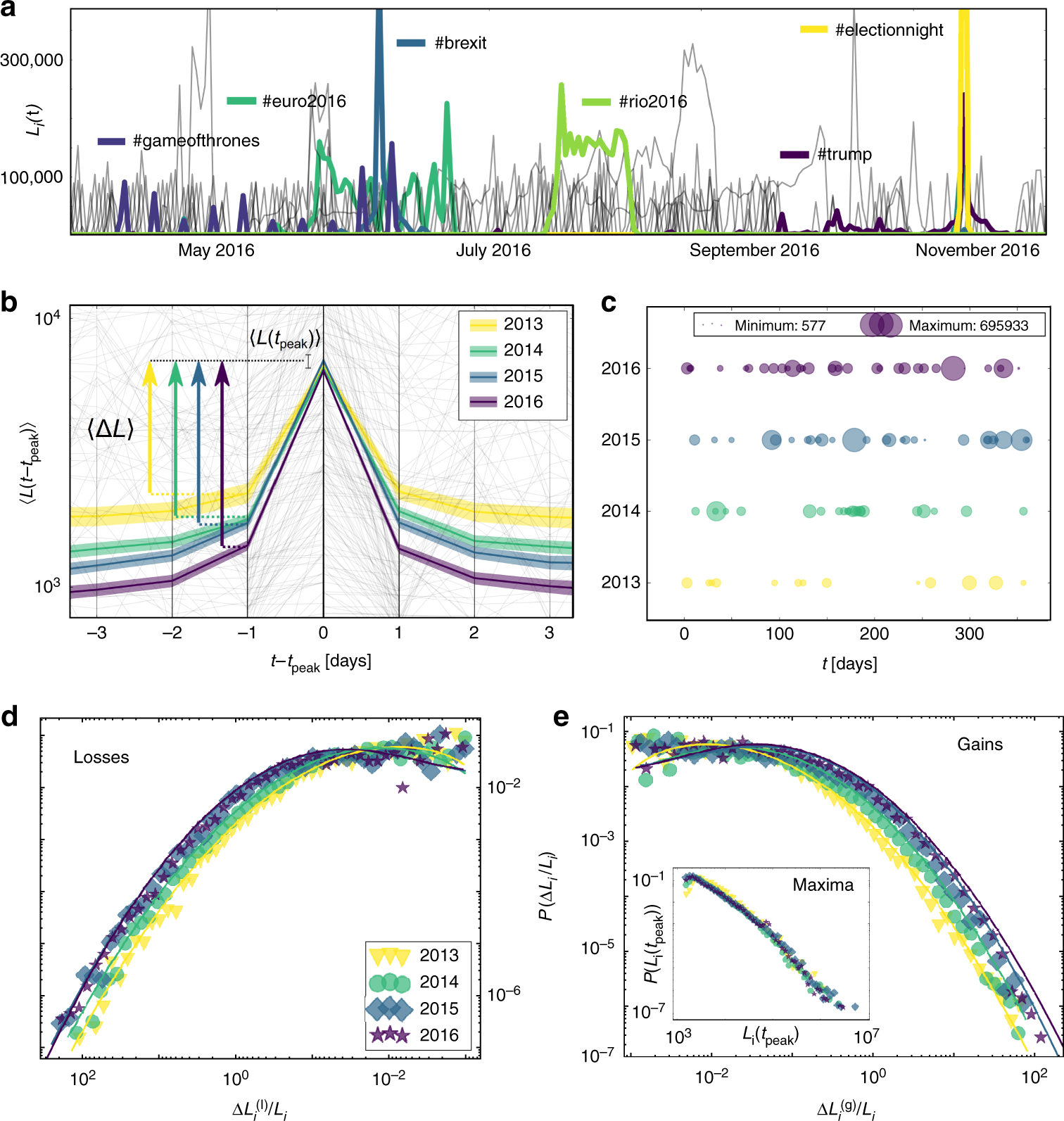
Accelerating dynamics of collective attention
With news pushed to smart phones in real time and social media reactions spreading across the globe in seconds, the public discussion can appear accelerated and temporally fragmented. In longitudinal datasets across various domains, covering multiple decades, we find increasing gradients and shortened periods in the trajectories of how cultural items receive collective attention. Is this the inevitable conclusion of the way information is disseminated and consumed? Our findings support this hypothesis. Using a simple mathematical model of topics competing for finite collective attention, we are able to explain the empirical data remarkably well. Our modeling suggests that the accelerating ups and downs of popular content are driven by increasing production and consumption of content, resulting in a more rapid exhaustion of limited attention resources. In the interplay with competition for novelty, this causes growing turnover rates and individual topics receiving shorter intervals of collective attention.

We have some news you can use on the blog this fine Monday! Ozone, our mod tool, is adding a new *report-based* moderation workflow, which enables higher-context moderating, better collaboration, auditing, and more! Check it: atproto.com/blog/report-based-moderation

Report-Based Moderation in Ozone - AT Protocol
atproto.com