Large language models (LLMs) are an indisputable breakthrough of the last five years, potentially profoundly changing the way that we work. As with any extraordinarily powerful tool, LLM use has both promise and peril — and that they are so general-purpose leaves real questions about how and when they should be used. The landscape is shifting so rapidly that static prescription is unlikely — but that LLMs are evolving so quickly also gives urgency to the question: how should LLMs be used at Oxide?
576 - Using LLMs at Oxide | RFD | Oxide
Large language models (LLMs) are an indisputable breakthrough of the last five years, potentially profoundly changing the way that we work. As with any extraordinarily powerful tool, LLM use has both promise and peril — and that they are so general-purpose leaves real questions about how and when they should be used. The landscape is shifting so rapidly that static prescription is unlikely — but that LLMs are evolving so quickly also gives urgency to the question: how should LLMs be used at Oxide?
The Ultimate Guide to Fine-Tuning LLMs from Basics to Breakthroughs: An Exhaustive Review of Technologies, Research, Best Practices, Applied Research Challenges and Opportunities (Version 1.0)
The State of On-Device LLMs
Xuan-Son Nguyen, an engineer at Hugging Face, specializes in on-device large language models (LLMs) and runtime optimization, working extensively with llam...

The State of On-Device LLMs
Xuan-Son Nguyen, an engineer at Hugging Face, specializes in on-device large language models (LLMs) and runtime optimization, working extensively with llam...
Large language model
A large language model (LLM) is a neural network trained on a vast amount of text for natural language processing tasks, especially language generation. LLMs can typically generate, summarize, translate, and analyze text in many contexts, and are a foundational technology behind modern chatbots.[1] Biased or inaccurate training data can make an LLM's output less reliable.[2]
Beyond Model Collapse: Scaling Up with Synthesized Data Requires...
Large Language Models (LLM) are increasingly trained on data generated by other LLM, either because generated text and images become part of the pre-training corpus, or because synthetized data is...

chad/whichlang
What programming language do LLMs default to when you don't tell them? A small benchmark.
Wikipedia:LLM-assisted translation
This guideline applies to machine translation tools that include a large language model ("LLM"). Assume that it applies to any online translation tool unless you have confirmed there is no LLM element.
Scaling Laws Across Model Architectures: A Comparative Analysis of...
The scaling of large language models (LLMs) is a critical research area for the efficiency and effectiveness of model training and deployment. Our work investigates the transferability and...
Dan Shipper 📧 on Twitter / X
this is true and is a big reason why you don’t need to be a highly technical researcher to use LLMs in surprising and novel ways https://t.co/TuxNzXzToU— Dan Shipper 📧 (@danshipper) July 27, 2025
On-Device LLM Throughput Calculator - a Hugging Face Space by FL33TW00D-HF
This tool estimates and visualizes the throughput of Large Language Models on devices with memory bandwidth constraints. Users input device and model configurations, and the tool generates a plot s...
Why Can’t Powerful LLMs Learn Multiplication?
These days, large language models (LLMs) can handle increasingly complex tasks, writing complex code and engaging in sophisticated reasoning. But when it comes to 4-digit multiplication, a task taught in elementary school, even state-of-the-art systems fail. Why? A new paper by Computer Science PhD student Xiaoyan Bai and Faculty Co-Director of the Data Science Institute’s …
LLM in a Flash: Efficient Large Language Model Inference with Limited Memory
Large language models (LLMs) are central to modern natural language processing, delivering exceptional performance in various tasks…


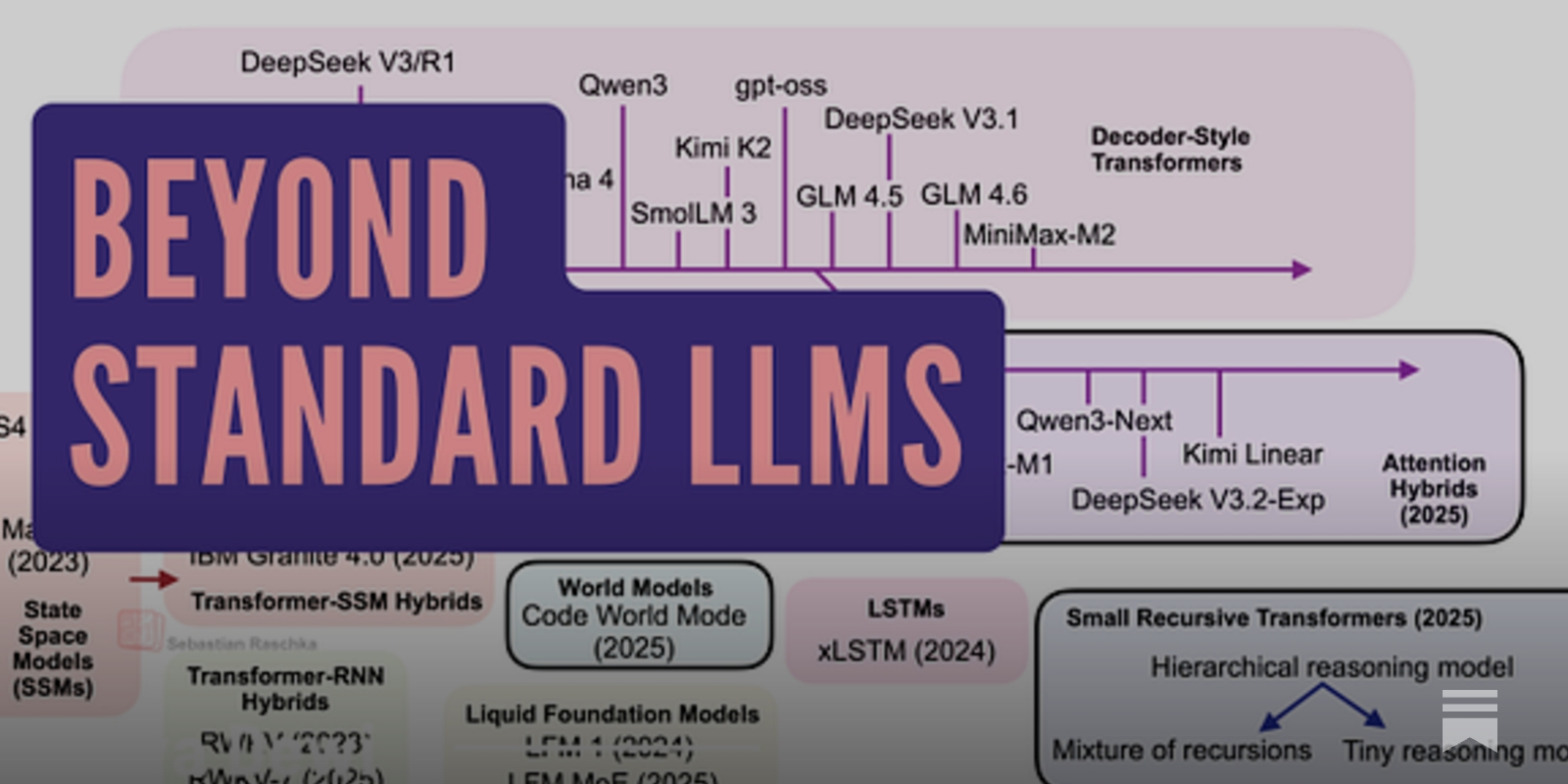
Beyond Standard LLMs
Linear Attention Hybrids, Text Diffusion, Code World Models, and Small Recursive Transformers