

Why do we still call it "social media"?
People, Not Posts - Real Housewives of San Francisco
Why do we still call it "social media"?
People, Not Posts: Part II - Real Housewives of San Francisco
What comes after social media?
People, Not Posts: Part II - Real Housewives of San Francisco
What comes after social media?
1 Year on the AT Protocol: Part I - Real Housewives of San Francisco
Putting Social Media Back on the Internet
1 Year on the AT Protocol: Part I - Real Housewives of San Francisco
Putting Social Media Back on the Internet
1 Year on the AT Protocol: Part I - Real Housewives of San Francisco
Putting Social Media Back on the Internet
Pluralistic: Social media without socializing (19 Jan 2026) – Pluralistic: Daily links from Cory Doctorow
From the earliest days of social media, social media bosses have been at war with sociability. To create a social media service is to demarcate legitimate and illegitimate forms of sociability. It's a monumental act of hubris, really.
Shifts in U.S. Social Media Use, 2020–2024: Decline, Fragmentation, and Enduring Polarization
The social media ecosystem appears to be in flux. Twitter’s rebranding to X has come to symbolize a broader reorganization of online publics – political reshuffling, user attrition, and uncertainty over the role of legacy platforms. Simultaneously, the shift from text-based, networked feeds toward algorithmically curated, short-form video has accelerated, with TikTok setting the pace for the wider ecosystem [18, 14, 16]. At the same time, everyday communication increasingly migrates from large, open networks to semi-private spaces such as group chats and messaging apps. Commentators describe a digital public sphere in transition: smaller, more fragmented, less dominated by traditional social networking sites, and rise of more broadcast-oriented forms of media – with some even suggesting that we are seeing the beginning of the end of the social media era.
Social Media Is Now Parasocial Media
When practitioners used the term “social media” to describe the internet tools that emerged in the mid-aughts, they were giving a name to the kinds of platforms and protocols that allowed people to socialize with friends and communities of interest by using digital technologies. Twenty years later, users of social media are far more likely to scroll than post – and the content that they consume is often strategically produced and algorithmically curated. In this essay, I argue that the very essence of social media has changed. To more effectively interrogate what we are witnessing, we need to stop presuming that these tools are “social media” and begin recognizing that they are now “parasocial media.” Doing so raises new questions about digitally mediated sociality, not to mention the politics and governance of these platforms.

Scientists no Longer Find Twitter Professionally Useful, and have Switched to Bluesky
Synopsis. Social media has become widely used by the scientific community for a variety of professional uses, including networking and public outreach. For
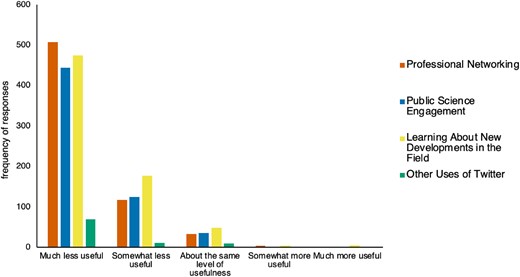
Scientists no Longer Find Twitter Professionally Useful, and have Switched to Bluesky
Synopsis. Social media has become widely used by the scientific community for a variety of professional uses, including networking and public outreach. For
The year social networks were no longer social | TechCrunch
The term “social network” has become a meaningless association of words. Pair those two words and it becomes a tech category, the equivalent of a single

Why E2EE? - Real Housewives of San Francisco
We either have private lives, or we don’t.
Social media is no longer social. Most of it is passive viewing of videos and pictures from people we've never met. But we're still studying social media like it's 2010. We've entered the post-social media era — and research needs to catch up. osf.io/preprints/socarxiv/6nue7_v1 preprint w/ Richard Rogers
🐝 Social Media (SB Commentary)

things I said about social media

Bee 🐝 (@sweetbee.vip)
Bee 🐝 (@sweetbee.vip)
Bee 🐝 (@sweetbee.vip)
