

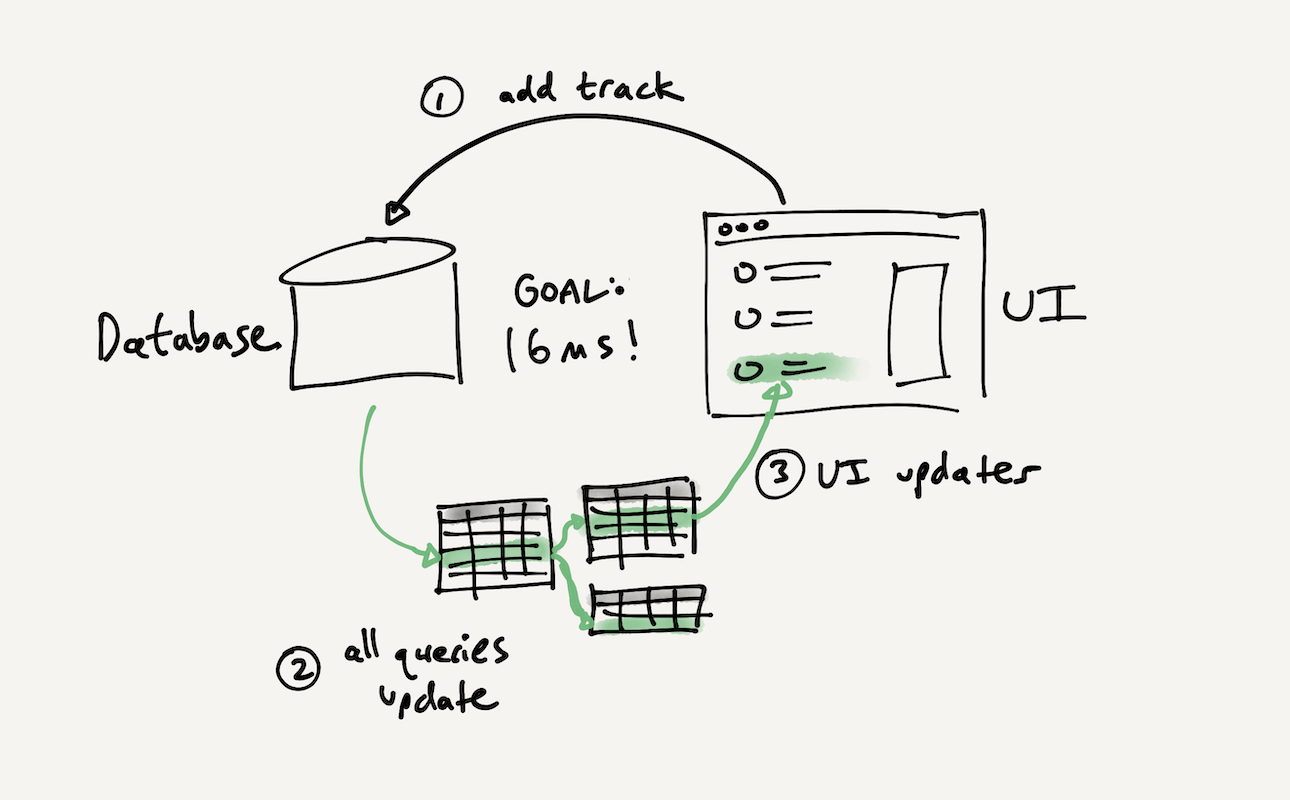
We're exploring an approach to simplifying app development: storing all application and UI state in a client-side reactive relational database that provides a structured dataflow model.
LiveStore
LiveStore is a next-generation state management framework based on reactive SQLite and git-inspired syncing (via event-sourcing). - LiveStore

livestorejs/livestore
LiveStore is a next-generation state management framework based on reactive SQLite and built-in sync engine.
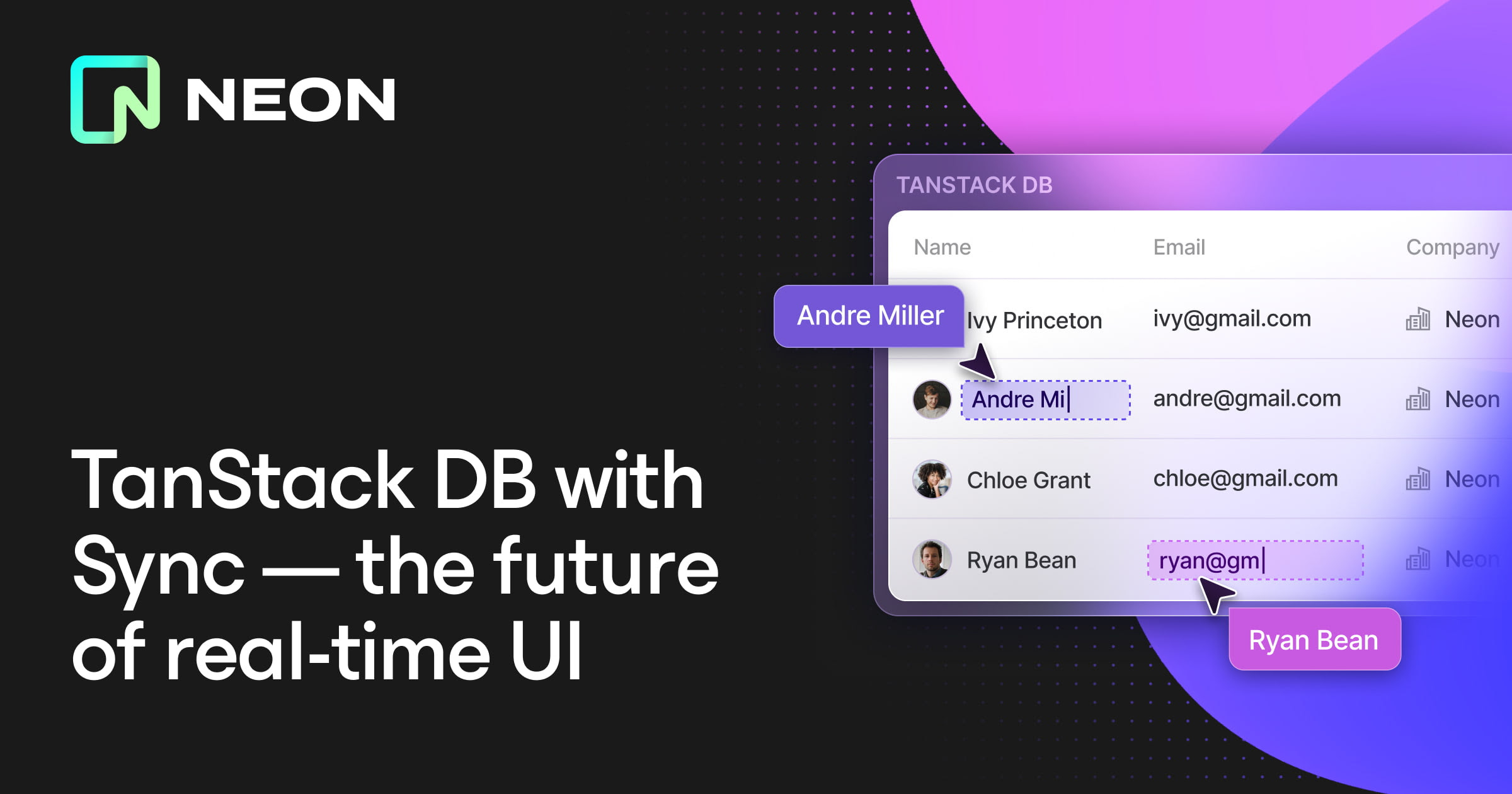
TanStack DB with Sync - the future of real-time UI - Neon
Learn how to achieve end-to-end reactivity and optimistic UI updates with Electric SQL, TanStack DB, and Postgres.
Johannes Schickling on Twitter / X
After 4 years of work, I'm incredibly excited to introduce LiveStore, the next-gen data layer I'm building for Overtone.It's based on reactive SQLite and has a built-in sync engine. Give it a try - would love your feedback! https://t.co/DB0cEXY9MD— Johannes Schickling (@schickling) May 27, 2025
Relational foundations for functorial data migration | Proceedings of the 15th Symposium on Database Programming Languages
In this paper we present a simple database definition language: that of categories and functors. A database schema is a small category and an instance is a set-valued functor on it. We show that morphisms of schemas induce three ''data migration ...
Node-Based UIs in React - React Flow
Highly customizable React library for workflow builders, no-code apps, image processing, visualizers, and more

LiveStore: SQLite-based data layer for local-first apps
Introducing: LiveStore - the client-centric, local-first data layer for high performance applications.

Kyle Mathews on Twitter / X
D2TS enables really powerful streaming joins, aggregations, etc. and will be powering a lot of Electric features in the future!This is an early preview but very cool tech. First Typescript implementation of Differential Dataflow afaik. https://t.co/i4qSJnVZWV— Kyle Mathews (@kylemathews) February 28, 2025
Haystack: A Platform for Authoring End User Semantic Web Applications
The Semantic Web promises to open innumerable opportunities for automation and information retrieval by standardizing the protocols for metadata exchange. However, just as the success of the World Wide Web can be attributed to the ease of use and ubiquity of Web browsers, we believe that the unfolding of the Semantic Web vision depends on users getting powerful but easy-to-use tools for managing their information. But unlike HTML, which can be easily edited in any text editor, RDF is more complicated to author and does not have an obvious presentation mechanism. Previous work has concentrated on the ideas of generic RDF graph visualization and RDF Schema-based form generation. In this paper, we present a comprehensive platform for constructing end user applications that create, manipulate, and visualize arbitrary RDF-encoded information, adding another layer to the abstraction cake. We discuss a programming environment specifically designed for manipulating RDF and introduce user interface concepts on top that allow the developer to quickly assemble applications that are based on RDF data models. Also, because user interface specifications and program logic are themselves describable in RDF, applications built upon our framework enjoy properties such as network updatability, extensibility, and end user customizability – all desirable characteristics in the spirit of the Semantic Web.

Designing Data-Intensive Applications
Data is at the center of many challenges in system design today. Difficult issues need to be figured out, such as scalability, consistency, reliability, efficiency, and... - Selection from Designing Data-Intensive Applications [Book]
VisQuill – Reactive Geometry for Interactive Data Visualization
VisQuill lets you explore data through interactive visuals or build your own using a reactive geometry SDK. Create geospatial and interactive visual systems with real-time updates.

Data exchange: getting to the core | ACM Transactions on Database Systems
Data exchange is the problem of taking data structured under a source schema and creating an instance of a target schema that reflects the source data as accurately as possible. Given a source instance, there may be many solutions to the data exchange ...

複雑なJavaScriptアプリケーションを考えながら作る話
Stores contain the application state and logic. -- Flux | Application Architecture for Building User Interfaces