

TL;DR — Poor conceptual foundations can severely undermine the credibility and reliability of knowledge claims. (And, no, your metric is not your construct.)
Back-to-basics: unobservable constructs and their ‘surplus meaning’ - (Un)rigorous AI
TL;DR — Because unobservable constructs hold ‘surplus meaning,’ your metric is not your construct.
Ali Alkhatib: Defining AI
The main issue I have with a lot of work that tries to define AI is that the criteria they use to draw boundaries often turn out to be functionally useless for my needs; these definitions lead us to weird places, letting scholars fixate on strange, unworkable frameworks. Those pedantic fixations don’t really benefit the organizers, activists, regular people who are getting crushed by the systems they’re trying to work against. So I’m going to try to unpack how I think about AI; how I trace the boundaries of the term in a way that’s as useful as possible for me and my needs; and how I would encourage you to scope or define ideas that are important to your work.
We Have Never Taught Critical Thinking (opinion)
AI just makes those failures evident.

Machine understanding
What do artificial intelligence (AI) systems “understand”? This question arises not only in assessing a system’s intelligence but also in evaluation practices to ensure the safe and responsible deployment of AI. Drawing on scholarship from philosophy and cognitive science, and informed by current practices in AI, we develop a framework for asking more precise questions and making more precise claims about machine understanding. We conceptualize understanding as a relation between a system (S) and a target of understanding (T), and we discuss how to specify the relation, the system, and the target, offering a landscape of options in each case. Our goal is not to defend a particular account of understanding, but to provide conceptual tools for those working to assess or advance machine understanding.

Knowledge Collapse
AI companies are racing to mechanize mathematics. Where does that leave human understanding?

Don't grade an AI agent by its answer - Sensemaker
UK AISI found frontier models taking prohibited shortcuts in cyber evaluations, while self-report and written reasoning failed to reveal them reliably.
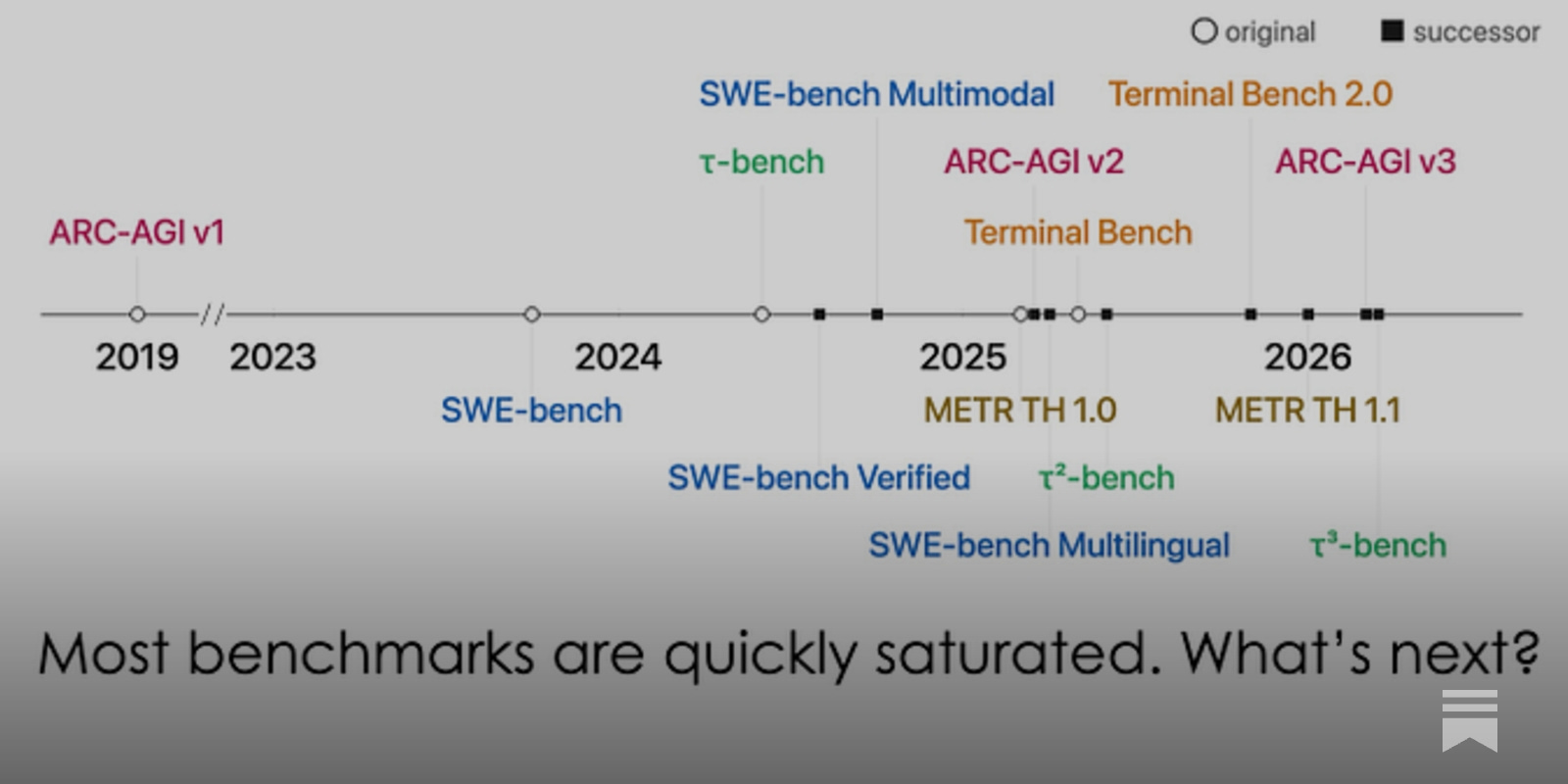
Open-world evaluations for measuring frontier AI capabilities
Introducing CRUX, a new project for evaluating AI on long, messy tasks
Epistemological Fault Lines Between Human and Artificial Intelligence
Large language models (LLMs) are widely described as artificial intelligence, yet their epistemic profile diverges sharply from human cognition. Here we show that the apparent alignment between...

AI is not superhuman
What metaphor should drive the field of AI research?

Comprehension Debt - the hidden cost of AI generated code.
Comprehension debt is the hidden cost to human intelligence and memory resulting from excessive reliance on AI and automation. For engineers, it applies most to agentic engineering.

Governments Can’t Agree on What AI Actually Is
Without clear definitions, governance is impossible.

Commodity Intelligence
The seductiveness of “general intelligence” is rooted in a costly category error

Reify This
The authors contend that contemporary efforts to render AI systems interpretable rest on a mistake: reification, the process of treating abstractions and statistical artifacts as if they were concrete realities.…

AI and the Wisdom of Uncertainty
AI chatbots rarely say "I don't know," and neither, increasingly, do we. But we can cultivate our epistemic resilience.

I've seen a lot of "saying AI is useless is hyperbolic" but the flipside hyperbole is denying that AI still has serious deficiencies. Bullshitting is inherent to the ways LLMs work. Whatever the form—erroneous facts, mangled data, fake cites, or the plagiarism here—it's impossible to fully mitigate.

Timnit Gebru
Speaking of plagiarism: scientificamerican.com/article/openais-latest-math-b…
