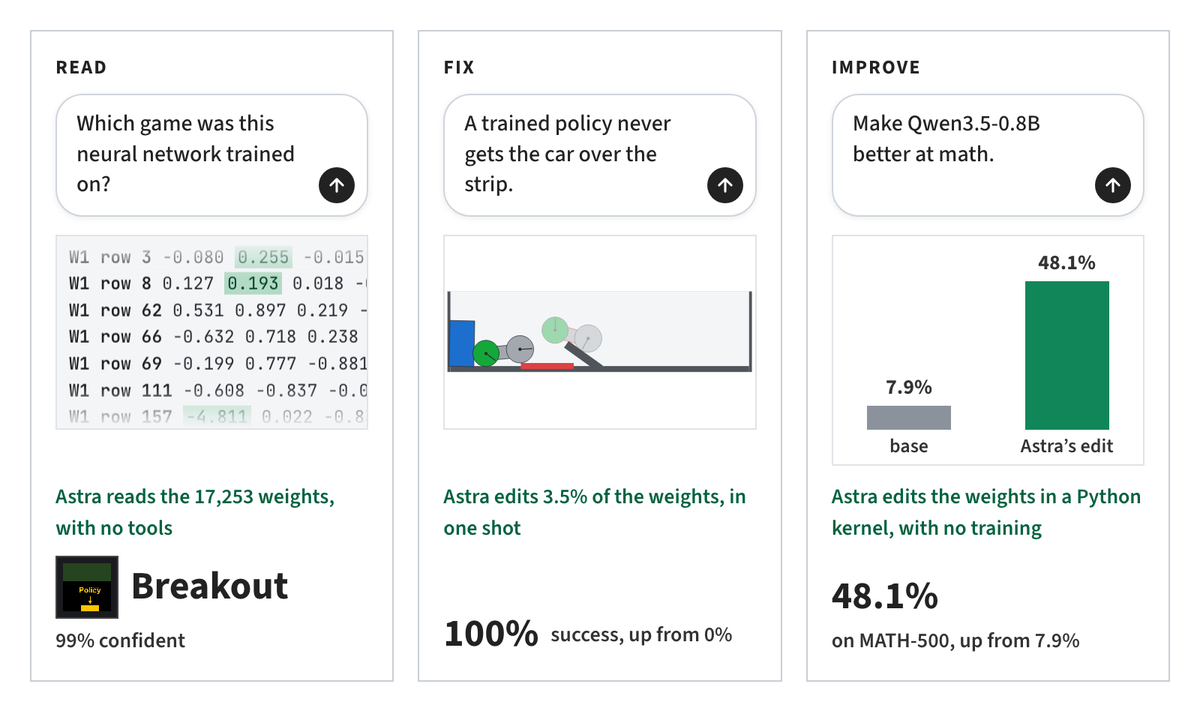
We find that frontier LLMs are surprisingly good at natively reading and writing neural network weights, using a variety of recent tools and algorithms or even via direct weight editing.
Sparks of Weight-Space Programming: LLMs can natively read & write neural network weights
We find that frontier LLMs are surprisingly good at natively reading and writing neural network weights, using a variety of recent tools and algorithms or even via direct weight editing.
Sparks of Weight-Space Programming: LLMs can natively read & write neural network weights
We find that frontier LLMs are surprisingly good at natively reading and writing neural network weights, well past what we’d expect from humans or conventional algorithms.
Qwen 3.8 27B on my laptop can interpret model weights, too
Yesterday’s hot paper was Sparks of Weight-Space Programming: LLMs can natively read & write neural network weights by Rikiya Takehi, Jayden Teoh, Alex Zhang, and Omar Khattab. The paper found …
Meta-Weight-Net: Learning an Explicit Mapping For Sample Weighting
Current deep neural networks(DNNs) can easily overfit to biased training data with corrupted labels or class imbalance. Sample re-weighting strategy is commonly used to alleviate this issue by designing a weighting function mapping from training loss to sample weight, and then iterating between weight recalculating and classifier updating. Current approaches, however, need manually pre-specify the weighting function as well as its additional hyper-parameters. It makes them fairly hard to be generally applied in practice due to the significant variation of proper weighting schemes relying on the investigated problem and training data. To address this issue, we propose a method capable of adaptively learning an explicit weighting function directly from data. The weighting function is an MLP with one hidden layer, constituting a universal approximator to almost any continuous functions, making the method able to fit a wide range of weighting function forms including those assumed in conventional research. Guided by a small amount of unbiased meta-data, the parameters of the weighting function can be finely updated simultaneously with the learning process of the classifiers. Synthetic and real experiments substantiate the capability of our method for achieving proper weighting functions in class imbalance and noisy label cases, fully complying with the common settings in traditional methods, and more complicated scenarios beyond conventional cases. This naturally leads to its better accuracy than other state-of-the-art methods.
Alex Krentsel on Twitter / X
i've reproduced the results from the MIT blog post today on weight-space programming. but one additional result i have to add: this is a new, step-change emerging capability that's appeared in just the latest set of models. pic.twitter.com/EhMsQaaOkL— Alex Krentsel (@AlexKrentsel) November 2, 2026

How To Scale Your Model
Training LLMs often feels like alchemy, but understanding and optimizing the performance of your models doesn't have to. This book aims to demystify the science of scaling language models: how TPUs (and GPUs) work and how they communicate with each other, how LLMs run on real hardware, and how to parallelize your models during training and inference so they run efficiently at massive scale. If you've ever wondered “how expensive should this LLM be to train” or “how much memory do I need to serve this model myself” or “what's an AllGather”, we hope this will be useful to you.
Can a Linear Program Do Weight-Space Programming?
Last week, MIT CSAIL published Sparks of Weight-Space Programming. Given the raw weights of a small network, GPT-6 Astra could tell which game it had been …
Beyond Model Collapse: Scaling Up with Synthesized Data Requires...
Large Language Models (LLM) are increasingly trained on data generated by other LLM, either because generated text and images become part of the pre-training corpus, or because synthetized data is...

Infinite-Parameter LLMs: Generating and Adapting Weights from Live Data
Scaling laws hold that language models grow more capable with more parameters and more training data. Mixture-of-Experts (MoE) architectures are a remarkable demonstration of these laws, activating only a fraction of an enormous parameter bank for each token. But this success is built on static pretraining data --- the facts and corrections supplied by users during live interactions are a significant untapped source of potential improvement for a deployed model, but cannot be exploited by conventional architectures whose weights are frozen after training. Instead, this newfound knowledge must be placed in the context (by instruction or retrieval) and re-read on every request, only to be discarded afterwards. We seek instead to learn from live interactions by dynamically updating model weights. Inspired by MoEs, we propose the \textbf{Infinite-Parameter LLM}. A compact hypernetwork turns the online data into low-rank modulations of a shared base network, so feed-forward weights are generated from live data, not read from static memory. Whereas existing weight generators are held fixed after reading the context once, we form a Bayesian belief over the generator's latent state and update it online, such that the effective weights are re-derived as our belief evolves during the session. Although the model's memory footprint is constant, the feasible space of generated weights is thus effectively infinite. Representing live data in the weights rather than the prompt amortises compute, frees the context window, persists updates across turns, and can generalise better than in-context use. Our evaluation protocol applies this methodology to in-context learning and retrieval.
Large language model
A large language model (LLM) is a neural network trained on a vast amount of text for natural language processing tasks, especially language generation. LLMs can typically generate, summarize, translate, and analyze text in many contexts, and are a foundational technology behind modern chatbots.[1] Biased or inaccurate training data can make an LLM's output less reliable.[2]
Can LLMs Be Computers? | Percepta
We build a computer inside a transformer — executing arbitrary C programs for millions of steps with exponentially faster inference via 2D attention heads.
Can LLMs Be Computers? | Percepta
We build a computer inside a transformer — executing arbitrary C programs for millions of steps with exponentially faster inference via 2D attention heads.
tinygrad: A simple and powerful neural network framework
We write and maintain tinygrad, the fastest growing neural network framework
Rikiya Takehi on Twitter / X
We asked GPT-6 Astra to edit Qwen3.5-0.8B weights to improve math.It directly changed only 0.016% of weights, fixing 0.8B's reasoning loops & improving math up to 6x and even instruction following 3x, without gradients or training.We call this Weight-Space Programming:… pic.twitter.com/DwTwzXzSbE— Rikiya Takehi (@rikiyatakehi) November 2, 2026

How Open Weights Are Changing the AI Race | Serverless Guru
Open Weight models: what they are, why you should care, and how the work of the open-source fine-tuning community around those models is reshaping daily life, both for developers and for everyday AI users.

LLMs are good at playing you
Large language models seem just like humans, but some of this is in our heads.