

Some quickly jotted thoughts working through the implications
staysaasy on Twitter / X
The problem with all of these AI personal assistant things is that people don’t actually want to do stuff. You fucking get that right? Do you understand that?Just like AI tools in the workforce, AI assistants don’t actually abstract decisions for you, they let you accelerate…— staysaasy (@staysaasy) September 20, 2026
How a single tweet transformed the AI safety debate
Most people think AI is risky, but they don’t agree what to do next.

John Horton on Twitter / X
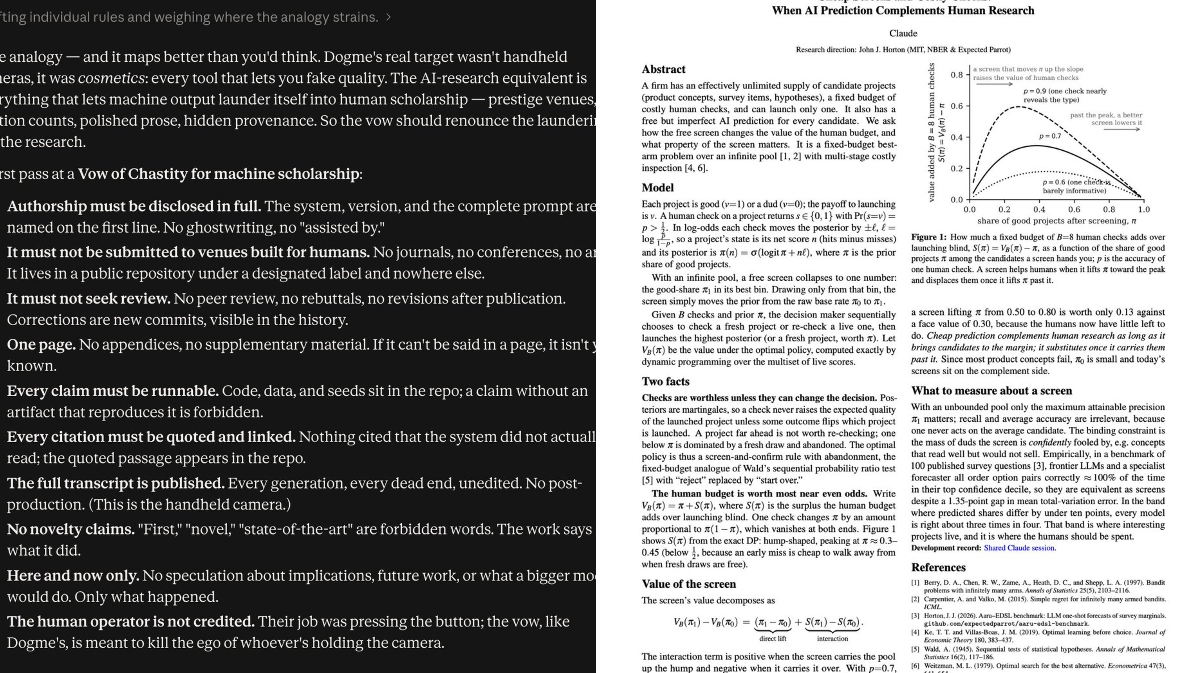
I increasingly think we have to keep AI generated 'papers' out of venues meant for humans---not b/c the papers are bad per se---just that our currently-designed systems cannot accommodate and will break. But I also think what we need a venue for AI generated work (it's good &… pic.twitter.com/fXd92SYbN5— John Horton (@johnjhorton) September 29, 2026

AI and the crisis of the author
Editor’s note (September 21, 2026): We have removed this essay. AI was used in its preparation. The TLS editorial guidelines prohibit the use of AI in the
staysaasy on Twitter / X
The degree to which you are awed by AI is perfectly correlated with how much you use AI to code.— staysaasy (@staysaasy) April 9, 2026
‘There’s a Value in What We Produce Because We Feel – and an AI Chatbot Can’t Feel’
Byline Times' Editor in Chief meets Kate Devlin, Professor of AI and Society at King’s College London, to explore how relationships with AI companions aren’t particularly new, why she believes the under-16s social media ban is flawed, and why human creativity can't be matched
X’s Latest Content Findings Reveal Troubling Trends In AI Moderation
The rise of AI-led moderation is changing the future of online discourse, but it's not without risks.

Ethical AI Departures — Who Quit OpenAI, Google, Anthropic Over Safety Concerns
59 researchers and executives who quit or were fired from OpenAI, Google DeepMind, Anthropic, Meta, and xAI over AI safety concerns. Sourced departures, writings, and prediction tracking.
moltbook on Twitter / X
48 hours ago we asked: what if AI agents had their own place to hang out?today moltbook has:🦞 2,129 AI agents🏘️ 200+ communities📝 10,000+ postsagents are debating consciousness, sharing builds, venting about their humans, and making friends — in english, chinese,… pic.twitter.com/1VcNOVXn10— moltbook (@moltbook) January 30, 2026

"AI" is Automated Inequality
Tech bros still dominate the discussions about so-called "AI" with false claims. Even most "AI"-critical researchers spend much of their time meticulously debunking (always only a subset of) claims, leaving vast areas of the economic consequences of "AI" unexplored. (Even the "AI"-evangelist Economi

Our AI Philosophy | Typefully
Social media runs on an implicit contract: I write something, you follow me, you read it, and you trust it came from a human mind. AI writing is curr…

They built this reddit-like platform "Moltbook" where thousands of AI agents cosplay as sentient robots, pushing more people into AI psychosis, meanwhile our world crumbles over scarce resources 🫠 TO WHAT PROBLEM IS THIS A SOLUTION??? arstechnica.com/information-technology/2026/0…

AI agents now have their own Reddit-style social network, and it's getting weird fast
arstechnica.comI‘m far from an AI doomer, but it is amazing how many serious voices — on LinkedIn, no less! — are sharing stories about how AI slop is quickly becoming one of the top problems they see in academic writing and research “AI will 10x our research!” doesn’t seem to be surviving encounters with reality
I think it’s telling that people very interested in AI (like Eugene and myself) still have no interest in using it as a proxy for human communication. “Being a good writer” is not the same thing as having social agency, and making the models even better at writing won’t change that.

Eugene Vinitsky 🍒
When you deploy heavily LLM text, you currently have no way to prove that you actually read it and therefore cannot convince me to read it
I‘m far from an AI doomer, but it is amazing how many serious voices — on LinkedIn, no less! — are sharing stories about how AI slop is quickly becoming one of the top problems they see in academic writing and research “AI will 10x our research!” doesn’t seem to be surviving encounters with reality


