

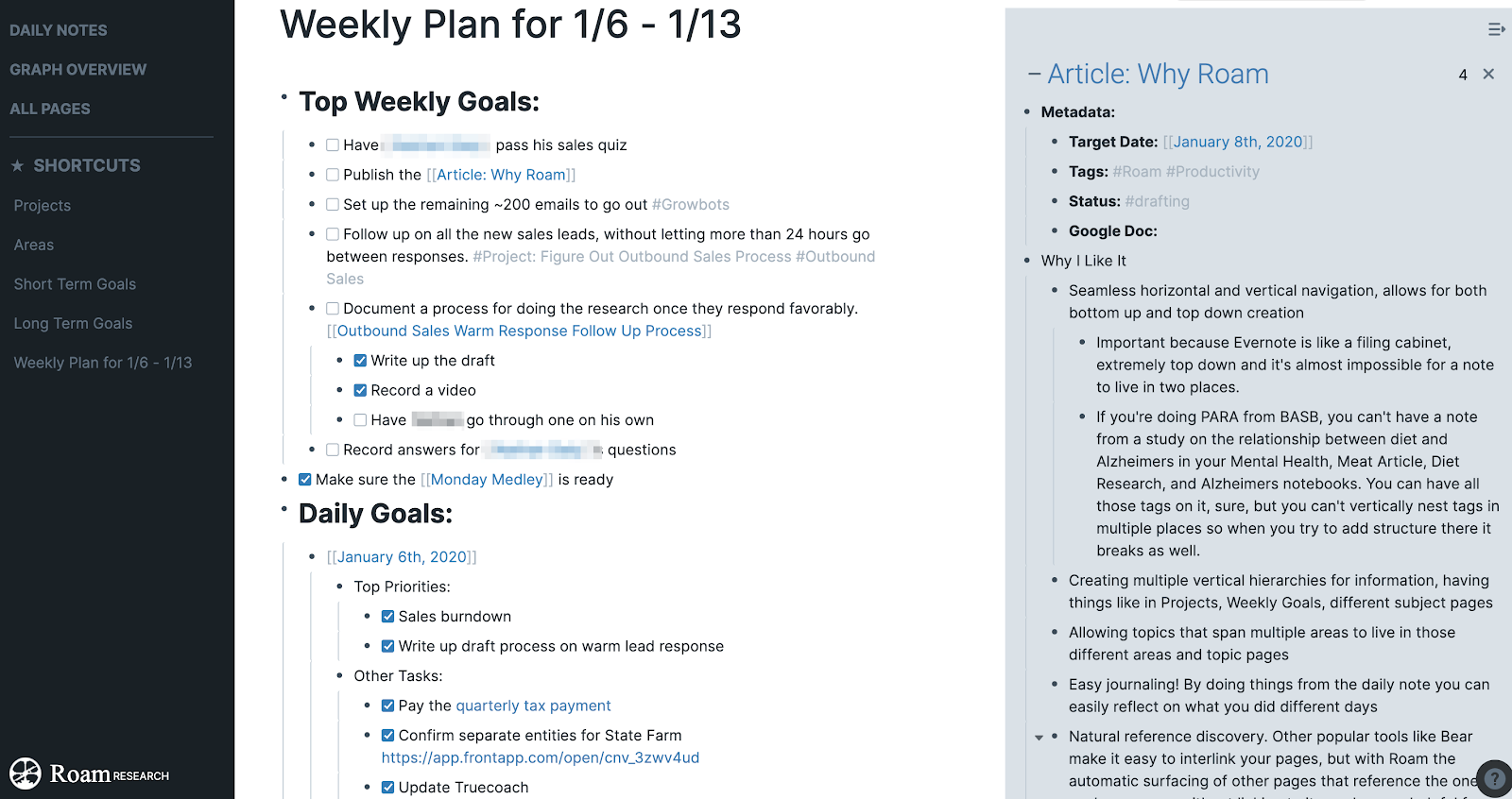
As easy to use as a word document or bulleted list, and as powerful for finding, collecting, and connecting related ideas as a graph database. Collaborate with others in real time, or store all your data locally.
Roam: Why I Love It and How I Use It | Nat Eliason
Author, writer, and creator sharing insights on learning, writing, philosophy, entrepreneurship, and more.
MIRA — the structure layer for a shared research graph
Research ships as a sealed document. MIRAfying it makes a graph of signed, citable records anchored on the actual data artifacts — so analyses compound without flattening the nuance.
A Text Renaissance
There is a renaissance underway in online text as a medium. The Four Horsemen of this emerging Textopia are: Roam , a hypertext publishing platform best…
Common Fabric
A social computing lab. We are building a medium for software that revolves around people, not apps.
Lanyards
One link to make your research life easier to share! Papers, talks, affiliations, socials, whatever... Easy, free, decentralised. A dedicated profile for researchers, built on the AT Protocol.
outl — local-first markdown outliner & LLM second brain
Open-source bullet-point outliner. Plain markdown on disk (no UUIDs), peer-to-peer tree-CRDT sync that doesn't lose data when devices edit offline — your devices talk straight to each other, end-to-end encrypted, no cloud or third-party server holding your notes — and an MCP server so Claude, Cursor and ChatGPT use your notes as a second brain. A modern Roam, Logseq and Obsidian alternative built in Rust.
Conflict-Free Replicated Data Types (CRDTs)
Semble — A social knowledge network for research
Follow your peers' research trails. Surface and discover new connections. Built on ATProto so you own your data.
How to Research Tools for Thought
Metagov x Future of Science Seminar - Discourse Graphs with Matt Akamatsu
Toward Wayfinding Infrastructure for the Living Web · Atlas Research Group
Our world is getting crazier by the day. Our old maps and compasses weren’t made for this complexity. While new tools may open up amazing possibilities, they also make it easier to lose ourselves – especially when they don’t belong to us, and make us vulnerable to other people’s hidden choices and unsavory intentions about what is worth attending to.

Feral Labs – A network of temporary dislocated hubs for research in art, technology and communities.
The Feral Labs Network is a network of temporary dislocated hubs for research in art, technology and communities. It’s members share a common interest in art-science research and contemporary do-it-yourself (DIY) & do-it-with-others (DIWO) communities.
Scholary infrastructure and the research nexus

The research nexus is "a rich and reusable open network of relationships connecting research organisations, people, things, and actions; a scholarly record that the global community can build on forever, for the benefit of society." (crossref.org/documentation/research-nexus/)

How Grobid uses Crossref metadata to enrich bibliographic information - Crossref
Schema 5.5 now available: adding CRediT, new record types for blogs and posters, and more - Crossref
Scholarly blogs and their place in the research nexus - Crossref
Rogue Scholar
SemRepo.org

Science discussions of retracted articles on Bluesky: public scrutiny or misinformation spreading?
