
What happens when the person responsible for supporting everyone else is struggling themselves? A personal reflection on living with depression while leading engineering teams, the emotional cost of projecting confidence, and learning to manage self-doubt, feedback, and mistakes. It explores why effective leadership doesn't require perfection and why seeking professional help shows self-awareness rather than weakness.
The Engineering Manager’s Guide to Emotional Tolerance
Five ways to lead with emotion without losing yourself in the process.

Managing Yourself: What Brain Science Tells Us About How to Excel
Reprint: R1012L Millions of people are struggling at work. Some are in the wrong jobs. Others feel no connection to their colleagues or engagement with their tasks. The result is rampant dissatisfaction and underachievement. Hallowell, a child psychiatrist specializing in learning differences, describes the Cycle of Excellence, a plan for helping people achieve peak performance. It consists of five steps: Select a job that reflects what you like to do and what you do best and that adds value to the organization. Research has shown that good job fit reduces stress and increases satisfaction and performance. Connect with the people around you. Robust relationships in the workplace galvanize people and build their engagement with their jobs. Small talk may seem trivial, but it pays big dividends. Play on the job. It sounds like an oxymoron, but people do their best—and are most satisfied—when they’re imaginatively involved with their work. And when you’re hard at play, you’re building your brain. Grapple and Grow —that is, work hard to achieve a difficult task. The stress you may feel as you engage with a tough assignment and connect with others to complete it is not the toxic kind. Shine in the acknowledgment of your achievements. Praise releases chemicals that make us feel good, and it fills our uniquely human need to be of value, to matter. If you aren’t getting it, ask for it. The need for recognition is fundamental to optimal human performance.
What Amazing Bosses Do Differently
Job satisfaction is often directly related to the relationships we have with our bosses. But how can managers help their employees have satisfying work experiences? Start by managing individuals, not teams, which means personalizing your interactions with individuals and being accessible for one-on-one conversations. Next, go big on meaning: inspire your employees with a vision, set challenging goals, and pump up their confidence so they believe they can win. You should also focus on feedback, using regular – at least weekly – conversations to give lots of coaching. Amazing leaders don’t just talk, they listen. Instead of promoting your own views too strongly, ask questions to enlist your team in generating solutions to problems. Finally, be consistent in your management style, vision, expectations, feedback, and openness to new ideas. These five key practices require attentiveness. Put time into helping your team grow, and the pay-off will be worth it.

Self Awareness: Key to Sustainable Leadership
After in-depth interviews with 170 world leaders and classroom discussions with 6,000 executives and MBAs in Authentic Leadership Development (ALD) at Harvard Business School, we've learned three essential steps to building your self-awareness.

Don't solve problems if you want to be a great manager.
What makes a great manager isn't the problems they solve, but the questions they ask. Start with these 16 questions here.

Why CEOs Don't Want Executive Coaching
Being able to see, understand and deal effectively with others' perspectives is key to successful leadership (as well as personal life). That capacity, part of self-awareness, is empathy. Two recent studies show its crucial role.
The Feedback Fallacy
For years managers have been encouraged to candidly praise and criticize just about everything workers do. But it turns out that feedback does not help employees thrive. First, research shows that people can’t reliably rate the performance of others: More than 50% of your rating of someone reflects your characteristics, not hers. Second, neuroscience reveals that criticism provokes the brain’s “fight or flight” response and inhibits learning. Last, excellence looks different for each individual, so it can’t be defined in advance and transferred from one person to another. It’s also not the opposite of failure. Managers will never produce great performance by identifying what they think is failure and telling people how to correct it. Instead, when managers see a great outcome, they should turn to the person who created it, say, “Yes! That!,” and share their impression of why it was a success. Neuroscience shows that we grow most when people focus on our strengths. Learning rests on our grasp of what we’re doing well, not what we’re doing poorly, and certainly not on someone else’s sense of what we’re doing poorly.

(PDF) Leadership Failure in the Eyes of Subordinates: Perception, Antecedents, and Consequences *
PDF | Effective leaders and leadership behaviors and practices are well-researched areas in the domain of leadership and management. However,... | Find, read and cite all the research you need on ResearchGate

Leadership fails, leadership failures, leaders fail
Leadership fails because leaders fail to connect with each team member in a meaningful way. Leadership failures can have a profound effect on the company.

Random Thoughts on Engineering Management
I have ended up managing people at the last three places I’ve worked, over the last 18 years. I can honestly say that only in the last few years have I really started to embrace the job of managing. Here’s a collection of thoughts and observations: Growth: Ideas and Opinions and Failures Expose your team to new ideas and help them create their own voice. When people get bored or feel they aren’t growing, they’ll look elsewhere. Give people time to explore new concepts, while trying to keep results and outcomes relevant to the project.
The Paradox of Perfection: When ‘Good Enough’ is Actually Better
Exploring the tension between engineering perfectionism and pragmatic delivery. Discover why striving for the perfect solution often prevents us from shipping valuable improvements and how to find the balance.
Simon Sinek: Why good leaders make you feel safe
What makes a great leader? Management theorist Simon Sinek suggests, it's someone who makes their employees feel secure, who draws staffers into a circle of trust. But creating trust and safety -- especially in an uneven economy -- means taking on big responsibility.

Why Good Leaders Fail
The risk of sudden leadership failure can be headed off by early detection of challenges and better supports.

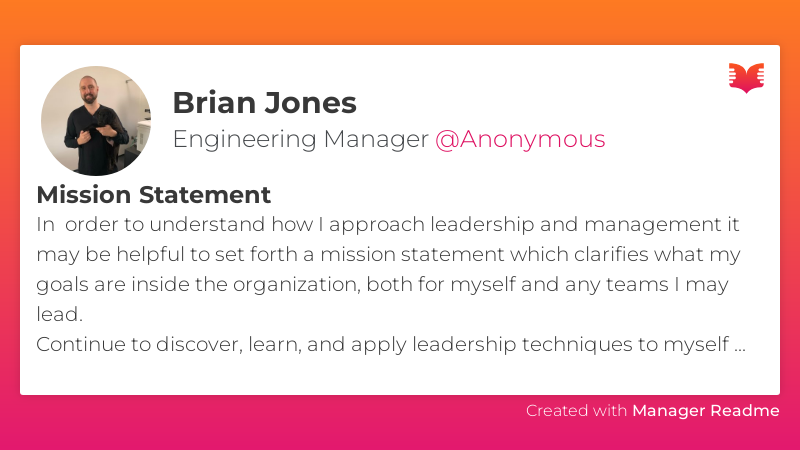
Brian Jones's Manager Readme
Brian Jones, Engineering Manager at Anonymous: Mission Statement In order to understand how I approach leadership and management it may be helpful to set for...
Here’s What Successful People Do When They’re Feeling a Lack of Confidence. (Hint: It’s Not About Working Harder)
Taking action is key.