

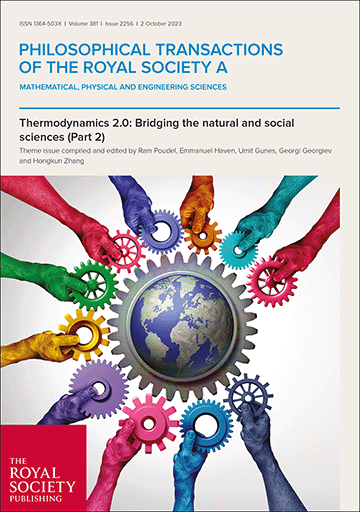
Ludwig Boltzmann suggested that natural selection was fundamentally a struggle among organisms for available energy. Alfred Lotka argued that organisms that capture and use more energy than their competition will have a selective advantage in the evolutionary process, i.e. the Darwinian notion of evolution was based on a fundamental, generalized energy principle. He extended this general principle from the energetics of a single organism or species to the energetics of entire energy pathways through ecosystems. Howard Odum and Richard Pinkerton, building on Lotka, extended this concept to ‘The maximum power principle’ and applied it to many biological and physical systems including human economies. We examine this history and how these ideas relate to concepts from other disciplines including philosophy. But there has been considerable confusion in understanding and applying these concepts which we attempt to resolve while providing various examples from routine life and discussing some unresolved issues. This article is part of the theme issue ‘Thermodynamics 2.0: Bridging the natural and social sciences (Part 2)’.
Maximum power principle
The maximum power principle or Lotka's principle has been proposed as the fourth principle of energetics in open system thermodynamics, where an example of an open system is a biological cell. According to Howard T. Odum, "The maximum power principle can be stated: During self-organization, system designs develop and prevail that maximize power intake, energy transformation, and those uses that reinforce production and efficiency."

Economics for the future – Beyond the superorganism
Our environment and economy are at a crossroads. This paper attempts a cohesive narrative on how human evolved behavior, money, energy, economy and th…
Evolutionary Political Economy: Content and Methods
In this paper we present the major theoretical and methodological pillars of evolutionary political economy. We proceed in four steps. Aesthetics: In chapter 1 the immediate appeal of evolutionary ...

A Drive to Survive
Since 2005, Karl Friston's proposal that the principle of free energy minimization underpins the purposive behavior of living agents has evolved through thou...
Systems of Global Governance in the Era of Human-Machine Convergence
Technology is increasingly shaping our social structures and is becoming a driving force in altering human biology. Besides, human activities already proved to have a significant impact on the Earth system which in turn generates complex feedback loops between social and ecological systems. Furthermore, since our species evolved relatively fast from small groups of hunter-gatherers to large and technology-intensive urban agglomerations, it is not a surprise that the major institutions of human society are no longer fit to cope with the present complexity. In this note we draw foundational parallelisms between neurophysiological systems and ICT-enabled social systems, discussing how frameworks rooted in biology and physics could provide heuristic value in the design of evolutionary systems relevant to politics and economics. In this regard we highlight how the governance of emerging technology (i.e. nanotechnology, biotechnology, information technology, and cognitive science), and the one of climate change both presently confront us with a number of connected challenges. In particular: historically high level of inequality; the co-existence of growing multipolar cultural systems in an unprecedentedly connected world; the unlikely reaching of the institutional agreements required to deviate abnormal trajectories of development. We argue that wise general solutions to such interrelated issues should embed the deep understanding of how to elicit mutual incentives in the socio-economic subsystems of Earth system in order to jointly concur to a global utility function (e.g. avoiding the reach of planetary boundaries and widespread social unrest). We leave some open questions on how techno-social systems can effectively learn and adapt with respect to our understanding of geopolitical complexity.

Frameworks v0.2
FRAMEWORKS v0.2 Many of the thoughts in this document draw on and synthesize concepts from economics, math, physics, chemistry, biology, and psychology. Here are a handful of core concepts that are often relied on as inputs: Activation energy Behavioral economics Cognitive biases Darwinism En...

Howard T. Odum
Howard Thomas Odum (September 1, 1924 – September 11, 2002), usually cited as H. T. Odum, was an American ecologist. He is known for his pioneering work on ecosystem ecology, and for his provocative proposals for additional laws of thermodynamics, informed by his work on general systems theory.
Opinion | Can Evolution Have a ‘Higher Purpose’? (Published 2016)
The biologist William D. Hamilton entertained the notion. So can we.

The ultrasocial origin of the Anthropocene
The current geological epoch has been dubbed the Anthropocene—the age of humans. We argue that the roots of the Anthropocene lie in the agricultural revolution that began some 8000years ago. Unique human psychological and cultural characteristics were present in our distant hunter–gatherer past, but in terms of the biophysical impact of our species, agricultural represented an unequivocal and decisive evolutionary break. With the transition to agriculture human society began to function as a superorganism functioning as a single unit designed by social natural selection to produce economic surplus. Where environmental conditions were permitted, early human agricultural societies followed the same pattern as a few social insects and exhibited explosive population growth, complex and detailed division of labor, intensive resource exploitation, territorial expansion, and a social organization favoring the survival and growth of the supergroup over the well-being of individuals within the group. Similar economic forces lie behind ultrasociality in social insects and humans—increased productivity from the division of labor, increasing returns to scale, and the exploitation of stocks of productive resources. Exploring the evolutionary mechanisms behind ultrasociality offers insights into the growth imperative that threatens the stability of the earth's life support systems.
Ecocivilization: making a world that works for all
""One of the greatest thinkers of our age" (The Guardian) presents a new way of living-one modeled on nature's design instead of capitalism's-for fans of Guns, Germs, and Steel and Doughnut Economics It has often been said that it is easier to imagine the end of the world than it is to imagine the end of capitalism-and yet that is what the historical moment urgently calls for. Climate change has reached an emergency state, inequality continues to grow, and, for many, the future has never seemed more bleak. Incremental policy improvements are no longer enough-we need a deep transformation of our current civilization to continue to survive. In Ecocivilization, leading thinker Jeremy Lent reimagines the basis of our civilization, and argues for a new global system of living, one based on life-affirming principles modeled after nature's own design. What enfolds is a robust framework incorporating Lent's own expertise, and the lived experiences of those on the ground already putting ecological civilization's core tenants into practice-justice, mutuality, diversity, and symbiosis. From the global economy to universal housing and income, from infrastructure to agriculture, every major aspect of our society could be redesigned to work together as a coherent whole, setting the conditions for all people to flourish. Ecocivilization shows how this future on a regenerated Earth is not only desirable, but entirely feasible"--

Mutual Aid: A Factor of Evolution
Mutual Aid: A Factor of Evolution is a 1902 collection of anthropological essays by Russian naturalist and anarchist philosopher Peter Kropotkin. The essays, initially published in the English periodical The Nineteenth Century between 1890 and 1896, explore the role of mutually beneficial cooperation and reciprocity in the animal kingdom and human societies both past and present. It is an argument against theories of social Darwinism that emphasize competition and survival of the fittest, and against the romantic depictions by writers such as Jean-Jacques Rousseau, who thought that cooperation was motivated by universal love. Instead, Kropotkin argues that mutual aid has pragmatic advantages for the survival of human and animal communities and, along with the conscience, has been promoted through natural selection.

« Une minorité privilégiée sacrifie la planète afin de préserver ses richesses et son pouvoir »
TRIBUNE. Le rejet de l’écologie est désormais promu par des gouvernements élus démocratiquement, autoritaires voire fascisants, et soutenus par les milieux d’affaires des énergies fossiles, déplorent trois spécialistes d’écologie politique, dans une tribune au « Monde ».

The Optimization Trap: Why Too Much Efficiency Makes Us Fragile - The Great Simplification
In this episode, Nate is joined by biologist and biophysicist Olivier Hamant to explore why living systems prioritize robustness over performance, and what that means for a civilization built almost entirely in the opposite direction.

Planetary carambolage: The evolutionary political economy of technology, nature and work
The following editorial introduces the special issue (SI) on “Work, Environment and Planetary-scale Computation in Political-Economic Evolution”. Here, however, we go beyond an outline of what each contribution to the SI addresses, and attempt to draw a more pronounced shared embedding of the arguments that have come to the fore. The original idea of this SI was to synthesize a range of contemporary global political-economic challenges, i.e. (1) technology (esp. digital transformation), (2) nature (esp. ecological crisis) and (3) work (esp. precarization via the evolving platform economy). The main argument developed in this editorial reflection focuses on the common ground and origin of those processes found in the complex evolution of capitalist development. We frame the latter by assigning it a new term, i.e. “planetary carambolage”.
Exponential Economist Meets Finite Physicist | Do the Math
[An updated treatment of some of this material appears in Chapter 2 of the Energy and Human Ambitions on a Finite Planet (free) textbook, also mirrors a 2022 article in Nature Physics..]
Une science économique sans pouvoir ?
La notion de pouvoir joue un rôle important dans les sciences sociales. Elle joue un rôle clé en sociologie (notamment dans les travaux de Max Weber et de Pierre Bourdieu) où elle est notamment associée à la notion de domination, en philosophie (notamment...