

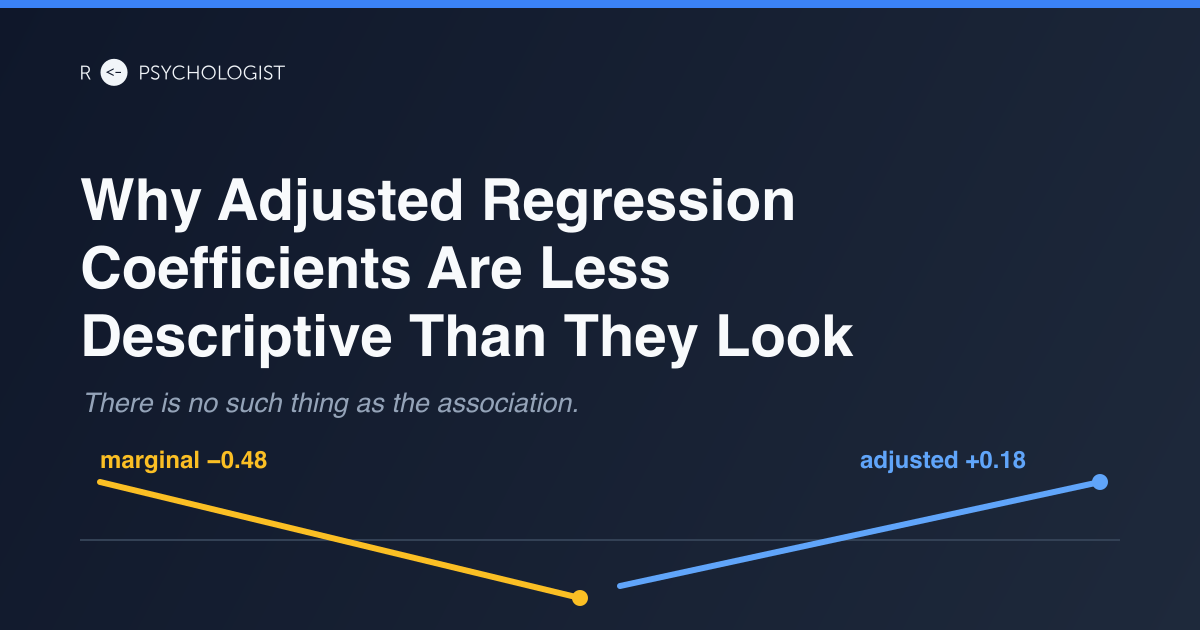
An interactive article about how regression adjustment works and the pitfalls of conditional associations in descriptive studies.
Reducing Bias in Observational Studies Using Subclassification on the Propensity Score
The propensity score is the conditional probability of assignment to a particular treatment given a vector of observed covariates. Previous theoretical arguments have shown that subclassification on the propensity score will balance all observed covariates. Subclassification on an estimated propensity score is illustrated, using observational data on treatments for coronary artery disease. Five subclasses defined by the estimated propensity score are constructed that balance 74 covariates, and thereby provide estimates of treatment effects using direct adjustment. These subclasses are applied within subpopulations, and model-based adjustments are then used to provide estimates of treatment effects within these subpopulations. Two appendixes address theoretical issues related to the application: the effectiveness of subclassification on the propensity score in removing bias, and balancing properties of propensity scores with incomplete data.
New paradigm for psychology just dropped
OR: the ideas your mother warned you about

Disclosure: Psychology Changes Everything
We review literature examining the effects of laws and regulations that require public disclosure of information. These requirements are most sensibly imposed in situations characterized by misaligned incentives and asymmetric information between, for example, a buyer and seller or an advisor and advisee. We review the economic literature relevant to such disclosure and then discuss how different psychological factors complicate, and in some cases radically change, the economic predictions. For example, limited attention, motivated attention, and biased assessments of probability on the part of information recipients can significantly diminish, or even reverse, the intended effects of disclosure requirements. In many cases, disclosure does not much affect the recipients of the information but does significantly affect the behavior of the providers, sometimes for the better and sometimes for the worse. We review research suggesting that simplified disclosure, standardized disclosure, vivid disclosure, and social comparison information can all be used to enhance the effectiveness of disclosure policies.

Addressing Moderated Mediation Hypotheses: Theory, Methods, and Prescriptions
This article provides researchers with a guide to properly construe and conduct analyses of conditional indirect effects, commonly known as moderated mediation effects. We disentangle conflicting d...

mediation: R Package for Causal Mediation Analysis
In this paper, we describe the R package mediation for conducting causal mediation analysis in applied empirical research. In many scientific disciplines, the goal of researchers is not only estimating causal effects of a treatment but also understanding the process in which the treatment causally affects the outcome. Causal mediation analysis is frequently used to assess potential causal mechanisms. The mediation package implements a comprehensive suite of statistical tools for conducting such an analysis. The package is organized into two distinct approaches. Using the model-based approach, researchers can estimate causal mediation effects and conduct sensitivity analysis under the standard research design. Furthermore, the design-based approach provides several analysis tools that are applicable under different experimental designs. This approach requires weaker assumptions than the model-based approach. We also implement a statistical method for dealing with multiple (causally dependent) mediators, which are often encountered in practice. Finally, the package also offers a methodology for assessing causal mediation in the presence of treatment noncompliance, a common problem in randomized trials.

RCTs: Crucial Yet Crucially Limited
RCTs do NOT estimate average effects; they also rarely EXPLAIN that which they have demonstrated.

The C-Word: Scientific Euphemisms Do Not Improve Causal Inference From Observational Data
Causal inference is a core task of science. However, authors and editors often refrain from explicitly acknowledging the causal goal of research projects; they refer to causal effect estimates as associational estimates. This commentary argues that using the term “causal” is necessary to improve the quality of observational research. Specifically, being explicit about the causal objective of a study reduces ambiguity in the scientific question, errors in the data analysis, and excesses in the interpretation of the results.

The central role of the propensity score in observational studies for causal effects
Abstract. The propensity score is the conditional probability of assignment to a particular treatment given a vector of observed covariates. Both large and

“Statistical Significance” and Statistical Reporting: Moving Beyond Binary
Null hypothesis significance testing (NHST) is the default approach to statistical analysis and reporting in marketing and the biomedical and social sciences more broadly. Despite its default role, NHST has long been criticized by both statisticians and applied researchers, including those within marketing. Therefore, the authors propose a major transition in statistical analysis and reporting. Specifically, they propose moving beyond binary: abandoning NHST as the default approach to statistical analysis and reporting. To facilitate this, they briefly review some of the principal problems associated with NHST. They next discuss some principles that they believe should underlie statistical analysis and reporting. They then use these principles to motivate some guidelines for statistical analysis and reporting. They next provide some examples that illustrate statistical analysis and reporting that adheres to their principles and guidelines. They conclude with a brief discussion.

The Dunning-Kruger effect in accessibility - Craig Abbott
Why your confidence in accessibility could be a sign of how little you know

Late Diagnosis, Demographic Shifts, and Narrative Resistance:
A Critical Analysis

Promises and Perils of Pre-analysis Plans
The purpose of this paper is to help think through the advantages and costs of rigorous pre-specification of statistical analysis plans in economics. A pre-analysis plan pre-specifies in a precise way the analysis to be run before examining the data. A researcher can specify variables, data cleaning procedures, regression specifications, and so on. If the regressions are pre-specified in advance and researchers are required to report all the results they pre-specify, data-mining problems are greatly reduced. I begin by laying out the basics of what a statistical analysis plan actually contains so those researchers unfamiliar with it can better understand how it is done. In so doing, I have drawn both on standards used in clinical trials, which are clearly specified by the Food and Drug Administration, as well as my own practical experience from writing these plans in economics contexts. I then lay out some of the advantages of pre-specified analysis plans, both for the scientific community as a whole and also for the researcher. I also explore some of the limitations and costs of such plans. I then review a few pieces of evidence that suggest that, in many contexts, the benefits of using pre-specified analysis plans may not be as high as one might have expected initially. For the most part, I will focus on the relatively narrow issue of pre-analysis for randomized controlled trials.
Introduction to Statistical Mediation Analysis
This volume introduces the statistical, methodological, and conceptual aspects of mediation analysis. Applications from health, social, and developmental psychology, sociology, communication, exercise science, and epidemiology are emphasized throughout. Single-mediator, multilevel, and longitudinal models are reviewed. The author's goal is to help the reader apply mediation analysis to their own data and understand its limitations. Each chapter features an overview, numerous worked examples, a summary, and exercises (with answers to the odd numbered questions). The accompanying CD contains outputs described in the book from SAS, SPSS, LISREL, EQS, MPLUS, and CALIS, and a program to simulate the model. The notation used is consistent with existing literature on mediation in psychology. The book opens with a review of the types of research questions the mediation model addresses. Part II describes the estimation of mediation effects including assumptions, statistical tests, and the construction of confidence limits. Advanced models including mediation in path analysis, longitudinal models, multilevel data, categorical variables, and mediation in the context of moderation are then described. The book closes with a discussion of the limits of mediation analysis, additional approaches to identifying mediating variables, and future directions. Introduction to Statistical Mediation Analysis is intended for researchers and advanced students in health, social, clinical, and developmental psychology as well as communication, public health, nursing, epidemiology, and sociology. Some exposure to a graduate level research methods or statistics course is assumed. The overview of mediation analysis and the guidelines for conducting a mediation analysis will be appreciated by all readers.

Elegant theories and the problems of social psychology
This perspective article provides a commentary on the current state of theories used in social psychology, with a particular emphasis on the importance of distinguishing between theoretical models ...
Why Most Published Research Findings Are False
Summary There is increasing concern that most current published research findings are false. The probability that a research claim is true may depend on study power and bias, the number of other studies on the same question, and, importantly, the ratio of true to no relationships among the relationships probed in each scientific field. In this framework, a research finding is less likely to be true when the studies conducted in a field are smaller; when effect sizes are smaller; when there is a greater number and lesser preselection of tested relationships; where there is greater flexibility in designs, definitions, outcomes, and analytical modes; when there is greater financial and other interest and prejudice; and when more teams are involved in a scientific field in chase of statistical significance. Simulations show that for most study designs and settings, it is more likely for a research claim to be false than true. Moreover, for many current scientific fields, claimed research findings may often be simply accurate measures of the prevailing bias. In this essay, I discuss the implications of these problems for the conduct and interpretation of research.
Measuring Psychobiosocial States in Sport: Initial Validation of a Trait Measure
We examined the item characteristics, the factor structure, and the concurrent validity of a trait measure of psychobiosocial states. In Study 1, Italian athletes (N = 342, 228 men, 114 women, Mage = 23.93, SD = 6.64) rated the intensity, the frequency, and the perceived impact dimensions of a psychobiosocial states scale, trait version (PBS-ST), which is composed of 20 items (10 functional and 10 dysfunctional) referring to how they usually felt before an important competition. In Study 2, the scale was cross validated in an independent sample (N = 251, 181 men, 70 women, Mage = 24.35, SD = 7.25). The concurrent validity of the PBS-ST scale scores were also examined in comparison with two sport-specific emotion-related measures and a general measure of affect. Exploratory structural equation modeling and confirmatory factor analysis of the data of Study 1 showed that a 2-factor, 15-item solution of the PBS-ST scale (8 functional items and 7 dysfunctional items) reached satisfactory fit indices for the three dimensions (i.e., intensity, frequency, and perceived impact). Results of Study 2 provided evidence of substantial measurement and structural invariance of all dimensions across samples. The low association of the PBS-ST scale with other measures suggests that the scale taps unique constructs. Findings of the two studies offer initial validity evidence for a sport-specific tool to measure psychobiosocial states.