Summary The opinion polls that were undertaken before the 2015 UK general election underestimated the Conservative lead over Labour by an average of 7 percentage points. This collective failure led politicians and commentators to question the validity and utility of political polling and raised concerns regarding a broader public loss of confidence in survey research. We assess the likely causes of the 2015 polling errors. We begin by setting out a formal account of the statistical methodology and assumptions that are required for valid estimation of party vote shares by using quota sampling. We then describe the current approach of polling organizations for estimating sampling variability and suggest a new method based on bootstrap resampling. Next, we use poll microdata to assess the plausibility of different explanations of the polling errors. Our conclusion is that the primary cause of the polling errors in 2015 was unrepresentative sampling.
Election polling errors across time and space
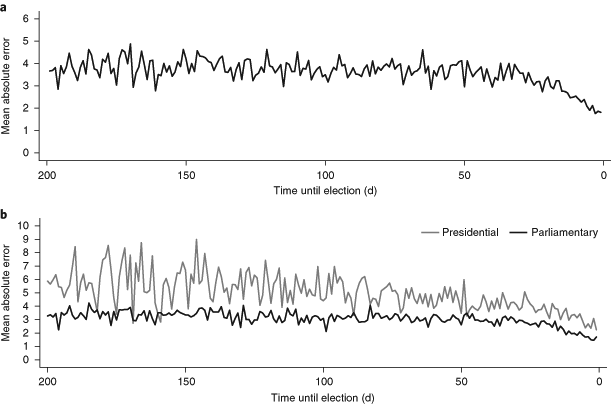
Are election polling misses becoming more prevalent? Are they more likely in some contexts than others? Here we undertake an over-time and cross-national assessment of prediction errors in pre-election polls. Our analysis draws on more than 30,000 national polls from 351 general elections in 45 countries between 1942 and 2017. We proceed in the following way. First, building on previous studies, we show how errors in national polls evolve in a structured way over the election timeline. Second, we examine errors in polls in the final week of the election campaign to assess performance across election years. Third, we undertake a pooled analysis of polling errors—controlling for a number of institutional and party features—that enables us to test whether poll errors have increased or decreased over time. We find that, contrary to conventional wisdom, the recent performance of polls has not been outside the ordinary. However, the performance of polls does vary across political contexts and in understandable ways.
The Twilight of the Polls? A Review of Trends in Polling Accuracy and the Causes of Polling Misses
Polls have had a number of high-profile misses in recent elections. We review the current polling environment, the performance of polls in a historical context, the mechanisms of polling error, and the causes of several recent misses in Britain and the US. Contrary to conventional wisdom, polling errors have been constant over time, although the level of error has always been substantially beyond that implied by stated margins of error. Generally, there is little evidence that voters lying about their vote intention (so-called ‘shy’ voters) is a substantial cause of polling error. Instead, polling errors have most commonly resulted from problems with representative samples and weighting, undecided voters breaking in one direction, and to a lesser extent late swings and turnout models. We conclude with a discussion of future directions for polling both in terms of fixing the problems identified and new approaches to understanding public opinion.
The Performance of the Polls in the 2019 General Election - British Polling Council
The Performance of the Polls in the 2019 General Election
Why does every poll seem to show a tossup now?
Campaigns see internal polls as tools for fundraising
Opinion | This Is What Will Ruin Public Opinion Polling for Good
Instead of navigating the obstacles to conduct polls with human respondents, pollsters are running A.I. simulations instead. Why?

Do AI and bogus respondents threaten polling’s future?
Courtney Kennedy, vice president of methods and innovation, answers some common questions about the current polling landscape in the U.S.

Why Are American Presidential Election Campaign Polls so Variable When Votes Are so Predictable?
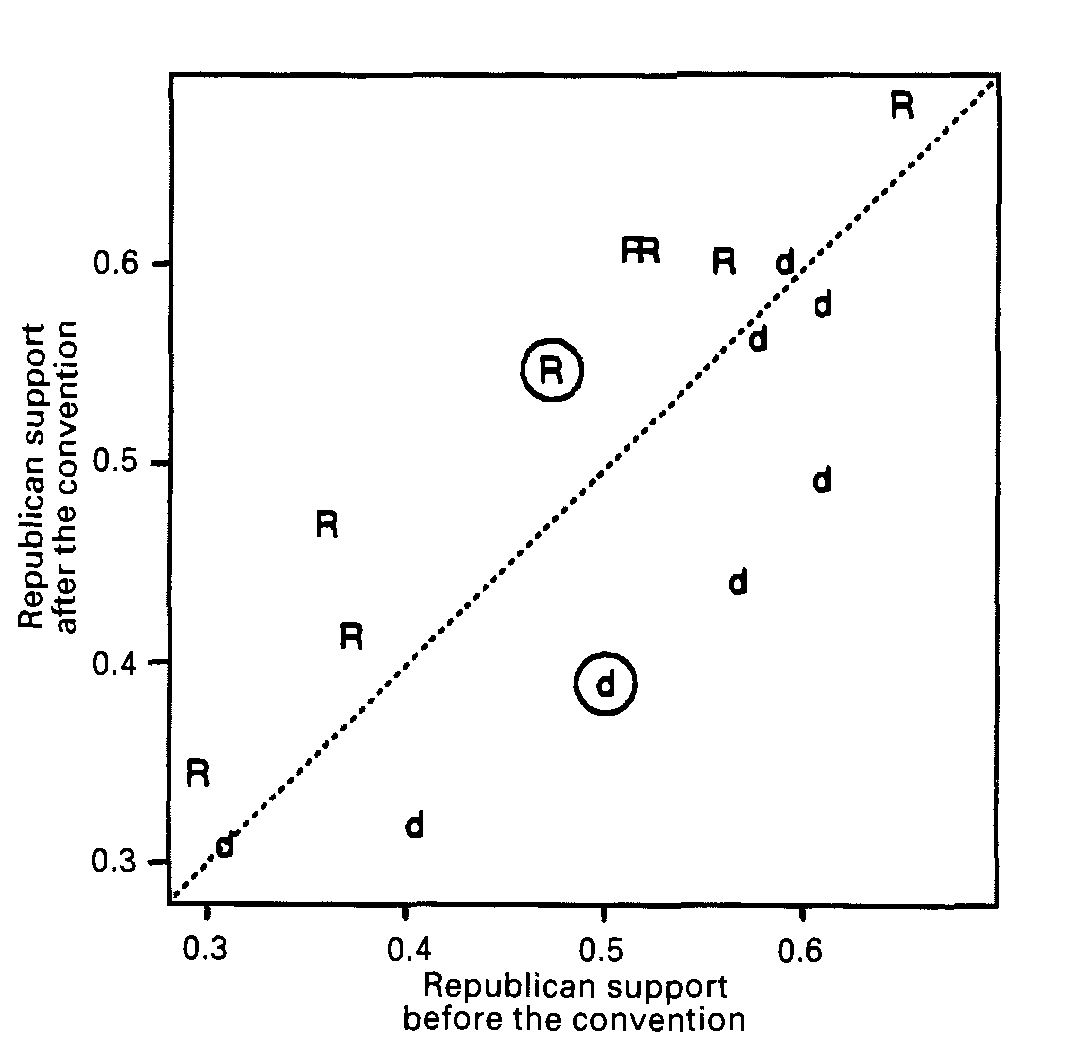
As most political scientists know, the outcome of the U.S. Presidential election can be predicted within a few percentage points (in the popular vote), based on information available months before the election. Thus, the general election campaign for president seems irrelevant to the outcome (except in very close elections), despite all the media coverage of campaign strategy. However, it is also well known that the pre-election opinion polls can vary wildly over the campaign, and this variation is generally attributed to events in the campaign. How can campaign events affect people's opinions on whom they plan to vote for, and yet not affect the outcome of the election? For that matter, why do voters consistently increase their support for a candidate during his nominating convention, even though the conventions are almost entirely predictable events whose effects can be rationally forecast? In this exploratory study, we consider several intuitively appealing, but ultimately wrong, resolutions to this puzzle, and discuss our current understanding of what causes opinion polls to fluctuate and yet reach a predictable outcome. Our evidence is based on graphical presentation and analysis of over 67,000 individual-level responses from forty-nine commercial polls during the 1988 campaign and many other aggregate poll results from the 1952–1992 campaigns. We show that responses to pollsters during the campaign are not generally informed or even, in a sense we describe, "rational." In contrast, voters decide which candidate to eventually support based on their enlightened preferences, as formed by the information they have learned during the campaign, as well as basic political cues such as ideology and party identification. We cannot prove this conclusion, but we do show that it is consistent with the aggregate forecasts and individual-level opinion poll responses. Based on the enlightened preferences hypothesis, we conclude that the news media have an important effect on the outcome of Presidential elections–-not due to misleading advertisements, sound bites, or spin doctors, but rather by conveying candidates' positions on important issues. Winner of the Pi Sigma Alpha Awardfor the best paper at the previous year's meetings of the Midwest Political Science Association. Replication data at the Harvard Dataverse: [https://doi.org/10.7910/DVN/I7GIKD](https://doi.org/10.7910/DVN/I7GIKD).
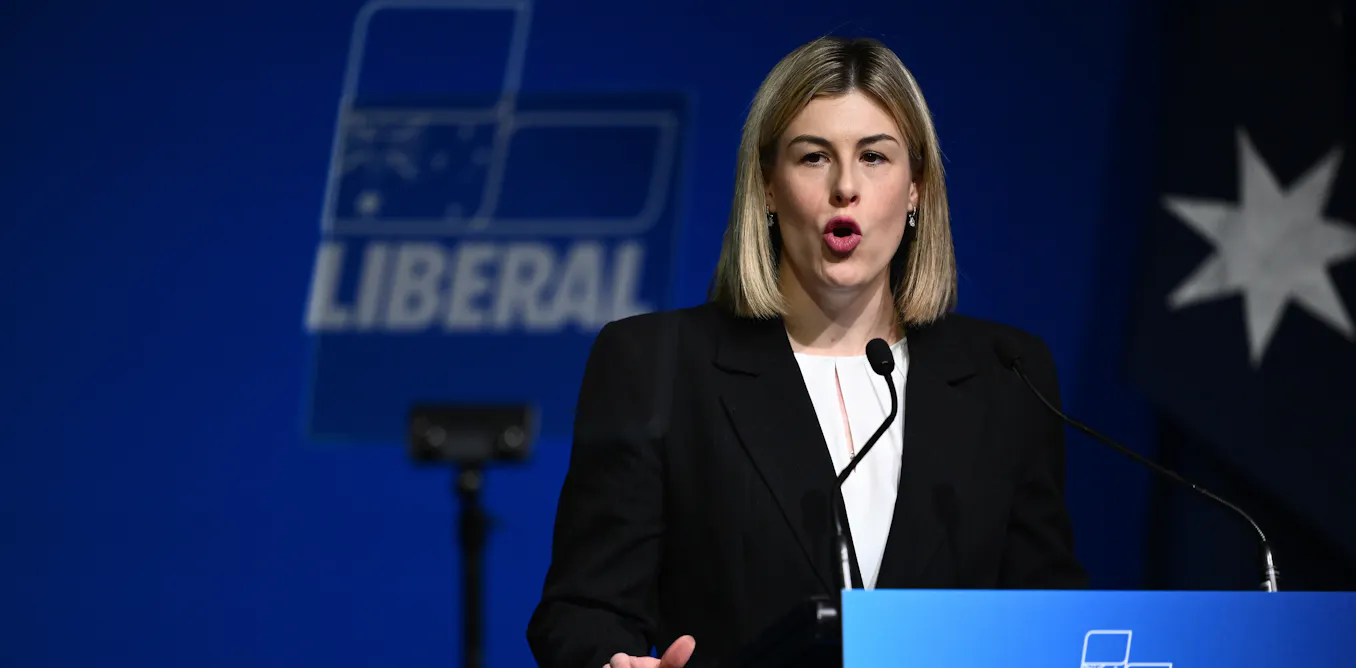
Victorian polls have Coalition leading Labor by narrow to large margins
About three months out from the Victorian state election, the five polls released since the state got a new premier all show the Coalition in front.
Left-Wing Governments and Far-Right Success
In recent decades, support for the far right has surged in many countries. One common explanation for this is that far-right support is a backlash against left-wing governments and their policies. We investigate the causal effect of the partisan make-up of governments on the electoral results of far-right parties. Evidence from over-time comparative data and a quasi-experimental analysis based on a regression discontinuity design in Spain indicates that far-right parties benefit electorally when the current government is on the left. In further analyses, we employ a novel regression discontinuity design (RDD)-based sampling strategy to examine original individual-level survey data from Spanish municipalities close to the discontinuity cutoff. These data show that the likely mechanism underlying the backlash effect is an ideological shift to the right among the electorate when left-wing parties govern. Overall, the far right benefits more when the mainstream left governs than when the mainstream right does.

How to Run Surveys: A Guide to Creating Your Own Identifying Variation and Revealing the Invisible
Surveys are an essential approach for eliciting otherwise invisible factors such as perceptions, knowledge and beliefs, attitudes, and reasoning. These factors are critical determinants of social, economic, and political outcomes. Surveys are not merely a research tool. They are also not only a way of collecting data. Instead, they involve creating the process that will generate the data. This allows the researcher to create their own identifying and controlled variation. Thanks to the rise of mobile technologies and platforms, surveys offer valuable opportunities either to study broadly representative samples or to focus on specific groups. This article offers guidance on the complete survey process, from the design of the questions and experiments to the recruitment of respondents and the collection of data to the analysis of survey responses. It covers issues related to the sampling process, selection and attrition, attention and carelessness, survey question design and measurement, response biases, and survey experiments.

FiftyPlusOne - Latest Political Polls and Averages
A comprehensive list of polls and polling averages for elections and politician approval.

FiftyPlusOne - Latest Political Polls and Averages
A comprehensive list of polls and polling averages for elections and politician approval.
When Do Parties Lie? Misinformation and Radical-Right Populism Across 26 Countries
The spread of misinformation has emerged as a global concern. Academic attention has recently shifted to emphasize the role of political elites as drivers of misinformation. Yet, little is known of the relationship between party politics and the spread of misinformation—in part due to a dearth of cross-national empirical data needed for comparative study. This article examines which parties are more likely to spread misinformation, by drawing on a comprehensive database of 32M tweets from parliamentarians in 26 countries, spanning 6 years and several election periods. The dataset is combined with external databases such as Parlgov and V-Dem, linking the spread of misinformation to detailed information about political parties and cabinets, thus enabling a comparative politics approach to misinformation. Using multilevel analysis with random country intercepts, we find that radical-right populism is the strongest determinant for the propensity to spread misinformation. Populism, left-wing populism, and right-wing politics are not linked to the spread of misinformation. These results suggest that political misinformation should be understood as part and parcel of the current wave of radical right populism, and its opposition to liberal democratic institution.

The Internet Doesn’t Have to Be Bad for Democracy
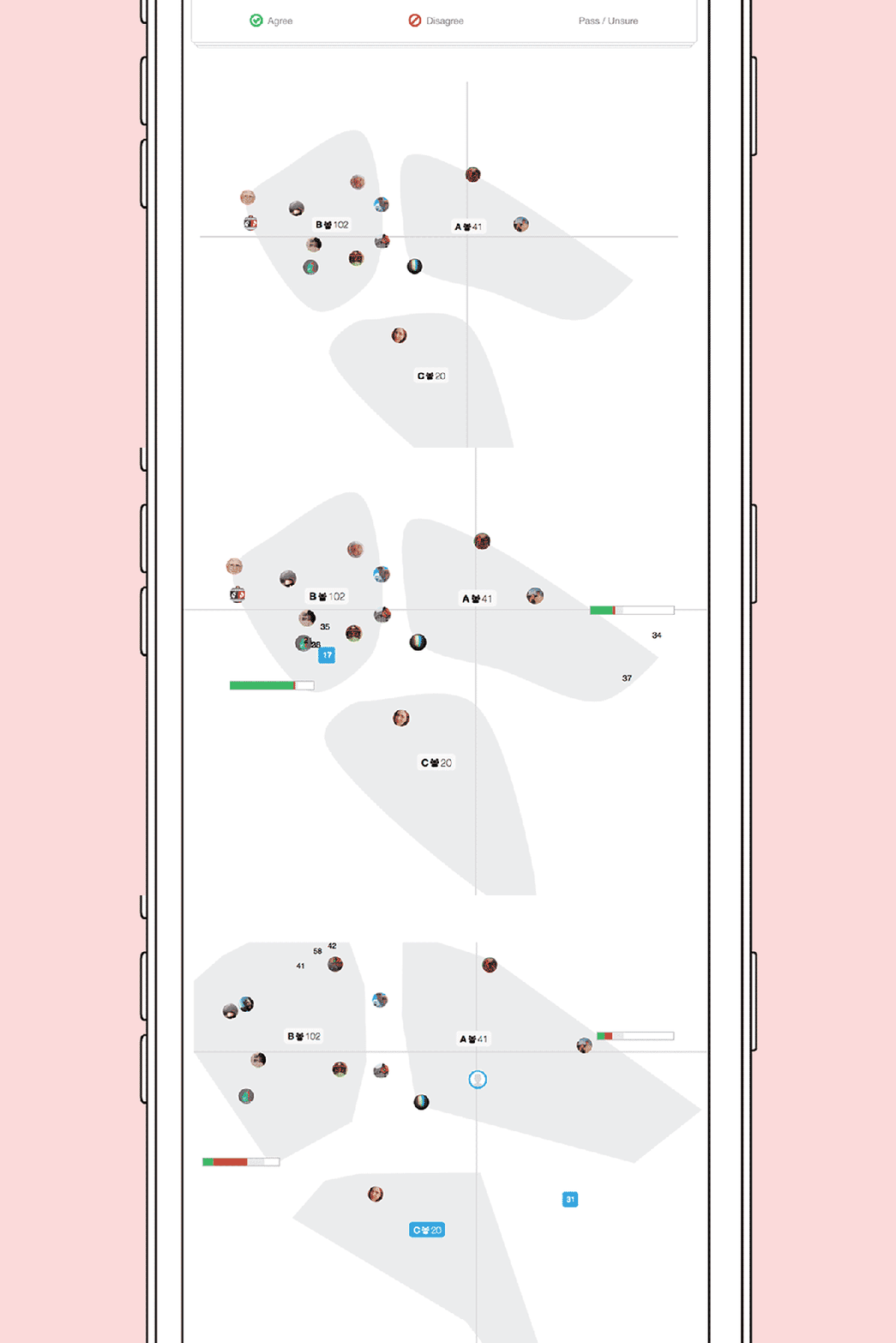
A new form of online survey uses crowdsourcing and data visualization to reveal the hidden nuances in partisan debates.
Simulating Aggregate Electoral Opinion Trajectories with LLM Personas and Media Exposure
LLM-based election simulation has largely been evaluated against a single final outcome, in many cases neglecting how much it can recover the trajectory shaped by media exposure and shifting candidate support. We propose evaluating election simulations in terms of trajectory fidelity: whether persona-conditioned LLM agents can update their beliefs in response to media to reproduce the temporal movement of public opinion, both in aggregate and across demographic subgroups. We design a framework in which each LLM agent carries its belief across time and updates it as new campaign information arrives. We further investigate how performance can vary across simulation design choices such as media exposure model, election context, and survey questionnaire. In a study on the 2026 Seoul mayoral and local elections, we validate simulated trajectories against weekly public-opinion polls and find that simulations that carry prior beliefs across time—rather than simulating each poll date independently—substantially improves alignment with observed polling movement, while the way media exposure is personalized leaves aggregate movement largely intact but reshapes subgroup-level dynamics. We propose a framework for validating simulated opinion trajectories against real-world traces, and discuss the simulation design choices that can influence the performance.
Victoria Poll Briefing, August 2026
The first DemosAU/PremierNational Victorian poll since Ben Carroll replaced Jacinta Allan, with the Coalition leading 55–45 after preferences.