The answer to these questions varies with different degrees of decentralization:
The Web3 Decentralization Debate Is Focused on the Wrong Question
Fixating on the degree—rather than the type—of decentralization is leading us astray.

Practical Decentralization
The point of decentralization is to guarantee the rights of individuals and communities on the Internet. Pulling that off is a balancing act between practicality and ideology.
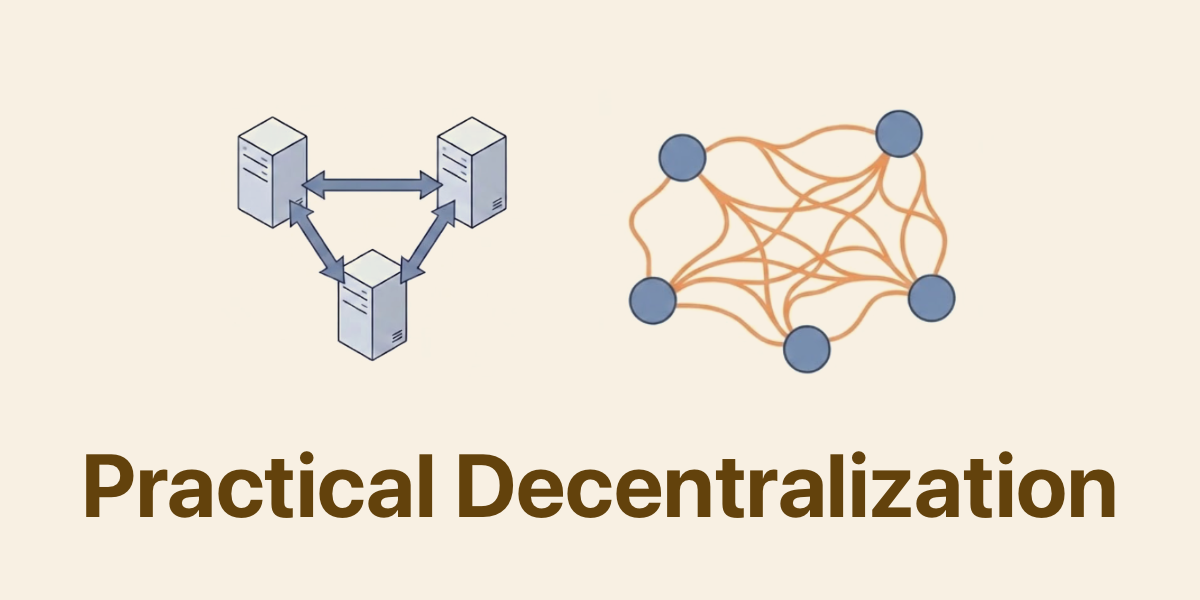
Practical Decentralization
The point of decentralization is to guarantee the rights of individuals and communities on the Internet. Pulling that off is a balancing act between practicality and ideology.
The Debate Over DWeb vs. Web3 & The Decentralized Elephant in the Room | FFDW
Comparing DWeb and Web3's approaches to decentralization, focusing on the key question: who designs, controls, and benefits from these technologies?

Decentralisation: the next big step for the world wide web
The decentralised web, or DWeb, could be a chance to take control of our data back from the big tech firms. So how does it work and when will it be here?

Web3 is not decentralization
It's just not. Here's a deep dive into why, exactly, I think that.

Locking the Web Open: A Call for a Decentralized Web | Brewster Kahle's Blog
(Short form article, Short lecture, Long lecture, demo of a fraction of the idea of a distributed website (or paste this link in maelstrom))
01 - Decentralized Web: An Introduction - Resource Guide
This resource guide was created to accompany Session 01 of the Webinar Series Imagining a Better Online World: Exploring the Decentralized Web. This session introduced essential DWeb concepts to library workers through demonstrations, resources, and examples of decentralized technologies in action. A video recording of this session has been archived by the Internet Archive and it can be viewed here.

Centralization, Decentralization, and Internet Standards
Despite being designed and operated as a decentralized network-of- networks, the Internet is continuously subjected to forces that encourage centralization. This document offers a definition of centralization, explains why it is undesirable, identifies different types of it, catalogues limitations of common approaches to decentralization, and explores what Internet standards efforts can do to address it.
Protocol: How Control Exists after Decentralization
How Control Exists after DecentralizationIs the Internet a vast arena of unrestricted communication and freely exchanged information or a regulated, highly
Department of Decentralization | Department of Decentralization
The website for the Department of Decentralization

Decentralized web movement imagines 'a web with many winners' that puts community first
Mai Ishikawa Sutton and Alicia Urquidi Díaz discuss the vision behind the movement known as DWeb, and how the decentralized web combines the community aspect of the '90s online experience with today's equity and accessibility principles.

Decentralizing the Economic Power of the Web (A Reading List)
We recently hosted a panel discussion as part of our MozFest’s Dialogues & Debates series focused on interrogating the web’s reigning business model — d…

DWeb
These principles define the values of a decentralized web based on enabling agency of all peoples. It is the basis for behavioral norms and mutual accountability.
DWeb
These principles define the values of a decentralized web based on enabling agency of all peoples. It is the basis for behavioral norms and mutual accountability.
The ecosystem is moving
Considerations for distributed and decentralized technologies from the perspective of a product that many would like to see decentralize....