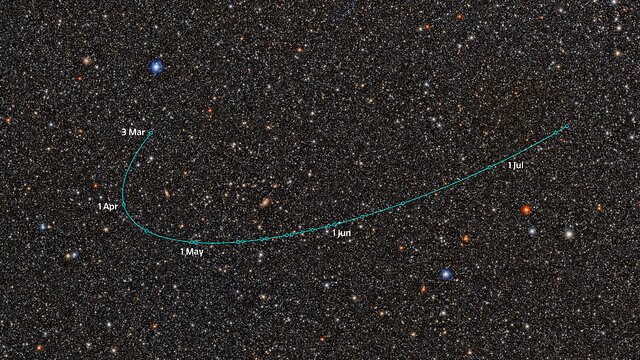
In the outer reaches of our Solar System, beyond the orbit of Pluto, NSF–DOE Vera C. Rubin Observatory has spotted 2026 ED138 — a large, bright trans-Neptunian object that scientists have identified as a dwarf planet candidate. The observations were announced today by the International Astronomical Union Minor Planet Center (MPC). If confirmed, ED138 would be among the largest dwarf planets ever discovered in this region of the Solar System.
— 2026 ED138
2026 ED138 is a large, bright trans-Neptunian object and dwarf planet candidate discovered in 2026 by scientists using data from NSF–DOE Vera C. Rubin...
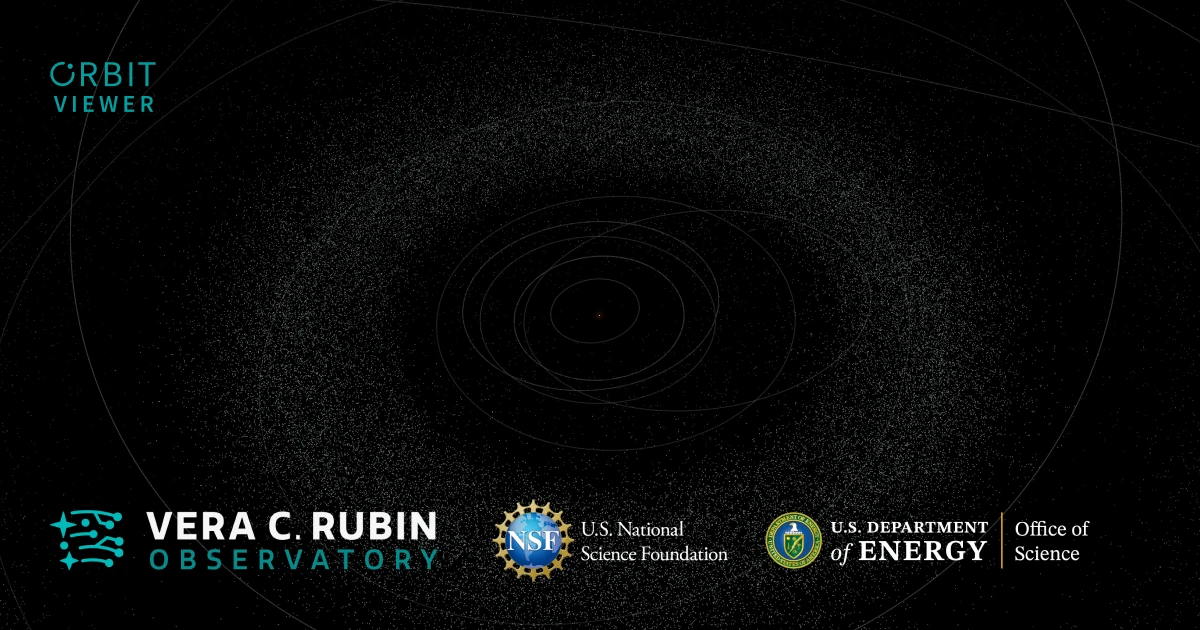
Solar System
The Solar System is the gravitationally bound system of the Sun and the masses that orbit it, most prominently its eight planets, of which Earth is one. The system formed about 4.6 billion years ago when a dense region of a molecular cloud collapsed, creating the Sun and a protoplanetary disc from which the orbiting bodies assembled.


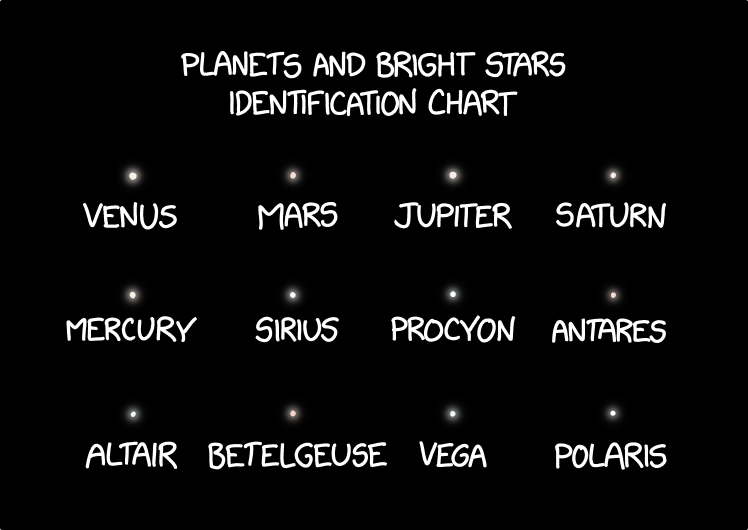
Planets and Bright Stars
This work is licensed under a Creative Commons Attribution-NonCommercial 2.5 License.
The Daily Planet #125 - The Daily Planet

da-luce/astroterm
A planetarium for your terminal! Explore stars, planets, constellations, and more, all rendered right in the command line—no telescope required. ✨🪐
Space Now — the Solar System in 3D
A live 3D map of the Solar System in your browser: planets, moons, asteroids, comets, the ISS and thousands of Earth satellites — right where they are now. NASA JPL and CelesTrak data, updated daily.
NASA's New Mission Will Try to Map the Heliosphere After Voyager's Exit - Slashdot
The heliosphere "plays a major role in why life is possible on our planet," reports CNN, "and how it perhaps once existed on others such as Mars." (Basically solar winds create "a constant flow of charged particles" that form "an enormous bubble that protects the planets in our solar system from c...

Eyes on the Solar System - NASA/JPL
Explore the 3D world of the Solar System. Learn about past and future missions.
The Coming Second Copernican Revolution | NOEMA
Astrobiology is rewiring our understanding of the intimate connection between life and planets as they appear in the universe.
National Data Platform Receives NSF Category I Award to Expand AI-Ready Data Infrastructure for U.S.
UC San Diego researchers will lead a collaborative project to expand a national platform connecting data, computing and AI resources to empower nationwide researchers and educators.

Figure 9: The radiance curves of several LEDs useful to mimic the Black...
Download scientific diagram | The radiance curves of several LEDs useful to mimic the Black Body representative of the M stars (from M0 to M8 spectral type). The absorption spectra of several photosynthetic bacteria are also shown. from publication: Simulating super earth atmospheres in the laboratory | Several space missions, such as JWST, TESS and the very recently proposed ARIEL, or ground-based experiments, as SPHERE and GPI, have been proposed to measure the atmospheric transmission, reflection and emission spectra of extrasolar planets. The planet atmosphere... | Atmosphere, Earth and Extrasolar Planets | ResearchGate, the professional network for scientists.

The Daily Planet #119: On Deep Time - The Daily Planet
NSF announces new initiative to launch and scale a new generation of transformative independent research organizations to advance breakthrough science
The U.S. National Science Foundation Directorate for Technology, Innovation and Partnerships (NSF TIP) on Friday announced the launch of a new initiative designed to launch and scale a new generation…